
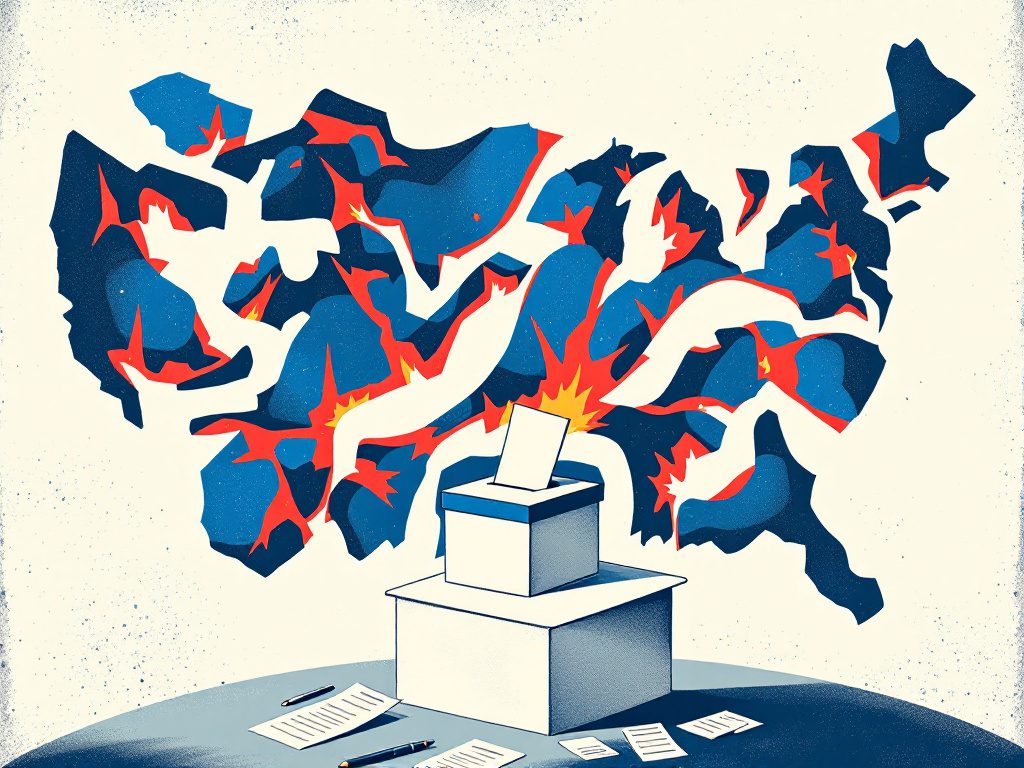
You might think of electoral maps as neutral tools in democracy, fairly representing public opinion and civic participation. However, imagine instead that these maps, originally intended to ensure equal representation, become strategic chessboards for partisan powers. In this reality, the seemingly dull practice of drawing electoral districts takes center stage, profoundly shaping American democracy.
The Nuanced Battle Against Gerrymandering
Researchers at Binghamton University are shining a spotlight on this very struggle, describing gerrymandering with a striking metaphor — “an electoral illness” diagnosed using complex statistical tools. Their recent study, “Assessing Gerrymandering After the 2020 Census,” reveals some discomforting findings: statistically sophisticated methods used to detect distorted maps can perversely facilitate drawing ever more precise gerrymanders. This creates a troubling dynamic of escalating sophistication, a sort of “arms race” within electoral map drawing. According to the study, clear gerrymandering evidence is present in four states, moderately mixed results in 21 others, while only 12 states remain untouched by partisan manipulation.
This isn’t just academic curiosity. Electoral districts profoundly impact representation—determining which communities have a voice or are marginalized. According to political scientists Daniel Magleby and Michael McDonald, gerrymandering significantly skews electoral results, undermining democratic integrity. If left unchecked, it threatens to further erode public trust in democratic institutions.
States Step Into the Breach
A turning point in combating gerrymandering was reached in 2019 when the Supreme Court made a controversial decision. By ruling that federal courts could not adjudicate disputes over partisan gerrymandering, the Court essentially dismantled a crucial line of defense against distorted electoral practices. This disturbing precedent set the stage for intensified partisan redistricting battles at the state level. Far from resolving the issue, this ruling thrust responsibility—and controversy—onto state legislatures and local courts, significantly weakening federal oversight.
According to election experts, the impact of this ruling is continuing to unfold. While some states may proactively introduce measures to protect fairness, others might exploit this newfound freedom to solidify partisan advantages. A closer look at recent legislative actions in states reveals this ongoing struggle. New Jersey, previously criticized for its “county line” ballot system that systematically favored party-endorsed candidates, offers a ray of hope. There, Democratic Governor Phil Murphy signed into law NJ S4142, replacing party-centric ballots with a more inclusive office-block structure. Critics argued that county lines effectively marginalized those without party backing, relegating them to so-called ballot “Siberia.” By abolishing this system, New Jersey opened the door to more equitable candidate representation, creating a healthier democratic environment where voter choice matters more than party loyalty.
“By shifting focus to individual office and the merits of candidates, rather than party backing, New Jersey’s new law could become a catalyst influencing election laws nationwide.”
Urgency and Hope for the Future
Still, vigilance remains essential. In other states, reforms face resistance or partial reversals. Utah’s recent moves to alter its acclaimed vote-by-mail system exemplify this: now voters must opt into mail-in voting and comply with new ID verification requirements, raising concerns from both parties that fewer citizens might engage in elections.
Historically, gerrymandering has existed nearly as long as America itself. Its name derives from Governor Elbridge Gerry, who in 1812 endorsed a politically manipulated district shaped oddly like a salamander—hence, “Gerrymander.” This practice intensified dramatically from the mid-20th century onward, especially with advances in computing power and data analytics. The sophisticated tools originally intended to detect gerrymandering now help parties engineer electoral maps precisely for maximum benefit, frustrating democratic transparency.
Yet amid bleak scenarios, the ongoing grassroots response offers glimmers of hope. Public awareness campaigns and movements advocating for independent redistricting commissions grow stronger, underscoring that active civic engagement is crucial in combatting electoral manipulation.
For voters, this presents both urgency and opportunity. Becoming involved in local politics, supporting legislation against gerrymandering, and choosing representatives committed to electoral fairness are essential engagements. Political scientists reinforce that transparent electoral processes heavily influence the effectiveness of governance, the accuracy of representation, and voter trust—critical components of a functioning democracy.
Ultimately, there’s a lesson here for both legislators and citizens alike: Ensuring democratic fairness isn’t only a matter of ethical principle; it’s a necessary precondition for political stability and social equity. Truly fair elections should be an uncontroversial goal, and the evolving pushback against gerrymandering demonstrates many voters recognize its importance.
For America’s democracy, the stakes could hardly be higher. Will states step up responsibly, making electoral justice a priority, or will partisan manipulation continue unabated? In this essential battle for the nation’s democratic health, the choice lies in your hands.
