
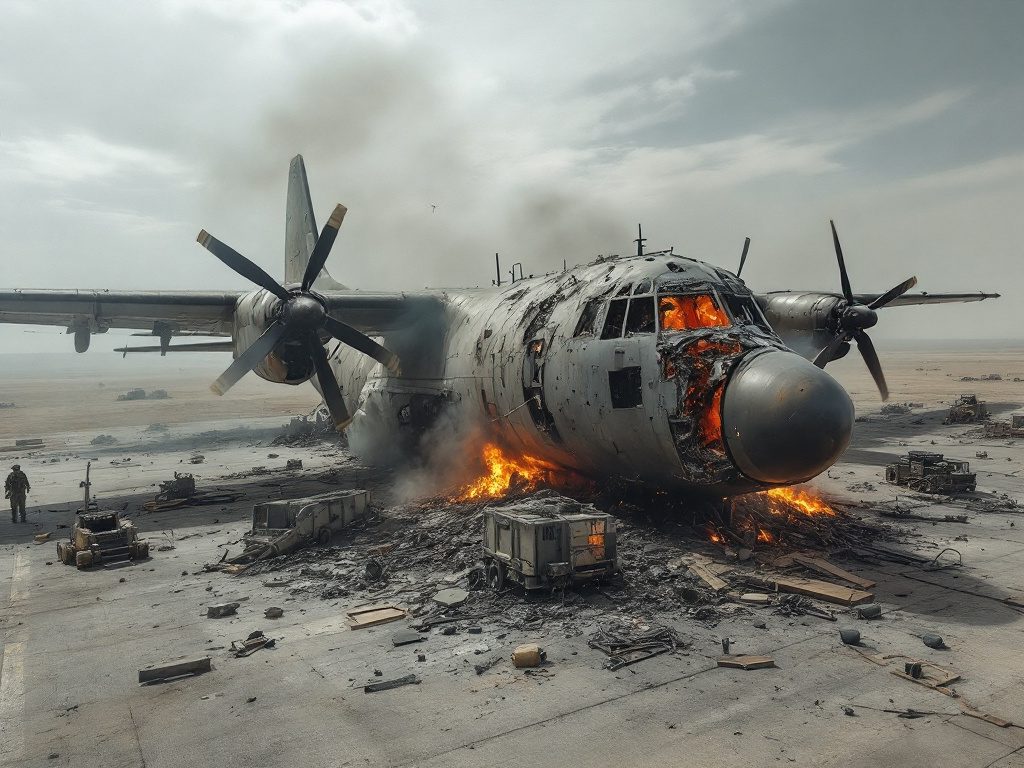
An Audacious Strike Amid Ongoing Conflict
The strategic landscape of the Russia-Ukraine war received a vital jolt earlier this week when Ukraine successfully deployed a drone to destroy a valuable Russian Tu-22M3 strategic bomber. Valued at approximately $100 million, this super-sonic aircraft was taken down immediately after it landed, emphasizing Ukraine’s rapidly evolving proficiency in drone warfare.
Commander-in-Chief Oleksandr Syrskyi revealed the significance of this action in his recent interview with Lb.ua, underscoring the growing strategic advantage that drone technology offers to Ukrainian forces. This event starkly contradicts the Russian Defense Ministry’s claim that the aircraft’s destruction resulted from a mechanical malfunction, which conveniently diverts attention away from Ukraine’s military successes.
But just how critical was this particular aircraft to Russia’s military objectives?
The Loss of an ‘Aircraft Carrier Killer’
The Tu-22M3, built by the Tupolev Design Bureau during the Cold War era, is not merely a standard bomber but an exceptionally potent military platform. Equipped to carry lethal Kh-22 anti-ship missiles, this bomber is frequently dubbed an “aircraft carrier killer,” highlighting its specialized capacity to target and disable naval assets at great distances. Losing a bomber of this caliber significantly undermines Russia’s naval and aerial capabilities, weakening their potential influence across critical maritime regions as well.
Commander Syrskyi stressed the growing threat posed by Ukrainian drone capabilities, indicating the strategic restrictions now faced by Russia: “The Russian bomber fleet is largely restricted to Novorossiysk due to the threat of Ukrainian strikes.” This geographic constraint illustrates Ukraine’s evolving military strategy focused on restraining and incapacitating Russia’s powerful aerial assets, effectively grounding their feared aerial projection of power.
This incident also underscores the tactical wisdom behind Ukraine’s decision to invest significantly in drone technology. Ukrainian drone operations not only allow for precision strikes but also minimize personnel risks compared to traditional aerial bombing missions. With every successful strike like this one, Ukraine continues to chip away at Russia’s formidable military arsenal.
“Drone warfare is reshaping modern conflict—allowing Ukraine to punch well above its weight. With precision and persistence, Ukraine is challenging Russia’s strategic air superiority and fundamentally shifting the balance of tactical advantage.”
Historical Resonance and Strategic Shifts
Designed in the late 1960s and produced until 1993, the Tu-22M3 marked decades of Russian military aviation history, typifying the robust military industrial complex inherited from the Soviet era. Through numerous global conflicts and Cold War tensions, this aircraft symbolized a form of Russian pride and military intent. Its destruction signifies more than merely a temporary setback; it symbolizes Ukraine’s resilience and their capacity to alter tactical narratives in lasting ways.
Beyond tactical value, the psychological impact on Russian forces cannot be overstated. Every successful strike against sophisticated and high-valued Russian military equipment fuels morale among Ukrainian troops while simultaneously demoralizing Russian operators and their command structure. For Ukraine, each drone strike victory like this isn’t just a singular strategic win—it’s part of a broader campaign of attrition, steadily increasing operational pressure on Russian forces.
It is noteworthy that details about this significant loss weren’t promptly reflected in the General Staff’s earlier reports. This delay points either to an intentional military information strategy—a cautious move during ongoing operations—or potential communication lags within Russia’s armed forces. Either way, this slow response reveals internal fissures that Ukraine could further exploit as long as drone warfare continues successfully.
Harvard military analyst Dr. Rebecca Holloway notes, “Failures to rapidly recognize and report critical losses within Russia’s military structure often imply deeper issues—communication dysfunctions, low morale, or command inefficiencies.” Holloway emphasizes such weaknesses might create strategic openings for Ukraine, potentially leading to greater counteroffensive successes in the future.
Ultimately, the broader takeaway from Ukraine’s strategic bomber victory underscores a rapidly shifting reality: even heavily fortified military powers are vulnerable against smaller, tech-savvy adversaries. Ukrainian armed forces are leveraging ingenuity and adaptive technologies, carefully exploiting gaps in Russia’s defenses with innovative drone strikes. As Ukraine continues refining its drone combat capabilities, Russia faces a future of uncertainty, vulnerability, and increasing operational setbacks.
In a broader historical context, this strike may come to symbolize one of many pivotal moments wherein strategic narratives and military doctrines fundamentally shifted. While the war continues to exact tragic human tolls and unimaginable loss, triumphs like this—strategically decisive and symbolically potent—underscore Ukraine’s steadfast determination to assert its sovereignty against sustained aggression.
As the dust settles over the smoldering runway where Russia’s formidable Tu-22M3 bomber once stood, we witness a compelling testament to the immediacy, effectiveness, and strategic depth of Ukraine’s resistance—a resistance increasingly strengthened by a powerful and rapidly advancing drone warfare capability.
