
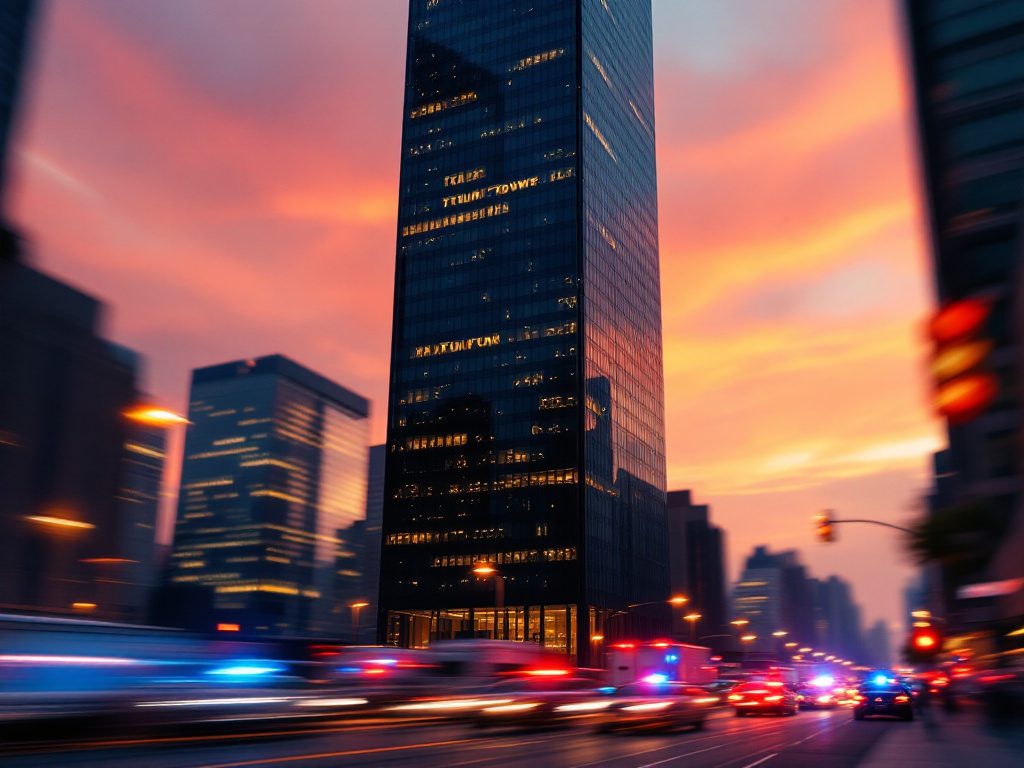
A Troubling Scene: Disorder and Drama Above Manhattan
Late Monday afternoon, sirens echoed off the gold-glass façade of Trump Tower as New York’s finest descended once again on one of the city’s most controversial buildings. Police arrested a 30-year-old man inside Trump Tower after he was reported to be on what authorities called an “elevated surface.” The phrase doesn’t begin to capture the spectacle that unfolded on Fifth Avenue—a stretch synonymous with colossal ambition, ballooning egos, and growing civic tension.
Eyewitnesses described a chaotic but measured NYPD response, with the emergency service unit donning helmets and safety harnesses, indicating the unique challenges posed by urban high-rises. As they cordoned off the public atrium and evacuated tourists, journalists rushed in to document the unfolding standoff. According to independent journalists on the scene, the air was tense—no one quite sure whether this was a political protest or a lost dare, another footnote in the building’s colorful, controversial history.
New York City Police responded at approximately 4:30 p.m., according to official department statements. Officers located and removed the suspect with what appeared to be professional efficiency—no reports of violence, no dramatic climax.
Political Landmarks and Public Risk: Why Trump Tower Attracts Spectacle
Beyond the incident itself lies a more systemic question: Why has Trump Tower continually functioned as a magnet for high-profile acts of civil disobedience or disorder? It’s no accident that this 58-story skyscraper, home to a former president, private condominiums, luxury shops, and a tourist-magnet atrium, is both a symbol and a lightning rod. The latest episode recalls the infamous 2016 scaling attempt, when another individual managed to climb outside the tower using suction cups, drawing global headlines before being pulled inside by police at the 21st floor. The parallels are obvious, and they are troubling.
A closer look reveals that these incidents carry a deeper meaning in a country where the boundaries between protest, performance, and peril are increasingly blurred. Harvard sociologist Jennifer Hochschild observes, “Landmarks like Trump Tower become stages upon which individual dissent and collective anxiety are both performed and policed—it’s a sideshow reflecting much larger cracks in the national psyche.” As long as the property remains a political flashpoint, it will continue to invite attention-seekers as well as those with genuine grievances.
“When politics moves from the ballot box to the city skyline, every stone and pane of glass can become a canvas for protest—or a target for chaos.”
— Dr. Leah Wright Rigueur, professor of public policy
Trump Tower’s high visibility and symbolic weight make it uniquely vulnerable. Law enforcement has little room for error: swift intervention is essential not just for public safety, but also to prevent the spectacle from ballooning into something more dangerous or damaging. The stakes only increase when the building’s history and the current polarized, hyper-mediated political atmosphere are factored in.
Security, Spectacle, and the Cost of Politicized Space
Questions loom over whether New York—and, by extension, the country—is prepared for the realities of managing security at sites that double as political battlegrounds. The response to Monday’s incident shows that, while the NYPD is highly trained and well-equipped for these unique dangers, the underlying vulnerabilities have yet to be meaningfully addressed. Similar stunts have occurred not just at Trump Tower, but at high-profile locations nationwide. Each time, authorities respond with tactical precision, but the underlying condition remains unchanged.
Jane Adams, a former Secret Service official and expert on protective security, notes, “These properties, whether we like it or not, are theaters of American democracy and dissent—and they need a strategy that is both technically sound and democratically accountable.” The risks extend beyond criminal mischief: in hyper-visible locations like Trump Tower, a moment’s thrill can instantly become a global headline, propelling the actor—however misguided—into the center of a national spectacle.
Progressive critics argue that conservative claims championing “law and order” frequently ignore the ways in which hyper-policing and spectacle-driven responses can obscure vital issues of civil liberty and dissent. The lesson from Monday’s incident isn’t that Americans face a simple choice between order and chaos, but that our cities need frameworks that protect both public safety and the rights of individuals to peacefully protest. Civil liberties groups warn that blanket crackdowns and increased surveillance too often sweep in bystanders, chilling the very civic engagement the First Amendment was designed to protect.
What does the future hold for buildings like Trump Tower, where luxury, politics, and protest clash on the most public of stages? Until the nation reckons honestly with the profound divisions—economic, racial, political—playing out in its most iconic cityscapes, these headline-grabbing episodes will remain more symptom than cause.
Trump Tower’s latest brush with disorder is a stark reminder: urban centers are the beating hearts of American democracy. When security, spectacle, and dissent converge under one gilded roof, we are all called to ask not just how we police our spaces, but how we define them, and whose voices echo through their marbled halls.
