
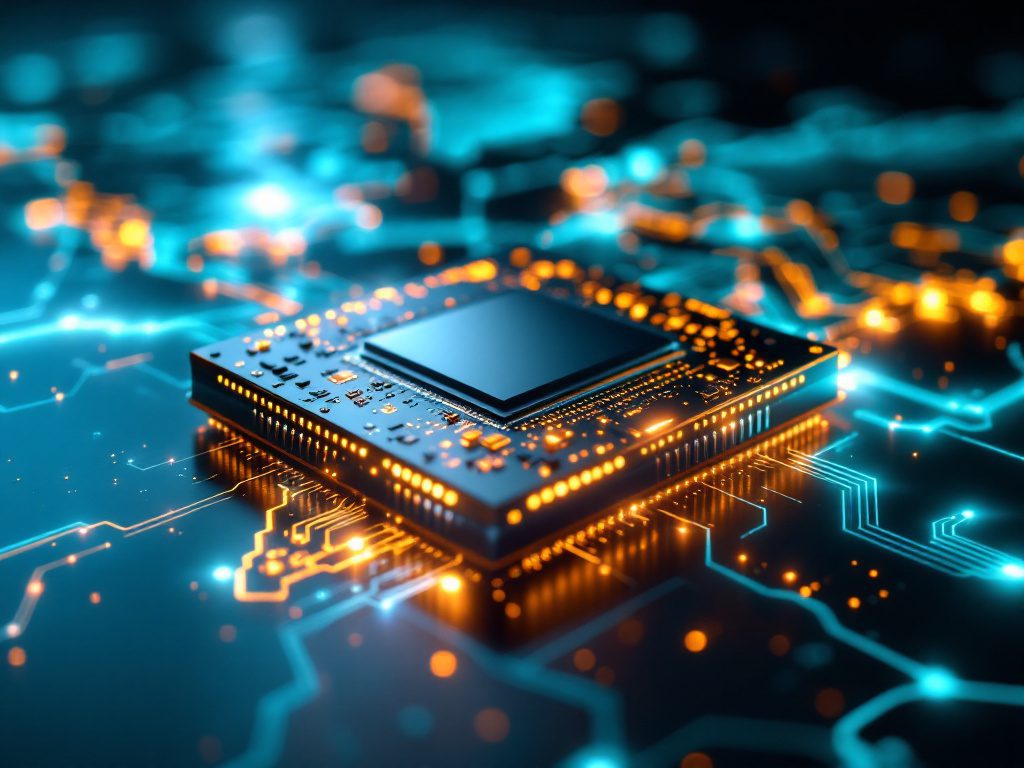
The Semiconductor Surge: Powering a Nation’s Future
Capturing the currents of American innovation often means looking past the headlines and into the heart of technology. When you consider the smartphone in your pocket, the electric vehicle gliding down the highway, or the rapid-fire results delivered by your favorite AI chatbot, you’re engaging with the unseen but potent force of semiconductors. These silicon marvels aren’t just technical curiosities; they are the backbone of America’s competitive aspirations. For those who think tech policy is just for the Silicon Valley elite, the reality is far more consequential—semiconductors now shape everything from national defense to the safety of your morning commute.
Rolling out fresh optimism, analyst Christopher Rolland of Susquehanna recently upgraded ON Semiconductor (ON), citing its expanding clout in the automotive sector—especially with Tesla—as well as its promise in AI and communications infrastructure. The company’s recent setbacks, including a precipitous 48% drop in stock value over six months and looming tariff threats, might frighten the risk-averse, yet its aggressive investment in “edge” AI chips for vehicles points toward a trajectory of real impact. These aren’t the chips powering your home laptop; they’re the integral brains reducing milliseconds in life-or-death automotive decisions. According to industry site TechCrunch, ON’s market share gains in advanced driver-assistance systems (ADAS) place it uniquely for the coming wave of intelligent, software-driven vehicles—vehicles that make the difference between an accident avoided or a tragedy realized.
Beyond that, the horizon grows even more consequential. SiMa.ai, a rising star in edge AI, has unveiled a machine learning system-on-chip (MLSoC) with staggering edge inference throughput—150 FPS per watt—completely eclipsing its competitors Dell and Qualcomm by margins of 200-300%. For real-world safety and sustainability, these leaps matter: Every millisecond saved in vehicle response means lives spared and emissions curbed. The promise is not only technological—it’s deeply human.
Congress Catches Up: Debating the Risks and Rewards of AI
While Silicon Valley and Tokyo laboratories surge ahead, Congress is racing to catch up to the realities of AI, holding a flurry of hearings that reveal bipartisan urgency as well as profound anxieties about the nation’s technological future. Congressional committees have spent much of this spring wrestling with the sprawling implications of artificial intelligence: its effect on jobs, its energy appetite, its centrality to military readiness, and, most controversially, the mounting challenge posed by China’s parallel technological ambitions.
Sen. Jon Husted (R-OH) succinctly captured the spirit at a recent session: “If you study the history of the world, the nations that are the most military and economically domineering are the nations that are the most innovative.” He’s hardly alone—both Democrats and Republicans understand that the AI race is existential for American preeminence, but their definitions of “innovation” and their willingness to regulate diverge sharply. The Senate Armed Services Cybersecurity Subcommittee spotlighted not just the need for AI-driven cyber defense but the risks of adversarial states leaping ahead. The House Oversight Committee fixated on the specter of an AI arms race slipping from U.S. grasp, while the Energy and Commerce Committee squared off over whether the United States can meet AI’s voracious data-center power demands with renewable resources.
Voices like Harvard’s Sherry Turkle caution not just about AI’s military and economic uses, but the potential social and ethical voids left when technological acceleration outpaces oversight. As highlighted by testimony from leaders in both defense and private industry, the call is not merely for more federal investment, but for a careful, robust regulatory framework that guides innovation without sacrificing accountability.
Some of the most striking testimony addressed the intricate challenge of export controls. TSMC, the world’s largest chipmaker, admitted in its 2025 report that it’s nearly impossible to guarantee that once chips leave the factory, they won’t land in “restricted hands”—a subtle nod to the persistent flow of technology to Chinese giants like Huawei despite sweeping U.S. sanctions.
“As global chip rules tighten and rivals accelerate local innovation, the U.S. risks ceding its edge not just to China, but to any nation willing to blend industrial policy with bold, future-focused investment.”
This quote, echoed in multiple committee hearings, underscores the stakes: Regulatory gridlock, or the perennial temptation to coddle dominant incumbents, could leave the United States in the technological rearview mirror.
The World Reacts: New Contenders and Material Innovation
America’s own soul-searching comes as Asian rivals push forward with striking speed. Huawei, long in Washington’s crosshairs, is sending shock waves through the industry with its forthcoming 910C AI chip. By leveraging advanced packaging to combine two previous-generation chips, Huawei is closing the performance gap with Nvidia’s vaunted H100—offering Chinese firms a powerful, locally-sourced alternative to U.S.-made processors. Market analysts at Counterpoint Research describe this as an “inflection point” in Beijing’s campaign for semiconductor self-reliance.
Japan, meanwhile, is advancing a quieter but deeply consequential material transformation. By 2026, Nippon Electric Glass promises to deliver glass substrates up to 510mm—up from today’s 300mm—escalating to 600mm within two years. This new class of glass not only provides superior heat resistance over legacy plastics, but will enable the next generation of high-performance AI chips critical for sustainable data centers and autonomous machines. Such innovation isn’t just a feat of chemistry; it’s about ensuring that democratized, affordable AI isn’t choked off by old bottlenecks.
Geopolitical rivalry, however, brings harsh realities. U.S. export controls, routed through partners in the UK and elsewhere, now limit Intel AI processor sales to China, forcing complex licensing negotiations—and inevitably boosting demand for homegrown alternatives. TSMC’s struggles to track chip end-users reflect a larger reality: Once technology leaves the drawn boundaries of the United States, the levers of control become blurry and hard to enforce. The world, in effect, is building semi-permeable walls and parallel supply chains in a globalized yet deeply divided tech ecosystem.
Charting a Progressive Path Forward
What emerges from this moment isn’t a story of zero-sum inevitability but of challenge and opportunity. The U.S. can either treat semiconductors—these essential engines of 21st-century life—as just another chip in a global casino, or as part of a collective project to secure our technological, economic, and ethical future. Smart regulation—rooted in expert advice, not lobbyist talking points—remains essential to protecting democracy without stifling the very innovation that keeps us safe and competitive.
The conservative impulse to treat every new technology as a race to the bottom, slashing environmental and consumer protections to favor incumbent giants, ignores both the spirit and the substance of American excellence. The real advantages have always come not from deregulation and government inertia, but from matching industrial action with clear-eyed vision—the kind that built the internet, landed on the moon, and, today, decides the balance of power in the AI age.
For voters and policymakers alike, the question isn’t just who wins the chip race, but what kind of world we want those chips to build. Solidarity, sustainability, and equity are not only progressive ideals—they are pragmatic strategies for enduring success in an interconnected, contested world. That’s not just an aspiration. It’s the essential future unfolding before our eyes.
