
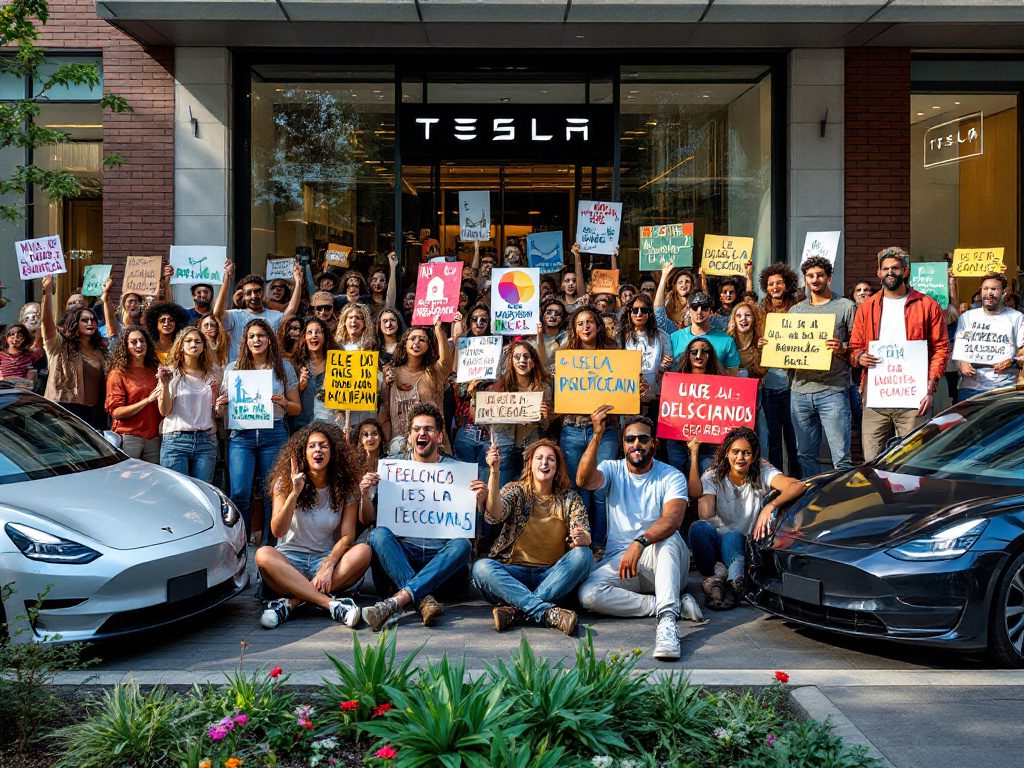
Earth Day Defiance: Spray Paint and Symbolism Outside the Tesla Showroom
In the heart of Manhattan, Earth Day 2025 was charged with more than just symbolic tree plantings and calls for environmental reflection. Activists from the climate group Extinction Rebellion descended on a Tesla dealership, unleashing a cascade of protest slogans across the glass façade in neon spray paint. The messages—blunt, bold, and unmistakably political—expressed seething anger not only at Tesla, but at the complex web of corporate power, government policy, and environmental stewardship embodied by Elon Musk’s dual role as Tesla CEO and head of the federal Department of Government Efficiency (DOGE).
One protestor, sporting a vivid pink t-shirt declaring, “Climate Change = Mass Murder”, embodied a movement disillusioned by what it perceives as performative promises and stark inaction by those with the resources to effect change. Police arrived quickly, prompting some activists to scrub away their own graffiti as handcuffs clinked in the background. Two were arrested, underlining both the risks and resolve that mark this new era of climate activism.
What motivated targeting Tesla—a company often lauded for accelerating the electric vehicle revolution? As Extinction Rebellion NYC explained in a public statement, the protest was about much more than cars. The demonstration’s mission: to resist a system they call a “government of chaos and cruelty,” and to push beyond mere symbolic gestures in the fight against climate catastrophe. Critics argue that these acts cross the line from principled dissent into counterproductive vandalism, but for many activists, the line in the sand was already crossed by the government and corporations long before a single can of spray paint was uncapped.
The Fractures Beneath the Paint: Tesla, Musk, and Public Backlash
Beneath the spectacle lies a deeper reckoning for Tesla and Elon Musk. Once the poster child for green innovation, Tesla now finds itself at the crossroads of mounting criticism. Musk’s shapeshifting public persona—from electric car evangelist to federal austerity czar—has catalyzed unprecedented frustration among climate activists. The Department of Government Efficiency, tasked with “streamlining” government but viewed by critics as a front for slash-and-burn cuts, has only exacerbated fears that environmental priorities will lose out to corporate interests and profit margins.
According to Harvard political scientist Dr. Elena Martinez, “Musk’s aura as a techno-visionary has eroded as his leadership pivots from climate to cost-cutting, alienating the very progressives once drawn to Tesla’s promise.” This perception is not just a liberal talking point; a 2024 Pew Research Center study found that public trust in corporations addressing climate change has plummeted, particularly among younger and more liberal demographics. The symbolism of Tesla’s electric vehicles—the once-proud badge of eco-consciousness—now draws mixed reactions. Some Tesla owners even report concealing badges on their cars to avoid “embarrassment” over Musk’s stances, a striking reversal publicly noted in recent social media posts and interviews.
Against this backdrop, the protest outside the Manhattan showroom was not the first public act of discontent. Tesla locations across the nation have faced escalating attacks—ranging from minor vandalism to alarming episodes of arson or drive-by shootings—signaling a surge of ire directed at both Musk and the corporate state apparatus many feel he now represents.
“As democratic rights get eroded, the time for niceties is long since past. Mass marches will not save us. Trump knows this. Trump counts on this. We refuse to be bystanders like the Democrats, we refuse to wait for this emergency to proceed beyond the point of no return.” — Extinction Rebellion NYC, Earth Day 2025 press release
This language painfully echoes the urgency of a generation raised on the warnings of climate scientists, yet left waiting by the patchwork of government half-measures. Actions like these—whether you view them as crimes or calls to conscience—underscore a collective demand to be heard.
The Price and Potential of Civil Disobedience in the Climate Era
A closer look reveals a broader context for this wave of activism—one shaped by decades of failed climate negotiations, watered-down policy, and an endless tug-of-war between economic interests and environmental realities. Civil disobedience on behalf of the climate is nothing new. From the suffragists chaining themselves to railings, to anti-nuclear protestors lying in the path of bulldozers, history bears witness to the catalytic role of disruption in driving legislative and cultural shifts. Yet today, observers are asking whether the cost is too high—damaged property, divided communities, and a media cycle all too eager to reduce complex crises to clickbait criminality.
Beyond that, the actions of Extinction Rebellion and similar groups reflect an escalating impatience with incrementalism. Dr. Fatima Greene, a sociologist at NYU, notes, “We see a convergence of social justice and environmental priorities, as activists connect the dots between government austerity, corporate influence, and ecological decay.” For these demonstrators, the choice of Tesla is pointed: an emblem of both technological hope and, paradoxically, of perceived betrayal as Musk adopts roles perceived as antithetical to progressive change.
Earth Day’s connection to movements of civil resistance was never about polite applause. The original 1970 marches broke laws and challenged authority, helping spark the creation of the Environmental Protection Agency and passage of the Clean Water Act. The difference today is the sharpened edge—the intersection of climate, democracy, and economic justice making every act of dissent thrum with existential stakes.
So where does this leave the climate movement and the companies claiming to lead it? The answer is unsettled, but the message of the Manhattan protest cannot be denied: genuine action on climate will not come from sanitized boardrooms or tepid government memos. As frustration mounts and the clock ticks down, activists are willing to risk arrest, vilification, and criminal records to expose what they see as the dangerous disconnect between rhetoric and reality. If history is any guide, such moments of disruption often prove to be the tipping points that force realignment—politically, culturally, and economically.
