
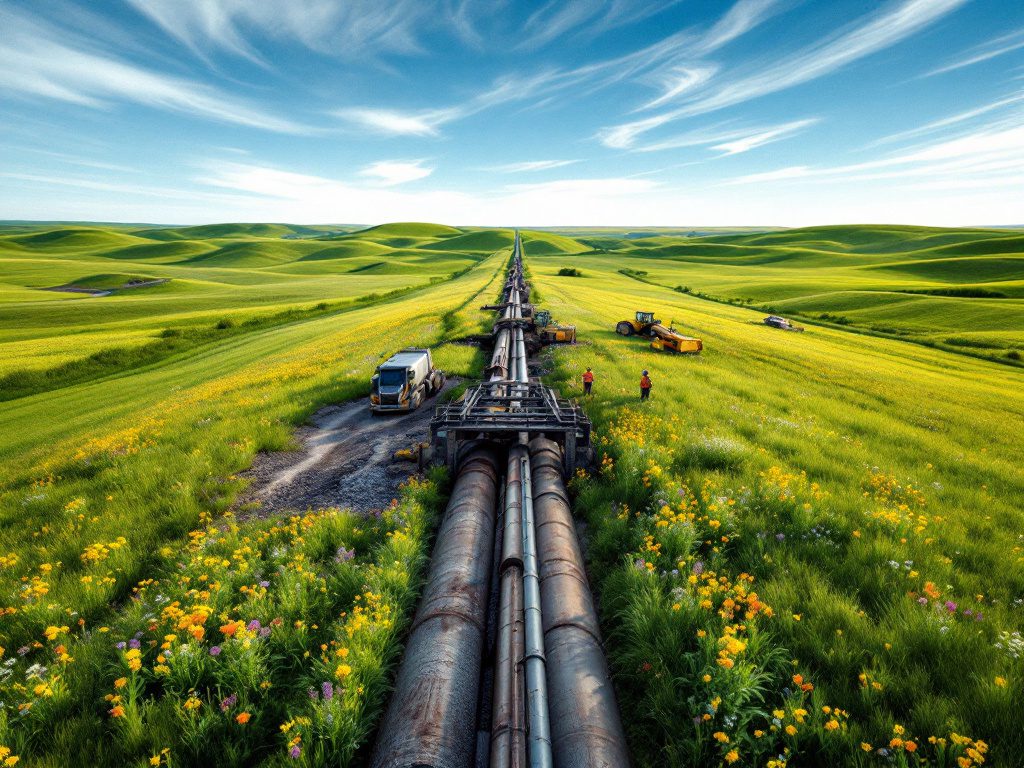
Landowner Rights Trump Corporate Ambitions
South Dakota’s miles of open prairie have become the staging ground for a clash emblematic of broader national tensions: citizens’ rights versus the outsized ambitions of Big Carbon—and, by extension, the fossil fuel-adjacent economy. The South Dakota Public Utilities Commission’s (PUC) recent 2-1 decision to deny Summit Carbon Solutions’ application for a 2,500-mile carbon dioxide pipeline comes after months of heated debate, cutthroat lobbying, and unprecedented political mobilization by rural landowners.
Imagine more than $150 million in sunk costs, public hearings echoing with stories of physical and financial trauma, and a corporate juggernaut stunned at losing what it thought was a sure bet. That’s the reality confronting Summit after the PUC rebuffed its permit—again. The company’s plan: pipe liquid CO2 from more than 60 ethanol plants across the Midwest to underground storage in North Dakota, pursuing a technological fix to a crisis shaped by fossil fuel excesses. Lofty rhetoric about climate mitigation collided headlong with property rights and local self-determination.
The pipeline wasn’t envisioned just as a win for climate carrots. Client ethanol companies—cornerstones of rural economies—stood to profit from cleaner operations, while billions in federal tax credits dangled just out of reach. Yet even with the support of influential partners, Summit’s plans foundered when locals refused to accept aggressive land grabs, enabled (until recently) by the legal cudgel of eminent domain.
Decoding the Rejection: Democracy in Action or Economic Self-Sabotage?
What tipped the scales this time? The answer is as much about process as politics. In March, South Dakota legislators—responding to mounting pressure from farmers and rural activists—passed a bill banning the use of eminent domain for private carbon pipelines. Suddenly, the legal path Summit once counted on to seize private property was off the map. The watershed law, House Bill 1052, shifted the narrative in favor of grassroots resistance, sending a clear signal that rural voices could no longer be steamrolled in the name of so-called progress.
The PUC echoed this power shift. As highlighted in the commission’s majority opinion, the “application is not viable and incomplete,” a clear rebuke after Summit requested an indefinite pause on review, hoping to buy time and regroup post-legislation. Landowners, many of them seasoned by years of corporate encroachment, praised the PUC for ending what they called a prolonged period of “physical, mental, and financial pain.” That’s not just hyperbole: property values, legacy farming practices, personal security, and rural mental health were all cited as casualties in public comments.
Commissioner Chris Nelson’s lone dissent—arguing Summit deserved another shot in light of their public commitment not to violate the new law or sue—adds complexity. Is this the system working as intended, or is it a harbinger of unintended economic fallout? After all, Summit’s $8.9 billion investment is meant to make the Midwest a carbon pipeline corridor, and a single state’s regulatory blockade reverberates through five states, thanks to Iowa’s mandate barring pipeline construction until the Dakotas sign off.
“South Dakota’s decision is pivotal. One state’s regulatory courage can upend even the most well-heeled corporate juggernauts.”
– Harvard environmental law professor Anna G. Bentley
Several experts warn that allowing pipeline companies to steamroll local opposition by weaponizing eminent domain sets an unsustainable precedent. “The right to shape your own community’s future shouldn’t be auctioned off to the highest corporate bidder,” says Harvard’s Anna G. Bentley. That sentiment runs through every testimony gathered during months of commission hearings, cementing the episode as a textbook case of democratic resistance—and a cautionary tale for proponents of industrial-scale carbon capture as a climate panacea.
The False Solution Fallacy: Risk, Reward, and the Road Ahead
Scratch the surface of Summit’s narrative of climate heroism, and a messier picture emerges. The pipeline’s stated goal—capturing and storing CO2 from ethanol plants—appears, on paper, to address emissions. But as Summit officials themselves concede, some of that carbon would also be shipped for use in enhanced oil recovery from aging wells, not just for permanent sequestration. Environmental groups decry this as a “false solution” benefiting fossil fuel extraction under the guise of greenhouse gas mitigation. Prairie Rivers Network and Food & Water Watch both assert that investing in pipelines encourages more fossil fuel reliance and locks communities into risky infrastructure, instead of bold decarbonization through renewables and electrification.
Rural South Dakota families have seen this dynamic play out before: a distant promise of jobs, infrastructure dollars, and energy security, followed by years of legal limbo and stress for landowners. Chicago-based energy historian Dr. Valeria Maldonado points out, “Projects like this are often sold with glossy climate promises, but rarely do the local communities share in the upsides—while bearing nearly all the risks.” Previous pipeline fights—from Keystone XL to Dakota Access—underscore this dynamic, where Indigenous nations, farmers, and small towns absorb the long-term consequences of regulatory shortcuts and corporate hubris.
Summit’s vow to refile a smaller application and more earnestly engage landowners sounds, to many wary observers, less like a course correction and more like déjà vu. In the face of a regulatory setback, the company telegraphed disappointment yet signaled it would not give up on its lucrative federal tax credits or its vision of a Midwest “CO2 superhighway.” The dream of perpetual growth dies hard—but the signals from the PUC and state lawmakers are unequivocal: the era of taking rural America for granted is over.
Bigger Lessons: Climate Equity and Democratic Oversight
South Dakota’s latest pipeline standoff isn’t just about environmental stewardship, though that’s central. At its core, it’s a wake-up call about the meaning of informed consent, climate justice, and the power of collective action. When economic development and decarbonization become code words for top-down control and unequal risk distribution, skepticism is not only warranted—it’s essential. As the climate crisis accelerates, decisions about infrastructure, land use, and technology must align with public good, not just profit margins.
America faces daunting decarbonization targets. Yet as South Dakota landowners demonstrate, democratic engagement is not an obstacle but an essential ingredient to legitimate, sustainable solutions. If you truly want a just energy transition, it starts by respecting the people who live with the outcomes.
