
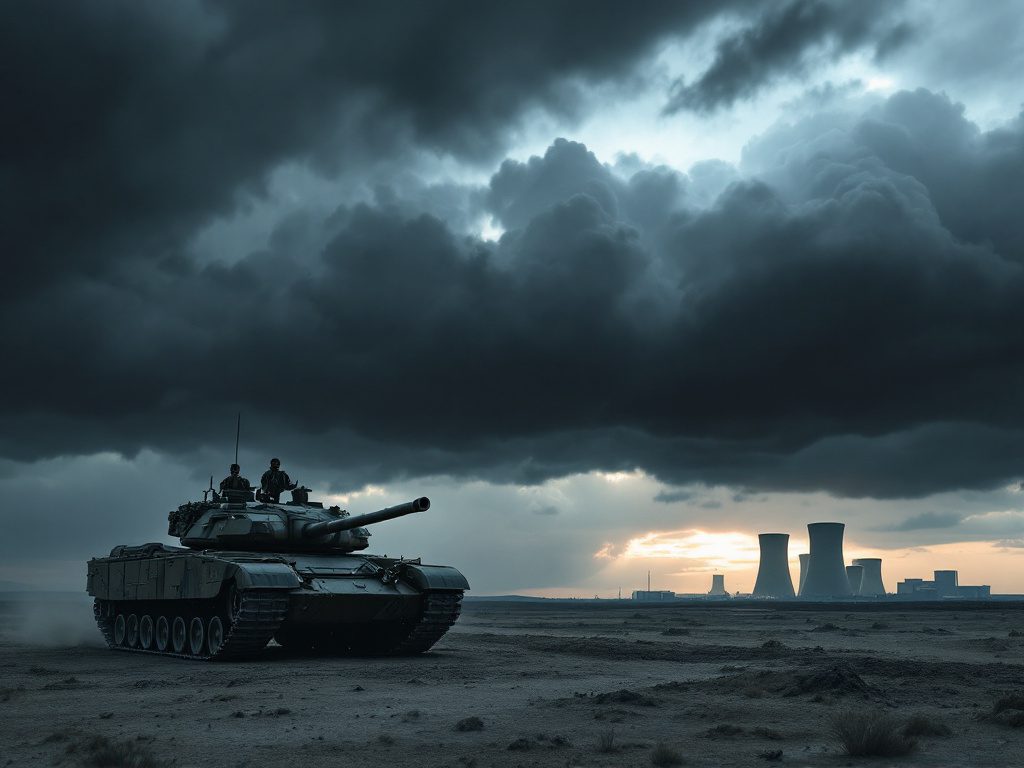
The Return of Nuclear Brinkmanship
An icy chill emanated from Moscow this week after Sergei Shoigu, Russia’s top security official, brandished the threat of nuclear force with an audacity echoing the Cold War’s most perilous moments. In a deeply unsettling interview with Russia’s TASS news agency, Shoigu declared that Moscow, with new doctrinal amendments in hand, now openly reserves the right to use nuclear weapons in response to any aggression by Western nations—conventional or otherwise. What was once an unspoken boundary, respected if not outright feared by post-Soviet leaders, looks dangerously eroded in Vladimir Putin’s Russia today.
What’s fueling these escalations? Shoigu’s message specifically targets discussions in London and Washington over a ‘coalition of the willing’ to intervene in Ukraine—an idea floated by British officials eager to support Kyiv amid Russia’s growing battlefield gains. The ex-defense minister cast Western forces as “contingent interventionists or occupiers,” accusing NATO of sparking the current conflict through persistent eastward expansion and the deployment of military infrastructure in Ukraine. He went a step further, alleging that Europe is quietly gearing up for war against Russia by 2030, and ominously hinted that Moscow is prepared to resume nuclear weapons testing in the Arctic for the first time in decades.
According to Harvard historian Serhii Plokhy, “Such rhetoric has not characterized Russia-West relations since the darkest days of the 1980s, but is now a regular feature of Moscow’s approach.” Shoigu’s saber-rattling is as much psychological warfare as policy—an unmistakable warning that the Russian leadership sees few boundaries in defending its territorial ambitions. But how credible is this threat, and how should the West respond?
Doctrinal Shifts and Dangerous Precedents
Beneath the bluster lies something more consequential: legal and political changes that formalize these escalatory policies. Shoigu highlighted recent amendments to Russia’s Basic Principles of State Policy on Nuclear Deterrence, greenlit last November. For the first time since the Soviet collapse, Russia now formally asserts the right to use nuclear arms not only in response to nuclear attacks but also to defeat a conventional strike perceived as an existential threat to itself or its closest ally, Belarus. This drastic revision places far more scenarios on the nuclear table—and with both Russia and Belarus treaty-bound to joint defense, spillover risks for NATO increase dramatically.
Even during the stormiest years of the Cold War, both superpowers shared a tacit understanding: nuclear weapons were weapons of last resort, to be threatened but never employed. But now, as the Carnegie Moscow Center’s Dmitri Trenin points out, “The new doctrine lowers the threshold. It blurs the line between conventional and nuclear war.” This ambiguity is precisely what has alarmed Western capitals.
Recent months have seen Russia escalate not just its rhetoric, but its strategic posture. NATO’s intelligence has witnessed stepped-up deployments of tactical nuclear-capable systems in Western Russia and heightened alert status in Kaliningrad. At the same time, Washington has entered a new era of political uncertainty, with Donald Trump and his likely vice president, JD Vance, pressing for a different approach—threatening to reduce U.S. support to Ukraine unless negotiations produce rapid results. A withdrawal of American resolve would leave Europe dangerously exposed to Russian pressure, underlining how security on the continent is once again hinging on the willingness of Western leaders to act boldly rather than capitulate to nuclear blackmail.
“The new doctrine lowers the threshold. It blurs the line between conventional and nuclear war.”
– Dmitri Trenin, Carnegie Moscow Center
Historical parallels should give us pause. In the early 1980s, misunderstandings and propaganda nearly caused a cataclysm during NATO’s Able Archer exercise, when Moscow feared a real attack was imminent. Today’s heightened mistrust, wildcard leaders, and sharper doctrines mean the risks have, if anything, grown. How many in the West are truly prepared for that reality?
The Real-World Stakes: Deterrence or Disaster?
Such policy shifts don’t exist in a vacuum. Shoigu’s threat arrives against a backdrop of mounting military activity along Russia’s borders and a grinding, unresolved war in Ukraine. While Kremlin spokespeople frame these warnings as a measured response to alleged Western provocations, experienced analysts see a more cynical motive: to intimidate European publics and fracture allied unity in support of Ukraine.
Europe’s leaders rightly view Russian threats with skepticism. French President Emmanuel Macron has repeatedly stated that any use of nuclear force by Russia would change “the nature of the conflict” and trigger a swift, unified response. Yet ambiguous threats prompt dangerous confusion and increase the risk of fatal miscalculation. A closer look reveals that Shoigu’s doctrine doesn’t just threaten policymakers; it terrifies ordinary Europeans, especially in front-line states like Poland and the Baltics. These populations remember all too well what it means to live under the threat of atomic annihilation. The trauma of Cold War brinkmanship is not an abstraction but a lived history barely a generation old.
Beyond that, Shoigu’s pronouncements should be seen for what they are: attempts to force Western governments into either appeasement or paralysis. History instructs that appeasement only emboldens autocrats, as seen in the 1930s and, more recently, in the lead-up to Russia’s 2014 seizure of Crimea. Effective deterrence requires resolve, clear communication, and solidarity among democratic nations. The alternative—a world cowed by nuclear blackmail—would be a dangerous place indeed.
Policy experts like Fiona Hill, former National Security Council Russia advisor, stress that “steady escalation without a credible Western countermeasure encourages Moscow to push further.” She argues that the messaging from Washington and Brussels should be unambiguous: NATO will not tolerate nuclear brinkmanship, and will respond firmly to any marked escalation—conventional or otherwise. Diplomacy, she asserts, must remain open, but not at the cost of giving Moscow a free pass to rewrite the rules of global security through threats and coercion.
Choosing Collective Security over Fear
So what do these warnings mean for you, for Europe, and for the world? The answer is stark but clear: retreating from a unified stance only increases the risk for all. Peace cannot be built on acquiescence to nuclear bullying. Old lessons demand new courage, and only through collective vigilance, open debate, and a renewed commitment to security alliances can progressive values—democracy, equality, and peace—endure amid the gathering storm clouds.
