
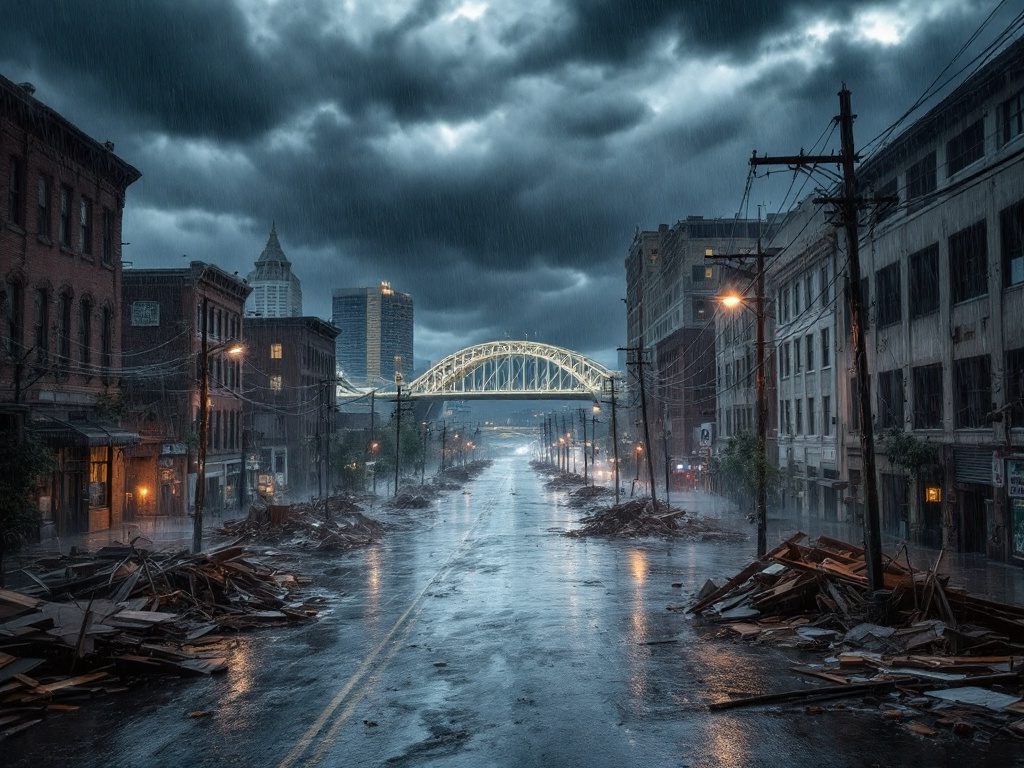
Life on the Line: A Tragedy in Pittsburgh’s South Side Slopes
When the skies darken and warning sirens blare, you brace for the worst. On Tuesday evening in Pittsburgh’s South Side Slopes, that worst-case scenario became a reality. Around 7 p.m., as fierce storms ripped through the city, a man encountered live wires on the 1000 block of St. Martin Street. His attempt to respond to the unfolding danger ended in tragedy when he was fatally electrocuted—a jarring consequence of nature colliding with fragile infrastructure.
His death was not an isolated accident but part of a pattern repeating across the region. With winds peaking at a staggering 71.3 mph at Pittsburgh International Airport—the third-strongest gust ever recorded there—trees were uprooted and utility poles snapped, plunging entire neighborhoods into darkness. In the hours after the storm, Pittsburgh Public Safety urged residents to “stay away from downed trees, wires, and debris,” but the cold truth was evident: Too many communities find themselves one storm away from catastrophe when it comes to basic utilities and disaster response.
By 8 p.m., roughly 400,000 households in the Pittsburgh area sat powerless, waiting in uncertainty as emergency crews navigated hazardous conditions. Local public works and utility companies scrambled to restore power and clear debris, but the ripple effects were immediate: road closures, school delays, and a chilling unease that lingered as the storm system moved on, threatening the wider Northeast.
Storms as a Stress Test—What Broke, and Why?
Disasters often serve as a litmus test for the strength and resilience of public systems. The devastation in Pittsburgh and other battered regions this week should prompt a moment of national reckoning—not just for their residents, but for every American city confronting the reality of outdated infrastructure pushed to its breaking point. According to the American Society of Civil Engineers’ most recent “Report Card for America’s Infrastructure,” the nation’s grid and utility networks remain significantly underfunded, leaving millions vulnerable to the kinds of cascading failures we saw in Pennsylvania, Ohio, and as far west as Missouri.
Consider the 1,800-mile swath from West Texas to Vermont that, according to the Storm Prediction Center, lay under a level 2 risk out of 5 for severe thunderstorms on Tuesday. In that enormous corridor, families faced more than just inconvenience—they faced genuine peril, from blocked emergency routes to homes rendered uninhabitable by flooding or fire. Emergency personnel worked around the clock, but “heroic effort is a poor substitute for comprehensive investment,” as disaster management scholar Professor Karen White of Carnegie Mellon University noted in a recent interview.
What’s especially galling is how preventable much of this hardship should be. The science is settled: climate change is fueling more frequent and severe storms. Yet, investment in electrical grid modernization, tree management, and distributed power generation continues to lag, particularly in states where conservative policy agendas prioritize tax cuts and deregulation over public safety and resilience.
“We’ve ignored the slow decay of our infrastructure for decades, and now every storm is a gamble. It shouldn’t take the loss of life to force a reckoning.”
According to the Department of Energy, U.S. electrical outages caused by weather have more than doubled over the past 20 years. In Pennsylvania alone, state legislators have chronically underfunded grid improvements, making the region particularly susceptible to the sort of chain-reaction failures that left Pittsburghers in the dark this week. The consequences—lives lost, property destroyed, economies disrupted—are not simply “acts of God,” but of legislative neglect.
Beyond Repair: Building a More Resilient, Just Future
The harrowing events in Pittsburgh are a stark reminder that storms reveal underlying social divides. Not all neighborhoods suffer equally when the power fails. Low-income and marginalized communities, often closest to neglected infrastructure, bear the brunt of danger, property loss, and prolonged recovery. Researchers at the Brookings Institution have regularly documented how storms and disasters widen inequality, noting that post-disaster aid tends to flow more readily to affluent areas. Resiliency isn’t just about wires and poles—it’s about justice and equity.
It’s easy for some policymakers to offer “thoughts and prayers” or tout post-disaster response without examining how their own agendas have set the stage for tragedy. Prioritizing corporate tax breaks while deferring maintenance, attacking environmental regulations, and gutting investment in public works doesn’t just make for poor optics in the wake of disaster—it puts lives at risk. What if, instead, we took cues from cities like San Jose or Boston, where public-private partnerships and progressive policy have driven grid modernization, tree-trimming initiatives, and rapid-response community hotlines? The data shows these investments pay dividends both in lives saved and economic resilience.
A closer look reveals a troubling truth: the cycle of disaster and patchwork recovery is not inevitable. As climate change continues fueling extreme weather, adaptation and mitigation must become moral imperatives, not just technical challenges. That means integrating renewable energy, hardening lines against wind damage, enforcing stricter building codes, and—most critically—funding these priorities through progressive taxation and federal investment.
We often ask, “How can this keep happening here?” The answer is clear: legislative choices, not natural fate, are driving the nation’s vulnerability. Until broad coalitions demand a politics that values long-term safety over short-term savings, stories like Pittsburgh’s—and the suffering behind them—will keep repeating. Progressive values—equity, justice, collective responsibility—offer a roadmap out of this cycle, if we’re brave enough to follow it.
