
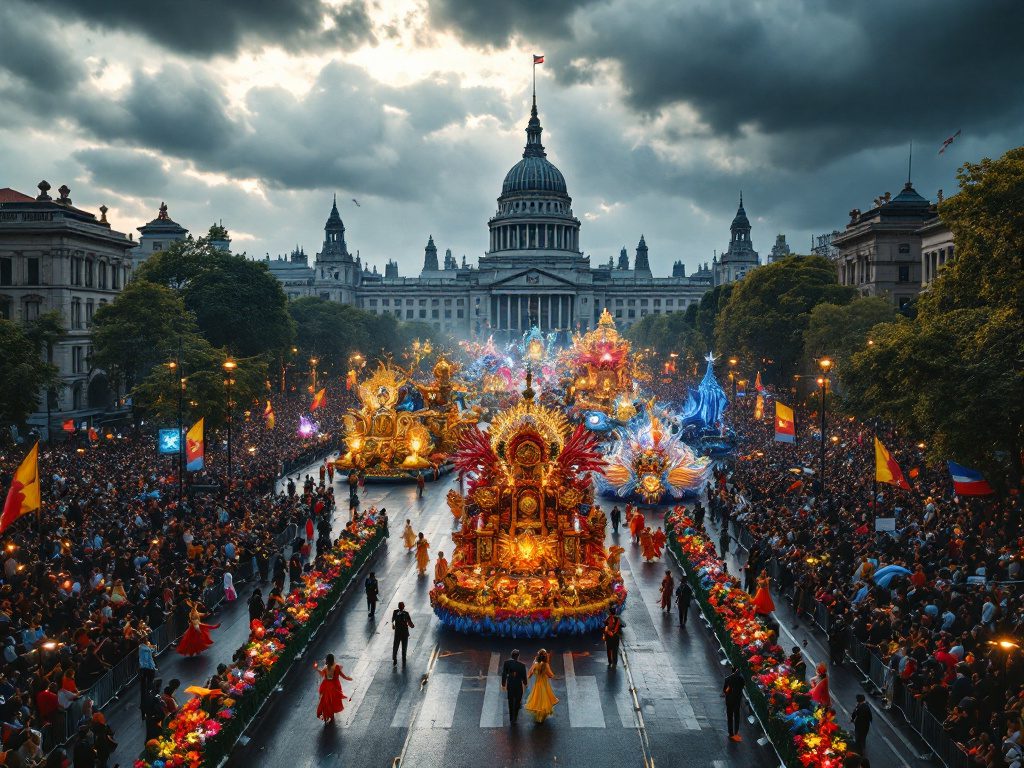
Power and Pageantry: The Parade’s True Cost
Talk of a massive military parade cutting through the heart of Washington, D.C., on June 14, 2025, is re-igniting old debates about democratic traditions, the responsible use of public funds, and the perils of political spectacle. According to detailed plans obtained by the Associated Press, the U.S. Army hopes to mark its 250th anniversary—and the 79th birthday of Donald Trump—with a full-throated display: 6,600 soldiers, more than 150 roaring military vehicles, 50 helicopters slicing the sky, seven bands, and thousands of civilians. The route would stretch a symbolic four miles from the Pentagon to the National Mall, a bold sweep demanding tens of millions in taxpayer dollars.
The Army’s official line aims for inclusivity. Army spokesman Col. Dave Butler tried to frame it as a “national celebration,” saying, “We want to make it into an event that the entire nation can celebrate with us…We want Americans to know their Army and their soldiers. A parade might become part of that, and we think that will be an excellent addition to what we already have planned.” Yet there’s no denying the awkward political choreography: the scheduling aligns perfectly with Trump’s birthday, and the parade’s scale dwarfs even the Army’s already-ambitious anniversary festival.
It’s hard to ignore the echoes of 2017, when Donald Trump—fresh from witnessing France’s Bastille Day parade—floated dreams of tank columns on Pennsylvania Avenue. That idea ultimately collapsed under the weight of public backlash and price-tag pressures; estimated streets repairs alone came in at $92 million, according to a Government Accountability Office report. Have we learned nothing?
Beneath the Spectacle: American Values or Authoritarian Aspirations?
Glittering with martial pride, this proposed pageant looks less like a heartfelt homage to the troops than a calculated bid for personal grandiosity. Many critics argue the parade’s true inspiration draws from leaders in Moscow and Pyongyang rather than the ideals enshrined in Philadelphia. Regulars on Bill Maher’s HBO panel wasted no time drawing pointed parallels to Vladimir Putin and Kim Jong-un, highlighting a dangerous trend: using the military not just as a symbol of national service, but as a prop for individual political power.
“Shameful,” says Ruth Ben-Ghiat, a historian of authoritarian regimes at NYU, noting that “public military displays of this magnitude are rarely apolitical. They signal regime strength, distract from controversy, and stoke populist fervor by blurring the line between the nation and its leader.” In the American context, this blurring can undermine core democratic norms—including the principle that the armed forces exist to defend the Constitution, not any one person.
Beyond that, the parade’s timing lands in a moment of painful federal cutbacks. The Trump administration has repeatedly pushed for deep reductions in everything from school nutrition to environmental protection. Critics see a contradiction: “We’re told the government can’t afford universal pre-K or safe water in Jackson, Mississippi, but there’s always cash for armored vehicles and fireworks when it flatters a politician’s ego,” notes Jane Mayer, a staff writer at The New Yorker.
“Our democracy depends on symbolic limits. You can’t honor the troops by using them as stagecraft for a personality cult.”
A Tradition at a Crossroads: What Kind of Country Do We Aim to Be?
A closer look reveals far more at stake than mere spectacle or the party-affiliation of the celebration’s honoree. The parade would marshal units from at least 11 corps and divisions, including Stryker, tank, and infantry battalions, along with the renowned Army’s Golden Knights parachute team and historical reenactors. But is there a dignified way to celebrate military history that doesn’t risk crossing the red line between reverence and glorification of violence?
History suggests Americans have always been leery of militarist displays. While the U.S. has staged victory parades after the world wars, these were rare exceptions—moments of shared sacrifice, not singular aggrandizement. Harvard historian Jill Lepore points to Dwight Eisenhower, a five-star general and president, who rejected indulgent parades while in office, warning that “the military-industrial complex” must never exert outsized political or cultural power.
This moment tests the nation’s appetite for healthy patriotism over hollow pageantry. Will the parade serve as an inclusive, reflective event or risk looking like the fulfillment of one man’s authoritarian fantasy? At a time when American democracy faces profound threats—partisan polarization, eroding civic trust, and mounting inequality—choosing substance over spectacle has never been more urgent.
The final decision, still pending amid logistical headaches and mounting public scrutiny, will signal the direction of American political culture. For now, citizens and lawmakers face a simple question: Are we willing to spend tens of millions to indulge nostalgia and personal celebration while essential services are pared to the bone? Or do we insist—on principle—that public resources in a democracy exist to advance the common good, not the glorification of any single man?
If patriotism means anything, surely it is defined not by the thunder of tanks, but by the quiet, persistent work of upholding liberty, dignity, and justice for all.
