
A Legal Ruling With Profound Consequences
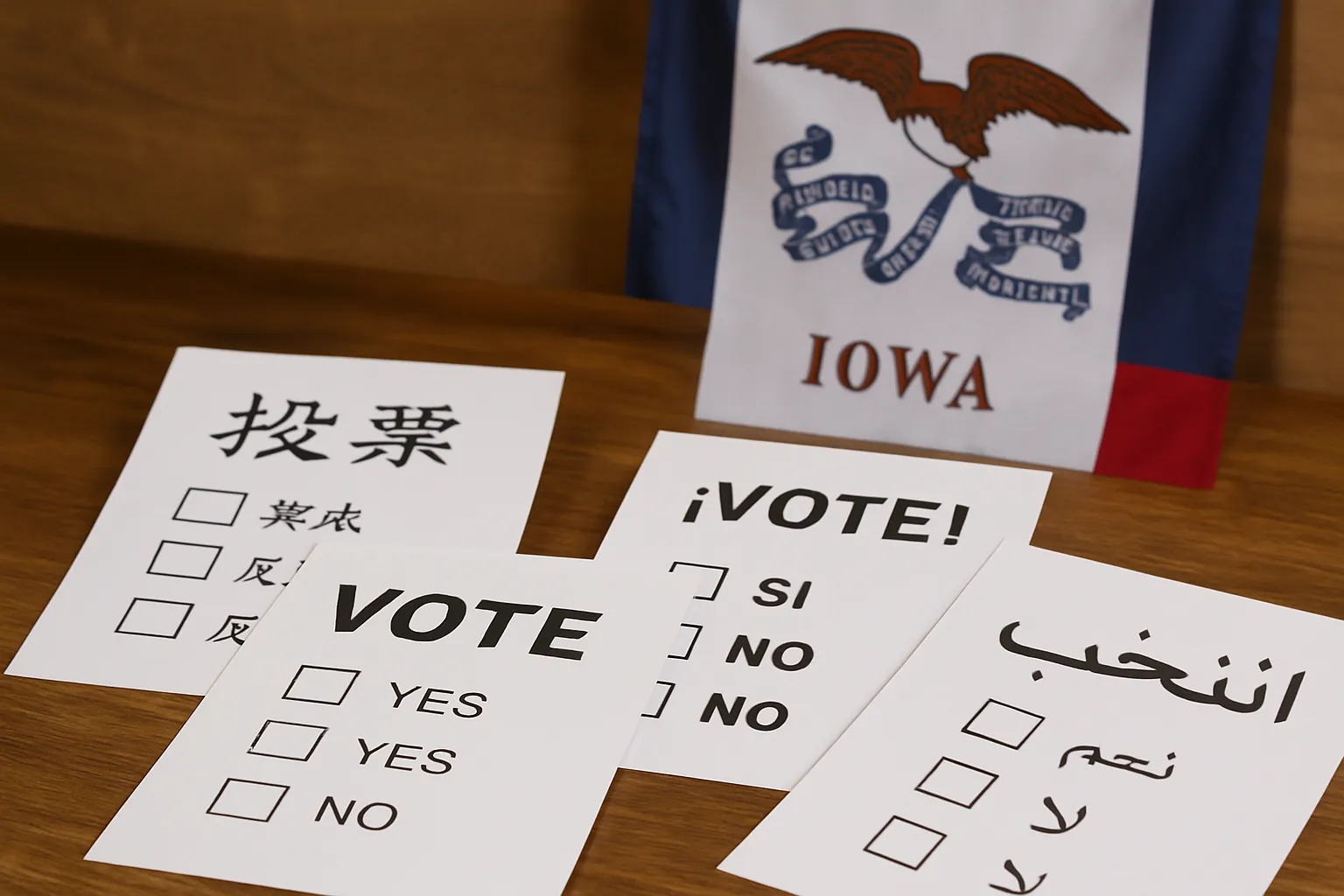
Imagine standing in a polling place, surrounded by ballots and forms that you struggle to read. For over 50,000 registered voters in Iowa whose primary language isn’t English, this isn’t a hypothetical scenario—it’s a reality re-affirmed by the Iowa Supreme Court’s latest decision. On June 21, the court reversed a lower court ruling, reinstating a 2002 law that mandates all official voting materials in Iowa must be printed exclusively in English, unless their translation is necessary to secure constitutional rights.
The ruling came in response to a lawsuit brought by the League of United Latin American Citizens (LULAC), which argued that the English-only requirement obstructed its voter registration efforts and imposed additional costs to serve non-English-speaking communities. The court’s response was procedural rather than substantive: LULAC was found to lack standing, as it couldn’t demonstrate a specific legal injury. “A litigant’s general interest in the proper interpretation and enforcement of the law is not a cognizable injury sufficient to support standing to sue,” the court stated in its opinion—echoing the principle that dissatisfaction, even if grounded in significant public interest, often fails as a basis for judicial intervention (da71fcba53b74194baf6c78e04085f52).
This decision arrives as the latest development in a protracted battle over language access and voter rights. A district judge had previously lifted Iowa’s two-decade-old ban on bilingual voting materials, allowing localities to produce ballots, voter registration forms, and absentee applications in Spanish and other languages. That reprieve is now gone. The reinstated ban traces back to a 2008 lawsuit originally filed by a coalition of conservatives and English-only advocates—none of whom represented Iowa’s large and growing Latino or immigrant communities (d9fc62f866ac4434a6deb91bb6ebb81b).
Who Gets Left Out: Democracy, Language, and Standing
Election access is about more than party lines—it’s about who gets to participate in the most basic promise of democracy. The court’s focus on legal standing—rather than the actual question of whether English-only voting documents are fair—illustrates the narrow corridors through which justice sometimes travels. LULAC, Iowa’s largest and oldest Latino advocacy organization, says it has spent “thousands of hours and tens of thousands of dollars” counteracting confusion generated by English-only materials. Yet the justices, echoing a conservative approach to legal thresholds, decided this organizational burden didn’t amount to a recognizable harm under Iowa law.
Is this merely a procedural footnote, or does it expose a deeper fissure in how our courts interpret access to democracy? Joe Enriquez Henry, president of LULAC Council #307, did not mince words: the ruling is “totally wrong” and, in his view, shreds the values enshrined in the U.S. Constitution. “Language should never be a barrier to exercising the constitutional right to vote,” he told reporters, warning that the impact extends far beyond the Latino community to refugees, new citizens, and rural Iowans with limited English proficiency (d9fc62f866ac4434a6deb91bb6ebb81b).
“Language should never be a barrier to exercising the constitutional right to vote.” – Joe Enriquez Henry, President, LULAC Council #307
The United States is no stranger to language debates, but voting rights often represent the high-water mark for such disputes. Historical parallels abound; from literacy tests that disenfranchised Black voters for generations to modern voter ID requirements, barriers to full participation have always arrived cloaked in bureaucratic language and steely formality. The Voting Rights Act of 1965, one of the era’s crowning civil rights achievements, eventually mandated that jurisdictions with substantial language-minority populations offer election materials in those voters’ native tongues. The Supreme Court’s latest action, while rooted in state-specific legal wrangling, stands in tension with those longstanding federal protections.
The Stakes: Integration or Exclusion?
Why cling to English-only voting documents in a country whose prosperity is built on diversity and pluralism? Secretary of State Paul Pate framed the ruling as an affirmation that Iowa is “administering election laws securely, fairly, and in accordance with state and federal laws,” presenting the decision as balanced governance (d9fc62f866ac4434a6deb91bb6ebb81b). Influential conservatives paint similar policies as bulwarks against confusion or fraud, but actual evidence of such problems arising from bilingual voting forms is vanishingly slim. On the contrary, restricting language access amplifies disenfranchisement, fostering distrust and suppressing turnout among communities already marginalized by geography, income, or immigration status.
A closer look reveals that Iowa is not alone. According to the Brennan Center for Justice, 27 states impose some form of “official English” law, a legacy of culture wars more focused on restriction than inclusion. The U.S. Census Bureau notes that nearly 1 in 12 U.S. residents speaks English “less than very well.” Denying these voters accessible ballots isn’t about preserving civic order—it’s about controlling the borders of our democracy.
LULAC’s Joe Enriquez Henry and others remind us what is at stake: trust, legitimacy, and the baseline of equal participation. Harvard political scientist Alexander Keyssar, whose work exposes the shifting barriers to the ballot box, has warned that when officials prioritize rigid legal procedures over broad enfranchisement, the result is a democracy by exclusion, not by consent. “If we make the right to vote contingent upon mastery of the dominant language, we undercut the very notion of equal citizenship,” Keyssar wrote in his landmark study, The Right to Vote.
The U.S. Supreme Court may not have weighed in directly on Iowa’s narrow standing ruling, but national trends are moving in parallel—recent years have seen a flurry of lawsuits over state attempts to limit multi-language voting access. The difference, this time, is that Iowa’s highest court signaled the door to further legal challenges may be effectively closed, at least unless individual voters themselves can prove personal harm. For civil rights advocates, it’s a chilling precedent.
The future of Iowa’s democracy depends on whether we build walls at the ballot box or pathways to participation. The arguments are more than abstract legalisms—they’re about the kind of America we wish to be: fearful and gatekeeping, or welcoming and just. For now, Iowa’s English-only policy stands as a sobering reminder of both the power and the limits of the courts to either expand or restrict the most fundamental democratic right of all.
