
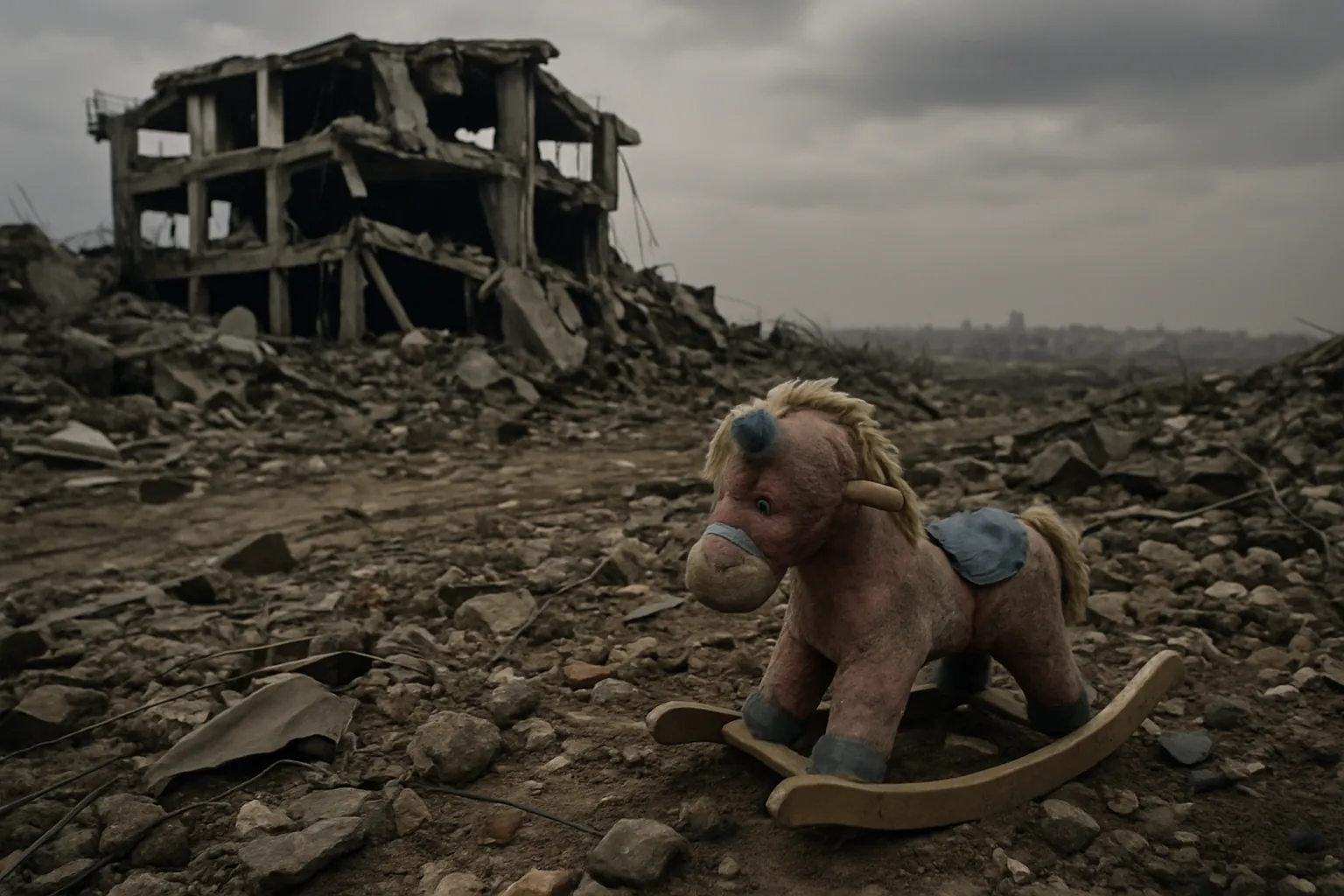
The Night Gaza Trembled: Strikes and Suffering in Khan Younis
A city shrouded in darkness, punctuated by the thunder of warplanes—this is what residents of Khan Younis endured during the second consecutive night of relentless Israeli airstrikes. According to the Nasser Hospital morgue, 54 bodies—some unidentifiable, some containing the remains of multiple people—were brought in after just one night of bombardment. Cameras captured weary medical staff, overwhelmed family members, and the sickening procession of body bags, each haunting testament to the escalating cost of this intractable conflict.
Among the 54 killed were journalists, children, and entire families—a devastating cross-section of a population already battered by months of siege and displacement. The dead included Hasan Saman, a correspondent for Al Araby TV, whose family of 11 perished with him. This was not an isolated incident. AP journalists counted ten separate strikes on Khan Younis that night, a sampling of the wider devastation stretching from northern to southern Gaza.
How did we arrive at this precipice? The roots, of course, run deep. The Israeli military campaign, now reaching a brutal peak, is a response to the October 7, 2023, Hamas-led assault in which 1,200 Israelis were killed and dozens taken hostage. Israeli Prime Minister Benjamin Netanyahu has since promised intensified operations, vowing to root out Hamas control at any cost. But as heavy munitions pound densely populated neighborhoods, the rationalization for such excessive force has become a global flashpoint.
Escalation Amid Isolation: Political Maneuvers and International Frustration
Never before has the phrase “double standard” felt so apt. As Israeli jets tore through the night sky over Gaza, U.S. President Donald Trump toured the Middle East, pointedly omitting Israel from his agenda. This conspicuous absence underscores how far the region has drifted from even symbolic efforts at peace or humanitarian relief. Israeli officials reportedly hoped that Trump’s presence in Gulf states might spark diplomatic momentum—perhaps a ceasefire, or at the very least, a resumption of critical aid shipments. Instead, their hopes were dashed as the cycle of violence continued unabated.
The continuing blockade of Gaza—now in its third month—exacerbates the carnage unleashed from above. The United Nations and Human Rights Watch have warned in unambiguous terms: Israel’s stated plan to seize control of Gaza would almost certainly violate international humanitarian law and amplify a crisis already teetering on the edge of true catastrophe. According to the World Health Organization, 90% of Gaza’s population has been displaced. Medical supplies are running dry, with only enough left to treat 500 children suffering acute malnutrition—a fraction of those in need. At the morgues, some victims arrive in pieces, forcing grieving families to share the same body bag.
Why, in the twenty-first century, does the world accept this as the status quo? A closer look reveals a potent mix of political inertia, strategic calculation, and the persistent shadow of dehumanization that so often accompanies asymmetric conflict. The Israeli government justifies these strikes—often targeting alleged Hamas leaders, like Mohammed Sinwar—by citing the need for security. Yet this argument grows increasingly brittle as the civilian toll mounts.
“Civilian suffering in Gaza has reached levels that should shock even the most jaded observer. It is past time for an honest reckoning with the consequences of strategies that treat entire populations as collateral damage.”
Human rights experts point out that such military operations, which consistently kill more civilians than combatants, erode the moral authority of any democracy that claims to value life and equality. As Amnesty International’s director for the Middle East, Heba Morayef, notes, “There are no purely military solutions to what is, at its core, a political and humanitarian crisis.”
History, Responsibility, and the Search for a Better Path
The sad irony of this moment is inescapable. The logic of overwhelming force—promoted again and again by hardline political factions—has led neither to lasting security for Israel nor meaningful relief for Palestinians. Instead, it has fostered generational trauma, deepened divisions, and subverted hopes for coexistence.
Historical precedent offers little comfort but abundant warning. American wars from Vietnam to Iraq have repeatedly shown that toppling an adversary through superior firepower rarely leads to sustainable peace. Former U.S. diplomat Aaron David Miller, speaking recently to NPR, drew explicit parallels to these failed attempts at “pacification,” emphasizing that “the longer such campaigns drag on, the harder it becomes to reestablish stability or any sense of trust among traumatized populations.”
Beyond that, ongoing Israeli policy has far-reaching consequences not only for Gazans but for Israeli society itself. Military escalation is incredibly costly—financially, morally, and in terms of Israel’s international standing. Increased criticism from the global community, including many of Israel’s traditional allies, has grown sharper as footage from Gaza reaches the world’s screens. Already, support for Israeli policies is splintering among progressive Jewish organizations and members of Congress, who argue persuasively for a swift return to diplomacy, humanitarian corridors, and real accountability.
What is the path forward? While the rise of authoritarianism, ethno-nationalism, and unchecked militarism have dominated headlines globally in recent years, there is a growing recognition among thoughtful leaders that sustainable security must be rooted in justice and dignity for all. Israeli and Palestinian human rights advocates alike are calling for an immediate ceasefire, unfettered humanitarian access, and a recommitment to dialogue. Even within Israel, voices like former Shin Bet director Ami Ayalon have stressed that “a secure future for Israel is bound to the aspirations and well-being of our neighbors.”
Any honest reckoning must confront not only the suffering of today, but the moral choices shaping tomorrow. As nightly bombardments shatter what is left of Gaza’s towns, and families count their dead, the words of the late Harvey Milk echo across decades: “Hope will never be silent.” The world cannot afford to silence its hope—nor its outrage—at a crisis that is, at its core, a test of common humanity.
