
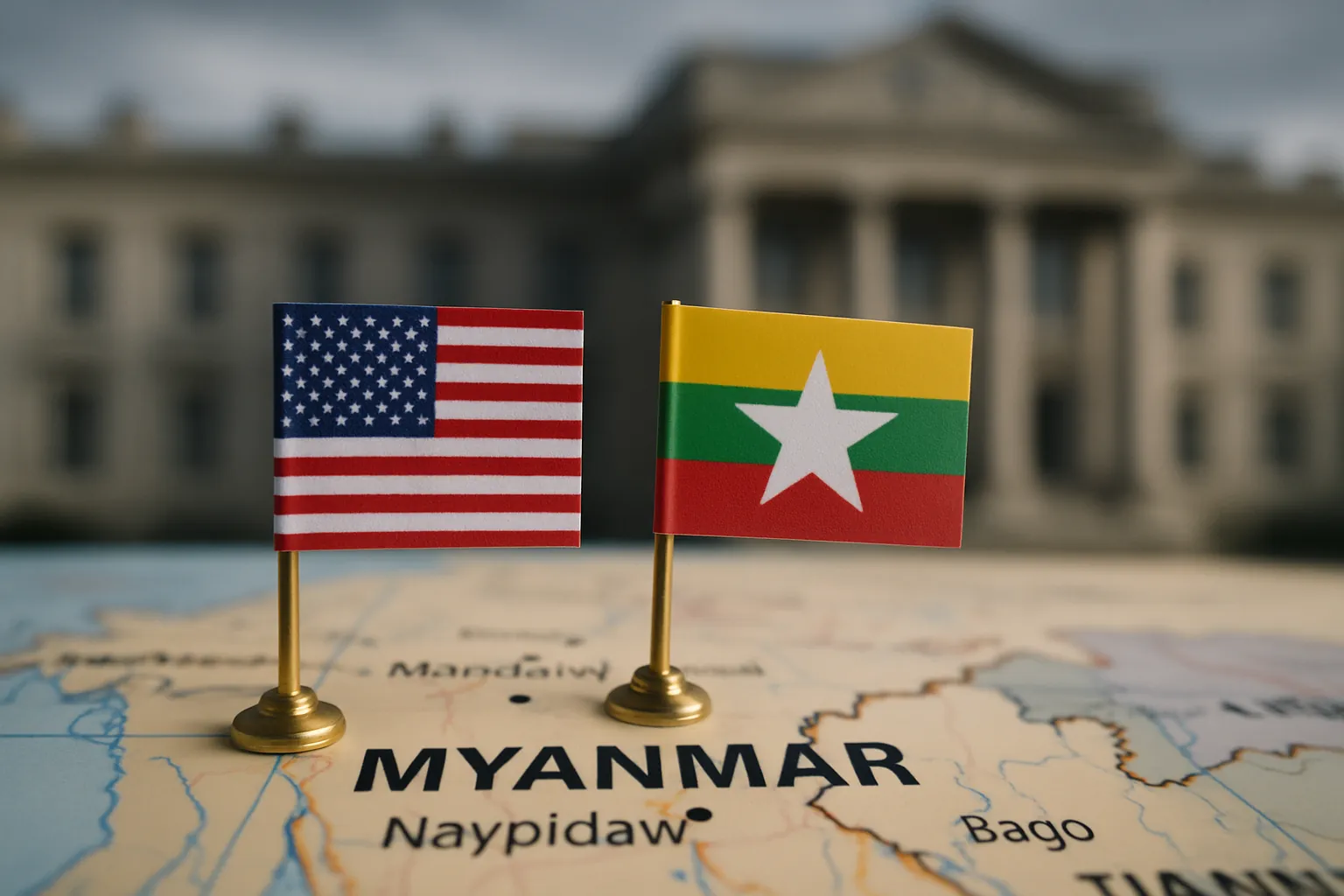
A Letter from the Shadows: Myanmar’s Junta Courts Trump
No one expected Min Aung Hlaing, Myanmar’s embattled military leader, to send a warm letter to former President Donald Trump. The overture was more than diplomatic pageantry—it was an audacious grasp for international legitimacy at a time when the world views Myanmar’s junta as an international pariah. Praising Trump’s “strong leadership” and drawing an improbable comparison between his own 2021 coup and Trump’s baseless claims of election fraud, Min Aung Hlaing effectively tried to tie their political fates together in a swirl of grievance and self-justification.
This letter—Myanmar’s first known direct communication with any part of the U.S. government in four years—followed a standard Trump tariff threat. On its face, Trump’s 40% tariff letter looked like boilerplate: dozens of similar missives landed on desks of world leaders the same day. For the junta, however, it was a symbolic opening and a chance to claim public “recognition” from Washington—even if it was little more than bureaucratic mechanics from an administration with a record of transactional, erratic foreign relations.
Min Aung Hlaing’s response was public, effusive, and self-serving. He thanked Trump for “regulating” U.S.-created broadcasters like Voice of America and Radio Free Asia—both critical lifelines for independent news in Myanmar—whose Burmese-language operations had shuttered after Trump-era budget cuts. And with a sense of calculated opportunism, the junta chief pressed for the U.S. to drop sanctions imposed after the brutal 2021 coup against Aung San Suu Kyi’s elected government.
Grievances, Comparisons, and Dangerous Parallels
A closer look reveals just how reckless these parallels are. By likening Myanmar’s coup d’état to purported U.S. election fraud—allegations roundly rejected in American courts and by independent observers—Min Aung Hlaing appropriates the language of false victimhood as a tool for self-exoneration. The military disrupted a fragile, fledgling democracy, detaining elected leaders, crushing dissent, and triggering civil war. Trump, on the other hand, led a failed campaign to delegitimize the U.S. democratic process, culminating in a violent assault on the U.S. Capitol.
Expert observers have been quick to call out the dangers of such rhetorical convergence. Richard Horsey, senior Myanmar adviser at International Crisis Group, cautioned that this outreach might allow the junta to leverage “some sort of renormalisation with the US through the back door.” As Horsey noted, this is the first time the U.S. has issued even a procedural, public letter to Min Aung Hlaing, a shift that the regime is now eager to weaponize as validation in its PR offensive at home and abroad.
“When autocrats co-opt the language of democracy to excuse their own authoritarianism, they cheapen global norms and embolden others to follow suit.”—International Crisis Group analysis
This move is more than just a consular oddity. It illustrates the risks inherent in U.S. inconsistencies—where statements meant to be routine are adroitly spun by authoritarian regimes into supposed endorsements. The State Department, for its part, continues to sanction Min Aung Hlaing and his allies for using “violence and terror to oppress the Burmese people and deny them the freedom to freely choose their leaders.” Yet the confusion sown by the mere existence of a letter—no matter the original intent—shows how careful democratic nations must be in their diplomatic signaling, especially in an era rife with “alternate facts” and weaponized narratives.
The Disappearing Voice of Dissent—and U.S. Accountability
One of the most sobering aspects of the junta’s letter is its glee over the shutting down of Voice of America (VOA) and Radio Free Asia’s Burmese services, after Trump-era funding cuts devastated U.S.-created media outlets noted for their fearless coverage of Myanmar’s conflict and corruption. This loss goes far beyond dollars and cents. For ordinary people inside Myanmar, VOA and RFA were among the few reputable sources for news not controlled by the regime. Their closures represent the disappearance of critical voices, limiting both international scrutiny and local resistance.
The targeting of independent media, both overtly by the junta and inadvertently by shifting U.S. priorities, highlights a broader crisis: When America telegraphs isolationist tendencies or undermines its own global institutions, repressive governments everywhere take notes—and take advantage. In Myanmar, this vacuum is filled by an emboldened military and a populace living under siege.
Looking at history, American ambivalence toward international democratic progressivism has always come with unintended consequences. From the post-Vietnam retreat in the 1970s to the Trump-era skepticism of alliances and democracy promotion, a pattern emerges: isolated, transactional engagement breeds chaos and leaves the most vulnerable exposed. Harvard political scientist Erica Chenoweth argues that “retreating from support for civil society and independent media doesn’t just forfeit influence; it cedes the ground to authoritarianism.”
So where does this leave progressives? It demands vigilance. It requires solidarity with activists, journalists, and ordinary people on the front lines of democratic struggle overseas. And, above all, it means demanding that U.S. leaders—whatever their party—remember the weight their words and actions carry, not just for geopolitics but for the daily lives of people caught in the crossfire of tyranny.
Toward a Responsible Foreign Policy
Tangible action is possible. Reinstating or expanding funding for independent media and civil society groups in Myanmar can help restore vital channels of truth and hope. More broadly, rigorous, consistent engagement—carried out with moral clarity and an unwavering opposition to violent repression—is the only way to prevent authoritarian actors from exploiting American inconsistency for their own gain.
You don’t have to be a foreign policy expert to see what’s at stake. The Myanmar junta’s calculated praise of Trump should be a wake-up call for anyone who believes in the fundamental American creed: that freedom, justice, and democracy are universal rights—not bargaining chips. Let us not forget that in the modern world, even something as simple as a generic tariff letter can be twisted to bolster regimes that thrive precisely when autocrats see opportunity in American ambivalence.
If history offers any guidance, it’s that silence and confusion embolden the worst actors. The U.S. must choose clarity over ambiguity, accountability over opportunism, and solidarity over isolation—because lives, freedoms, and the very credibility of democracy itself are on the line far beyond our own borders.
