
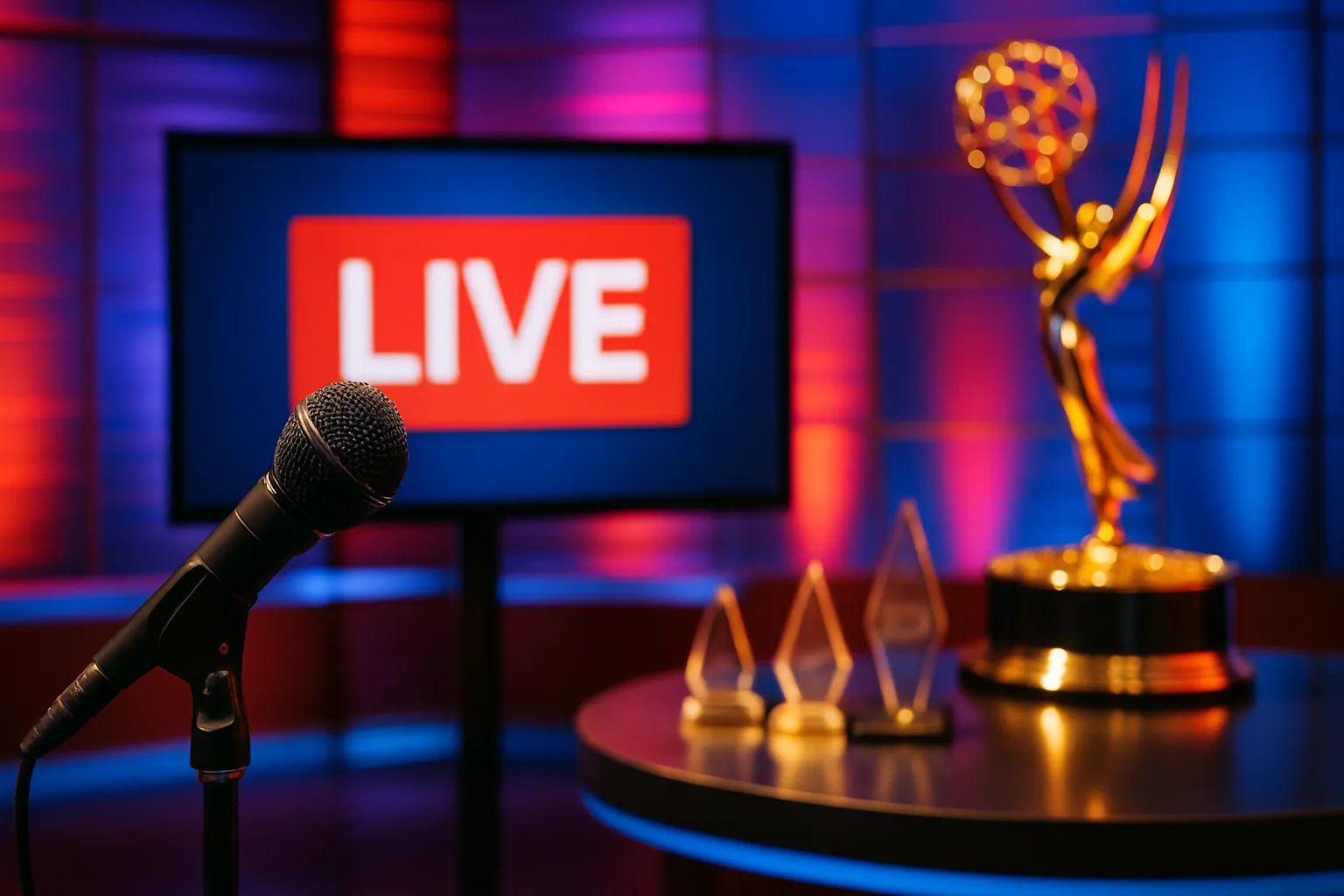
The Emmys, Satire, and a Bleeped Broadside
Television’s biggest night often doubles as a battleground for culture and free speech, but this year’s 2025 Emmy Awards saw John Oliver’s wit and candor grab the spotlight — and the censors’ button. When the Last Week Tonight host bounded onstage to accept his show’s third consecutive Emmy for Outstanding Scripted Variety Series, viewers might have expected sharp satire. Few predicted, though, that a significant chunk of Oliver’s acceptance speech would be bleeped out on CBS’s live broadcast.
What prompted the network to hit mute? With his trademark blend of mischievous humor and stinging commentary, Oliver turned to host Nate Bargatze and quipped about the “charity jar” — a clever mechanism Bargatze had implemented: for every speech that ran over 45 seconds, $99,000 would go to the Boys & Girls Clubs of America. Oliver, never one to back away from breaking the rules or skewering the wealthy and powerful, fired off an expletive-laden line in Bargatze’s direction as he tried to power through his thanks and (perhaps) nab back some of the charity’s newfound riches.
This was not the first time CBS has censored Oliver. Viewers with long memories recall last year’s ceremony when his speech met the scissors. In an industry built on performance and political edge, who gets silenced, and why, is rarely without greater meaning. As The Hollywood Reporter observed, these repeated interruptions seem increasingly pointed in a media landscape fraught with questions about what voices are deemed deserving of airtime.
Victory Amid Shifting Sands in Late-Night
There was a palpable undercurrent of solidarity and anxiety among late-night hosts at this year’s Emmys. As Daniel O’Brien, Last Week Tonight’s senior writer, accepted the writing award, he remarked, “Solidarity with all political comedy writers, while that is still a type of show that’s allowed to exist.” O’Brien’s words strike deep when you consider what’s happening on the late-night landscape: just weeks prior, CBS pulled the plug on The Late Show with Stephen Colbert after a decade on air. Officially, CBS blamed the cancellation on financial restructuring. Yet Colbert’s recent on-air criticism of Paramount’s $16 million settlement with former President Donald Trump set rumor mills alight, raising serious concerns about censorship and the chilling effect of corporate interests on satire.
Producers and comedians alike are left to wonder: Has American political comedy reached a tipping point? Harvard’s media scholar Emily Nussbaum points out that “Late-night used to be a laboratory for holding public figures accountable through humor — it has become a bellwether for the state of free expression in media.” The new Emmy category, created in 2023, reflects the genre’s ongoing identity crisis. Previously, Last Week Tonight competed and dominated in Outstanding Variety Talk Series, putting it head-to-head with daily talk giants. Now segmented into Scripted Variety, the show stands virtually alone, a testament to both its poetic sophistication and to the shrinking field of in-depth, satirical news analysis on network TV.
“Political humor is becoming riskier business. When critics are muzzled and satire meets the scissors, what we’re left with is not just less laughter, but a democracy operating with blinders on.”
Beyond that, the night was not short on lighter moments. Survivor host Jeff Probst animated the proceedings by bantering with cardboard cutouts of the nominees — a moment of levity that stood in contrast with the genuine tension pervading the room. When Probst finally announced Last Week Tonight as the winner, the crowd’s applause carried a distinct sense of relief for one of the genre’s last standing institutions.
Network Pressure, Populist Targets, and the Future of Satire
John Oliver’s win occurred as tensions flared beyond the footlights. His show’s persistent skewering of Trump, Elon Musk, and the right’s icons has regularly set the stage for online outrage. The recent viral dustup — with Oliver lampooning the never-ending Trump-Musk feud as a “billionaire bromance with too much free time and too few filters” — shows that even in an era awash with digital content, late-night retains formidable power to shape, provoke, and discomfort. That power comes at a cost.
Conservative critics frame Oliver’s Emmy sweep as proof of Hollywood’s liberal bias rather than of his show’s incisive commentary and research. But such complaints ignore the essential democratic function performed by comedy that questions authority and blends truth with ridicule. Taking the long view, historian Robert Thompson notes that shows like Last Week Tonight stand in the lineage of The Smothers Brothers and Saturday Night Live during its 1970s heyday, leveraging laughter as both shield and sword against political hypocrisy.
A closer look reveals the stakes aren’t just industry jobs or award statues; it’s the role of satire as social conscience. When CBS censors jokes and corporate settlements muzzle outspoken hosts, the real casualty is a public’s right to robust, unfiltered debate. According to a recent Pew Research Center report, 69% of Americans believe political comedy is important to democracy — a figure that climbs among younger and more diverse viewers.
Is this growing discomfort with sharp, progressive satire a passing phase, or the harbinger of a more sanitized media horizon? The answer, as always, is determined by those willing to speak — and laugh — truth to power. For now, John Oliver’s relentless voice remains heard, if sometimes only in bleeps and blurs.
