
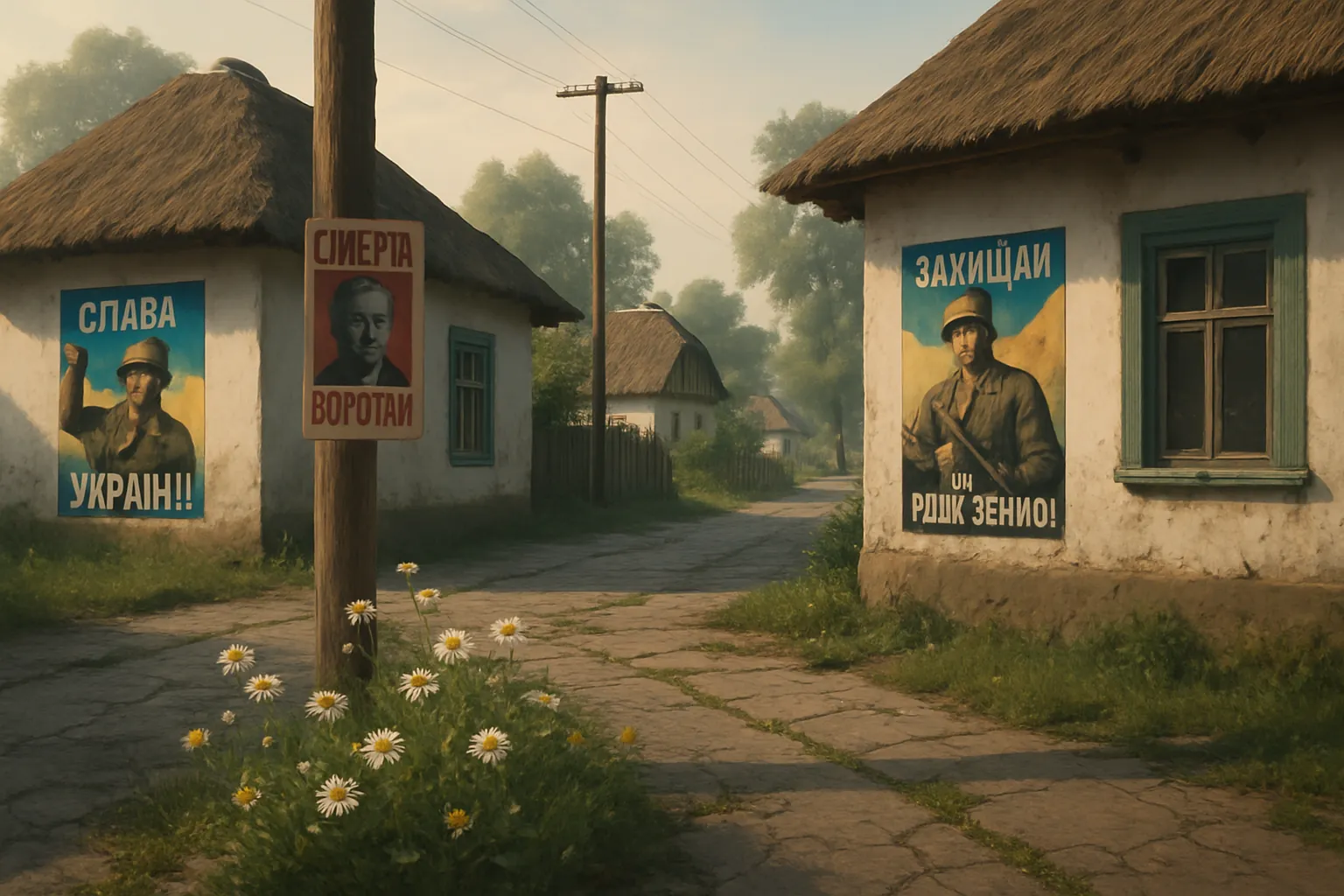
The Kremlin’s War for Young Minds
Ten-year-old Daria* walks nervously into her sixth-grade classroom in Donetsk, her mind racing with questions. The school—once a place for community and learning—now hosts a very different lesson: a history of Donbas and “Novorossiya,” meticulously crafted by Kremlin aides and presented as truth. Daria’s textbook tells her that she, her family, and her city have always belonged to Russia, that Ukraine is an “enemy,” and that her mother tongue is unworthy of daily use. This is the frontline of a battle not for territory, but for identity itself.
Russia’s Military-Historical Society (RVIO), under guidance from Kremlin ideologist Vladimir Medinsky, has introduced these new region-specific textbooks to occupied schools in Donetsk and Luhansk. Billed as part of an official “regional component” of Russia’s unified history curriculum, these materials amplify Moscow’s narrative of an “eternal connection” between the Donbas and Russia. Ukraine’s Center for Countering Disinformation (CCD) warns that these are not harmless lessons in local lore—they are weapons of erasure designed to overwrite Ukrainian identity and normalize the Kremlin’s occupation.
Institutionalizing Indoctrination: Propaganda by Design
Behind these textbooks lies a sprawling, state-sponsored machine. In the past two decades, Russia has built what one analyst called a “well-functioning apparatus of indoctrination.” Schools, youth groups, museums, religious organizations, and, now, digital media have all fused into a tight web designed to bind youth to the state’s vision. Since the full-scale invasion of Ukraine in 2022, this effort has accelerated dramatically. According to a recent report by the Wilson Center, the Kremlin has earmarked 66 billion rubles (roughly $787 million) for so-called “patriotic education” in 2025 alone—an increase of 20 billion rubles over 2024’s already staggering budget.
What does that funding buy? Everything from special “courage lessons”—where violence against Ukraine is justified—to youth festivals, mobile propaganda exhibitions, and state-run museums glorifying military conquest. Russian schools now routinely celebrate militarized holidays with patriotic rituals and encourage children to write essays lauding Russian soldiers in Ukraine. The grand design is clear: systematic cultivation of loyalty not just to Russia, but to Vladimir Putin’s regime and its war machine.
Youth indoctrination on this scale is not without precedent. The revival of Soviet-era organizations such as the Pioneers and Komsomol—famed for infusing rigid ideology into every childhood game, camp, and extracurricular—speaks volumes. William Pomeranz, acting director at the Kennan Institute, argues, “We are seeing a return to the instrumentalization of youth that defined the Soviet experiment. The difference now is the full-spectrum approach: schools, churches, the internet, and even children’s cartoons are now tools of the state.”
Youth as Information Warriors: The Next Generation of Propaganda
The attention to indoctrinating teenagers is equally chilling. In occupied regions, high school students are being enrolled in the euphemistically named “Young Info-Warrior Course.” Marketed as a journalism class, it is, in reality, an incubator for pro-Russian disinformation. Students are trained to create social media content that glorifies Russia and demonizes Ukraine—with the ultimate goal of producing a reservoir of homegrown, digitally savvy propagandists. Outstanding participants are singled out, recruited by so-called “mentors”—in fact, seasoned propagandists—who exploit these young people’s aspirations for popularity and stability in a world turned upside down by war.
Russian authorities justify this as patriotic education, but the intent is to build a generation impervious to the truth. The National Resistance Center of Ukraine notes that these efforts are complemented by mandatory courses in morality and historical memory, constructed to evoke pride in Russian imperial ambitions and collective suspicion of anything perceived as Western or Ukrainian.
“It’s not just about changing what children know—it’s about reshaping what they feel. When war is normalized in the classroom, children learn early that critical thinking is dangerous, and loyalty is everything.”
— Tatiana Stanovaya, Carnegie Russia Eurasia Center
Beyond that, teachers themselves are now obliged to lead “courage lessons” and observe mandatory patriotic rituals. The identities of many of these “teachers”—often newly arrived from Russia—are shielded, raising concerns about oversight, educational quality, and the psychological safety of Ukraine’s children. According to Ukrainian education analysts, the Kremlin’s strategy is not just assimilation but subjugation: replacing Ukrainian history, language, and memory with a militarized, Russified narrative. Ultimately, these children are deprived of any sense of independent thought or cultural belonging outside the confines the Kremlin dictates.
Historical Parallels and Global Lessons
A closer look reveals chilling echoes from darker chapters of 20th-century history. Rewriting textbooks, politicizing youth organizations, and criminalizing languages of the “other” were core tactics not only in Stalin’s Soviet Union, but also in fascist regimes across Europe. Harvard historian Serhii Plokhy, interviewed by NPR, points out, “The very methods the Kremlin now uses—forced assimilation, control of education, and youth militarization—are lifted straight from the Soviet and Nazi handbooks on occupation.” Plokhy warns that such tactics aim not only at the present, but at the erasure of an entire nation’s past and future.
What happens when formative years are dominated by a narrative contrived for imperial gain? Studies on post-Soviet societies reveal young adults often emerge with a sense of alienation—suspicious of outsiders, ill-equipped for civic engagement, and traumatized by enforced silence. According to a 2023 Pew Research survey, Ukrainian parents in occupied territories report increasing anxiety about their children’s worldview, fearing a permanent rift from their true homeland and values.
Yet, history also shows the limits of indoctrination. Repressed identities can simmer underground, only to reemerge stronger in moments of upheaval. Whether in the Baltic states’ “Singing Revolution,” or in Czechoslovakia’s Velvet Revolution, youth eventually reclaimed lost languages and identities, fueling resistance and renewal. The crucial difference, though, is that the world today can see what’s happening—educators, advocates, and international organizations now have the tools and platforms to expose, challenge, and counter such manipulation in real time.
The Stakes: Why It Matters Now
If you believe that every child deserves access to truthful education, critical thinking, and cultural dignity, the stakes in occupied Ukraine should be all too clear. This is not a parochial matter of textbook content or language policy. It’s a test of whether the international community is prepared to defend the principles of self-determination, diversity, and freedom of thought—or whether autocrats are permitted to remake reality itself for a generation of the vulnerable and voiceless.
*Name changed for privacy.
