
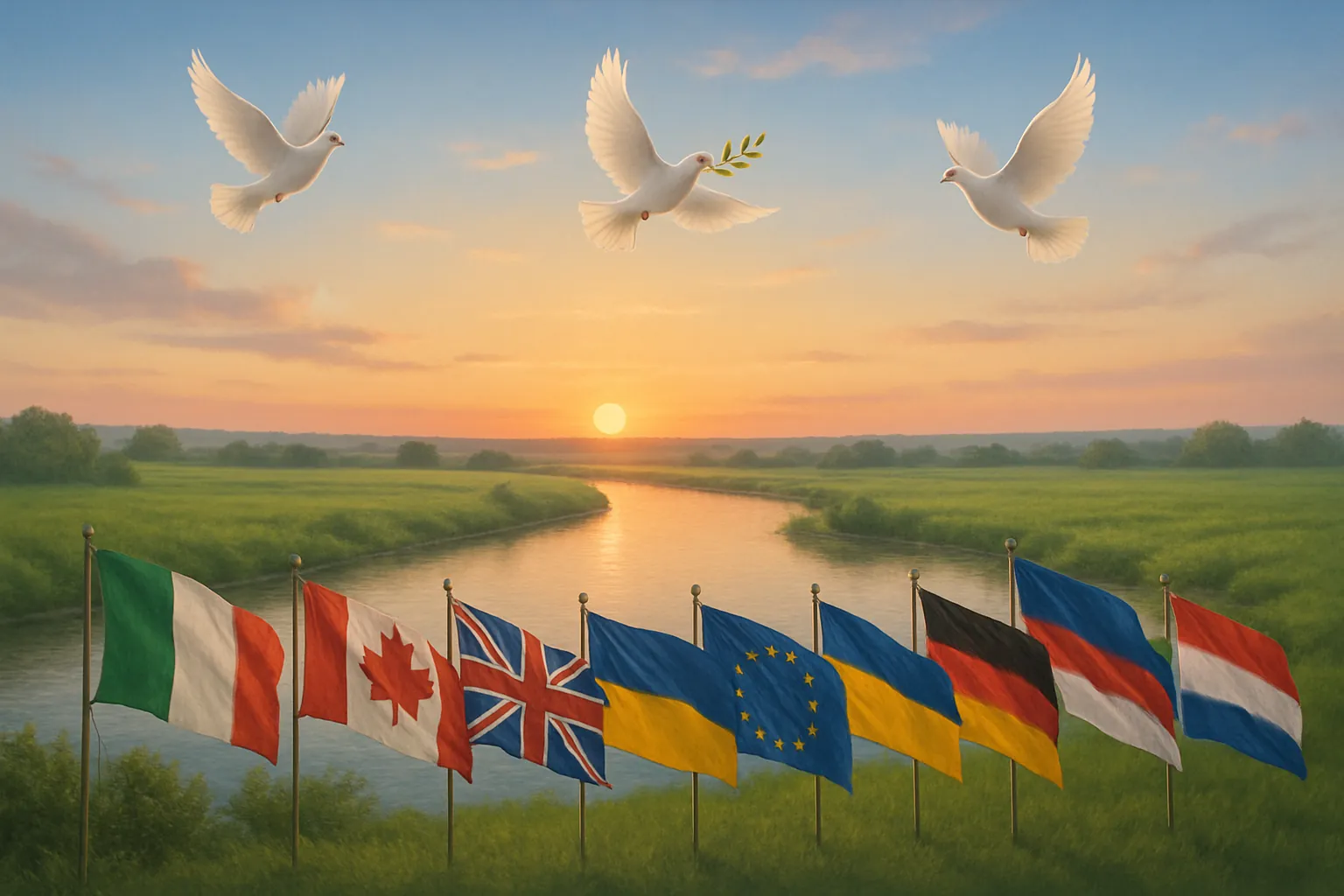
The Coalition of the Willing: Europe’s New Pledge to Ukraine
In a decisive moment that may reshape Europe’s security landscape for years to come, French President Emmanuel Macron announced this week that 26 countries are prepared to send or support troops in Ukraine once the guns finally fall silent. The announcement, made in Paris at a summit of the “Coalition of the Willing,” signals a bold, collective stand against Russian expansionism and a refusal to allow Ukraine’s sovereignty to be swept away by force.
This is not saber-rattling but a calculated commitment—a guarantee that when the dust settles, Ukraine will not be abandoned to the predations of a revanchist Kremlin. Instead, an unprecedented, multinational reassurance force will stand ready, not to wage war, but to secure an uneasy peace and form a visible deterrent against future escalations. “Our partners understand what the basis for security guarantees should be,” Ukrainian President Volodymyr Zelensky declared, describing the pledge as the “first concrete step” toward reimagining Ukraine’s future safety. The sentiment was echoed across the West, from British Labour Prime Minister Sir Keir Starmer to high-level envoys from Washington, whose voices united in affirming an ‘unbreakable’ pledge to Ukraine.
Twenty-six nations—including heavyweights like France, Germany, the UK, and others—are already preparing units for geographic deployment, though the precise locations remain under wraps, a deliberate move to avoid tipping off Moscow. According to the summit, this force will initially operate in non-frontline zones, focusing on maintaining order, protecting infrastructure, and guaranteeing that the terms of any ceasefire or peace deal are not unilaterally violated.
The Practicalities—And the Politics—of Security Guarantees
Beyond that, the pledge goes well beyond boots on the ground. In an increasingly complex and hybrid warzone, the coalition’s commitment spans land, sea, and air. Macron made clear that military presence would mix troop deployments with enhanced naval patrols and aerial surveillance, creating as much a psychological bulwark as a physical one. There is a lesson in history here: much like the post-World War II occupation forces that stabilized Germany and Japan, these multinational contingents offer more than deterrence; they provide assurance to war-weary populations, demonstrating ongoing investment in their freedom and recovery.
Yet challenges loom large—with unity being easier in principle than in practice. While Macron emphasized that this force is “not intended to wage war against Russia,” Moscow will almost certainly interpret any such deployment as a provocation. Others within the coalition, particularly some Central and Eastern European states, are acutely aware of the razor-thin line separating reassurance from escalation. Harvard political scientist Serhii Plokhy points out that “security guarantees must be credible to deter, yet restrained enough to avoid dragging Europe into a wider confrontation.” The balancing act will demand deft diplomacy and constant coordination.
Another complication is the hesitant posture from Washington. Though former President Trump and current American envoys have signaled support for the plan, the specific contours of the U.S. commitment remain unresolved—a concern for many European leaders. According to a recent Pew Research Center study, American support for Ukraine, while still holding at a majority, faces mounting skepticism, particularly among Republican voters and America-first populists. As presidential election season heats up, Ukraine’s fate risks becoming a political football in the United States—a reality the coalition cannot ignore as it seeks durable, bipartisan guarantees.
Historical Echoes and the Stakes for Democratic Values
The stakes extend well beyond eastern Europe. A closer look reveals that the 26-nation coalition represents more than just a military alliance; it’s a defense of the postwar liberal order currently under assault. Consider the lessons of modern history: When aggressors act with impunity—whether in Czechoslovakia in 1938, Hungary in 1956, or Georgia in 2008—the ripple effects are rarely contained. Standing by Ukraine is about defending the international norms that underpin peace, equality, and collective security. The alternative—a return to spheres of influence enforced by brute force—should alarm anyone who cherishes democracy or the rights of small nations.
Those skeptical of intervention often point to the risk of escalation or draw facile comparisons to NATO’s role in previous conflicts. Yet, as NATO historian Mary Elise Sarotte argues, “Doing nothing in the face of aggression is itself a choice—one that seldom ends well for stability or justice.” The tragedy of appeasement in the 1930s lingers as a stark warning.
“Those who choose to look away from Ukraine’s plight are betting against the arc of freedom. History teaches us that emboldened autocracy is a threat to all, not just those on the front line.”
Critics on the right argue this coalition is too costly, too provocative, or simply not in America or Europe’s national interest. Yet this narrow vision ignores the broader responsibility of prosperous democracies to stand up for a rules-based world order. Leaving Ukraine in limbo does not buy peace—it invites future conflict. According to the Kiel Institute’s Ukraine Support Tracker, the costs of inaction—in terms of refugee crises, destabilized energy markets, and a permanently belligerent Russia—would vastly exceed those of upholding a credible, cooperative peace.
As these 26 nations prepare for a challenging new chapter, progressive voices must not only defend the coalition’s value but also hold leaders accountable for matching words with action. The work of peace is arduous and rarely immediate, but its dividends—a freer, fairer Europe—are worth every effort. If the world has learned anything from this century’s earlier forays into isolationism, it’s that security, justice, and democracy are always collective projects—and none can afford to ignore Ukraine’s call for help.
