
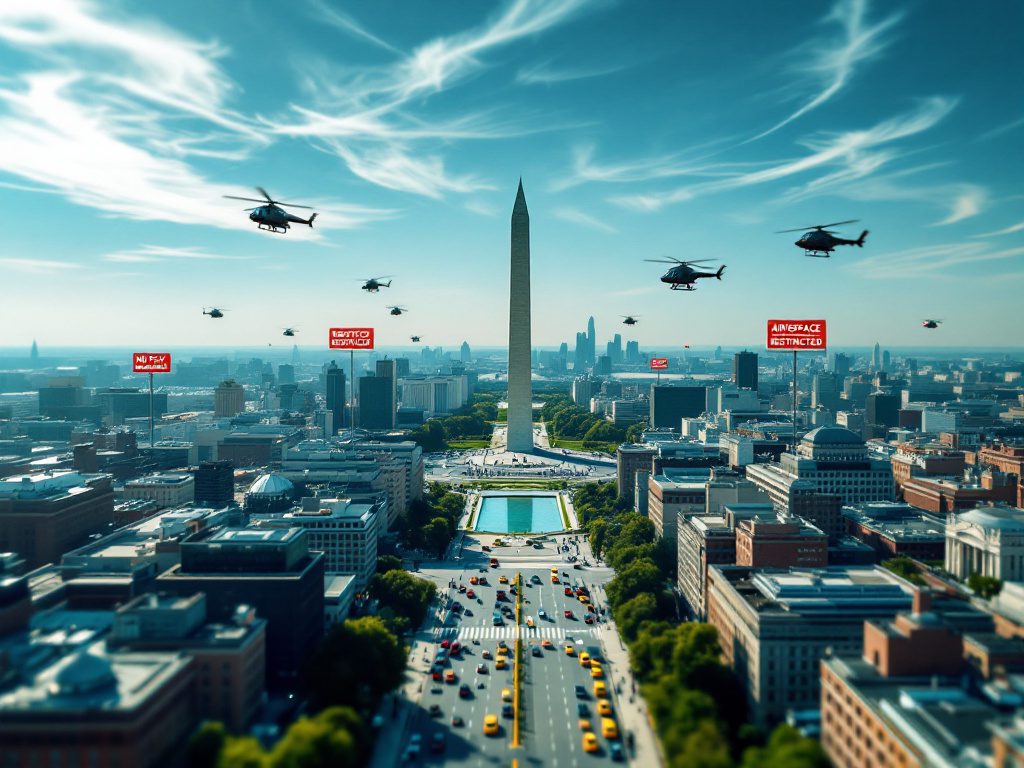
Turbulence Over D.C.: Army Helicopters, Airspace Safety, and Political Outcry
Thursday afternoon in the congested skies above Washington, D.C., air traffic controllers at Reagan National Airport abruptly cleared two inbound passenger jets to abort landings. Their rationale? A U.S. Army Black Hawk helicopter hovered near the Pentagon, its route designated as “scenic” according to an FAA document—a route choice enviable for its views, perhaps, but appalling for commercial traffic safety. In the aftermath, the U.S. Army’s 12th Aviation Battalion, based in nearby Virginia, has slammed the brakes on all helicopter training flights around the Pentagon and Reagan National. Safety concerns have finally forced action, prompting a hard look at the rules and routines guiding military aircraft in one of America’s busiest, most sensitive airspaces.
The catalyst is abundantly clear: January’s tragic midair collision between an Army Black Hawk and an American Airlines regional jet that killed 67 people remains a fresh wound. Lawmakers and transportation officials are demanding answers, hammering the military’s reliance on choppers for VIP transport—sometimes for what look like little more than convenience or pageantry. As the National Transportation Safety Board (NTSB) and Federal Aviation Administration (FAA) dig into overlapping investigations, the assertion of “following protocol” feels less reassuring by the day.
“How many more near misses—or casualties—should we tolerate before common sense prevails over military spectacle?” Transportation Secretary Sean Duffy thundered last week, pointedly suggesting Army brass “take a taxi or Uber” next time.
The resonance of Duffy’s call cannot be overstated. It’s not a new tension: The choreography of military and civilian aviation over the nation’s capital has always been an uneasy compromise. Still, these close calls and the tragic consequences of complacency beg the question: who is truly being protected by the current regime?
A Growing Pattern of Near Misses—and Growing Public Unease
Barely a week after the latest helicopter–airliner showdown, yet another blip arose when a Park Police chopper responded to an emergency, triggering go-arounds for three more commercial flights. A closer look reveals a troubling pattern: The airspace around Washington, D.C.—already the most complex in the country due to security restrictions, federal landmarks, and VIP movements—has become a hotspot for aviation near misses, a situation that’s as unsustainable as it is perilous.
Indignant lawmakers, including Senate Commerce Chair Ted Cruz and progressives like Senator Maria Cantwell, have joined in bipartisan rebuke. There’s a consensus: The blend of militarism and bureaucracy, with its mountain of memoranda about airspace deconfliction, has failed ordinary D.C. travelers and airline professionals alike.
Reagan National’s narrow flight paths hugging the Potomac River leave precious little margin for error. Veteran controller Jim Hall, who guided traffic at National for over fifteen years, put it bluntly: “D.C. airspace isn’t where you test the boundaries of civilian–military coordination.”
Behind the scenes, repercussions are rippling: Airport control tower managers have been reassigned following an internal review, with some quietly faulting a culture of deference to military flights at the expense of commercial safety. (Washington Post, May 2024) The FAA, in response to public and professional outcry, has now permanently restricted non-essential helicopter routes around Reagan National—a far cry from past practices that often subjected commercial pilots and passengers to abrupt last-minute changes dictated by high-speed military traffic.
History, of course, points to the stakes. The infamous January collision was not the first time lives were lost to overlapping and poorly coordinated flight operations. Aviation historian Sarah Winston notes that, since the Cold War era, Washington has seen periodic crises over airspace management, but none with this recent frequency and deadliness. “Each tragedy should be a catalyst for change, yet too often, reforms fade when public attention does.”
Rethinking National Priorities: Security, Spectacle, and Accountability
What does it say about our collective priorities when flights carrying hundreds of everyday Americans are imperiled so generals can commute over the Potomac with a better view? The politics of pageantry cannot come at the expense of public safety—a proposition progressives have echoed for decades, often to conservative indifference. Military prestige and tradition must never become a cover for dangerous inefficiency or unnecessary risk, especially with so many technological alternatives available.
Expert opinion sides decisively with reform. Harvard transportation policy analyst Laura Cheng emphasizes that the military’s logistical needs in the capital must “conform to current realities where commercial aviation is not merely a matter of convenience, but of essential infrastructure and public trust.” She and others call for a major overhaul—more transparent rules, stricter separation of flight paths, and rigorous justification for any exception to civilian flight priority.
Beyond that, the ongoing NTSB and FAA investigations signal long overdue change. President Biden, whose administration has pressed federal agencies to review safety lapses across domains, faces pressure from both parties in Congress to champion lasting legislative reforms. Some proposals on the table include codifying strict airspace quotas for military flights, expanding real-time civilian oversight of military air movements, and—crucially—making comprehensive safety data public.
Progressive critics are right to ask: Why should tradition outweigh the right of travelers to reach their destinations alive and unshaken? The battle isn’t against the military’s presence in the capital, but against the inertia and secrecy that have shielded unsafe practices from scrutiny. With lives at stake, the status quo is not a neutral position—it’s an endorsement of unnecessary risk.
The Path Forward: Who Owns D.C.’s Skies?
Moving forward, the Army’s review—and simultaneous FAA and NTSB investigations—offer a rare moment for substantive reform. The surge in bipartisan public anger suggests continued stonewalling will no longer suffice. Transparent, accountable airspace management must trump nostalgia for military spectacle or bureaucratic convenience. “Public safety,” as Duffy and others have hammered home, “cannot wait for the next headline-grabbing disaster to become policy.”
The question remains: Whose interests do we uphold when we draw the invisible lines above Washington, D.C.—those of the few who command helicopters, or the millions who fly beneath them?
