
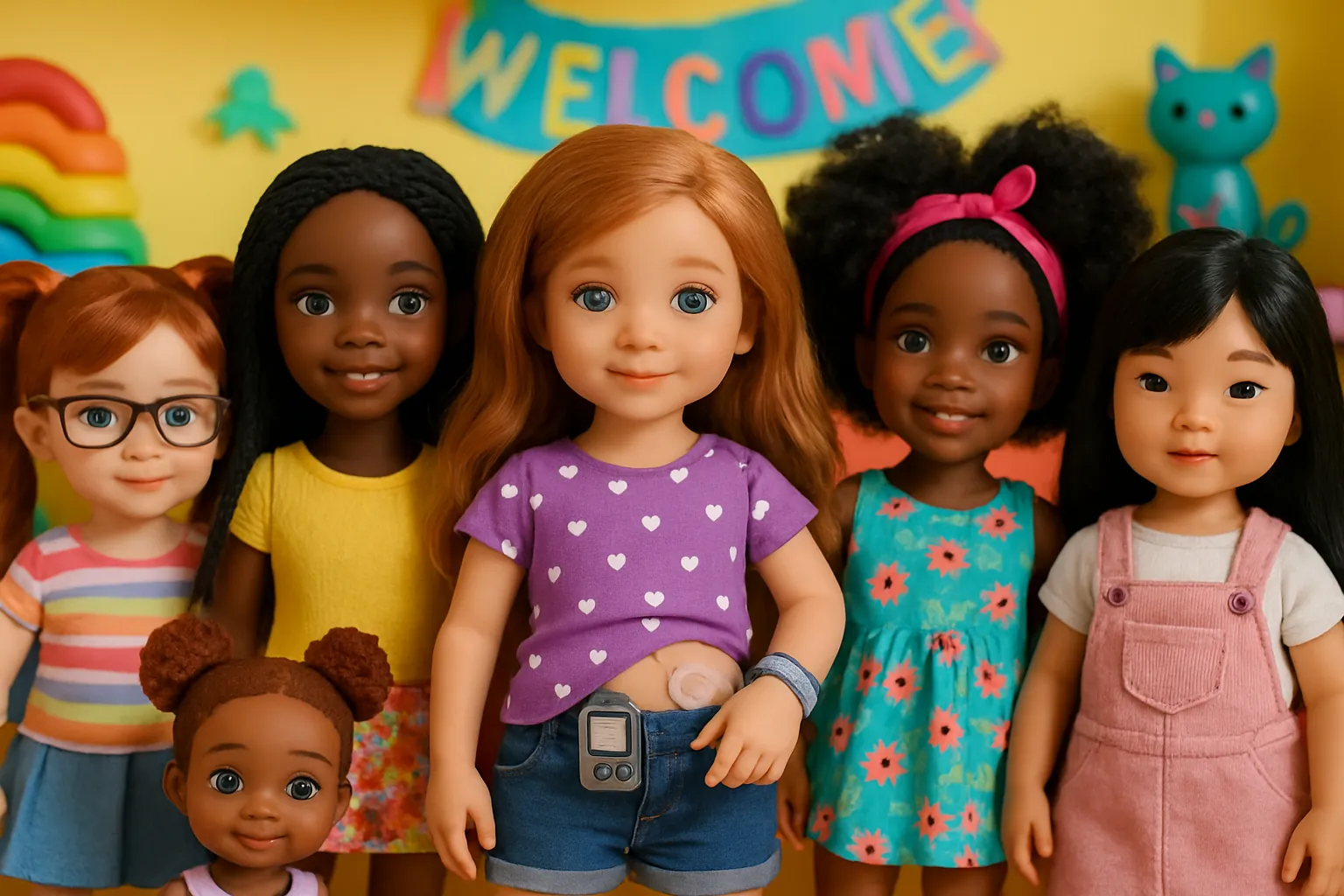
The Power of Seeing Yourself: Why This Barbie Matters
The latest addition to Mattel’s iconic portfolio—a Barbie with type 1 diabetes—is more than a headline-grabbing novelty. For the millions worldwide living with type 1 diabetes (T1D)—and especially for children who grew up feeling invisible—this doll represents a long-overdue chance to be seen. For too long, children with chronic illnesses encountered playtime universes where their unique differences weren’t just unrepresented; they were often stigmatized or ignored.
Recall a generation ago: Barbie’s world was slim, white, and largely able-bodied. Critics accused the brand of reinforcing a myopic standard of beauty and dismissing the realities of many girls’ lives. Today, the landscape is changing. The 2025 Barbie Fashionistas line not only includes dolls with Down syndrome, hearing aids, and vitiligo, but it now features a realistic, medically accurate doll equipped with a continuous glucose monitor and insulin pump—tools that are daily lifelines for hundreds of thousands of kids.
An unforgettable touch? The glucose monitor is gently secured with heart-shaped pink medical tape, a detail that signals affection and care. And the doll’s smartphone displays a real-time glucose reading—accurate and relatable for anyone familiar with T1D management. According to Breakthrough T1D, formerly the Juvenile Diabetes Research Foundation (JDRF), representation like this can dramatically reshape both self-perception and cultural attitudes. A 2023 study in Health Psychology underscores that when children see their experiences reflected in toys, they build confidence and resilience—qualities especially crucial for those managing chronic illness.
Behind the Design: From Advocacy to Authenticity
Who ensured the accuracy and emotional weight of this new Barbie? Emily Mazreku, Breakthrough T1D’s Director of Marketing and Communications, knows the stakes firsthand—she lives with type 1 diabetes. Mazreku spent nearly two years conducting focus groups with parents, kids, and medical professionals so that every detail—from the heart-shaped tape to the smartphone app—felt genuine rather than performative. This isn’t just about putting a plastic insulin pump on a doll’s waist; it’s about validating daily rituals that are often a source of shame or misunderstanding for kids.
Lila Moss, daughter of supermodel Kate Moss, has also emerged as a powerful voice in this campaign. Diagnosed at 12, Lila faced a public who rarely saw diabetes depicted in high fashion or pop culture. That’s changing: not only does the new Barbie bear her likeness, but Moss herself fronts the campaign, joined by fitness trainer Robin Arzón—another real-world ambassador who lives with type 1 diabetes. For parents and kids alike, these faces make the message personal: you are not alone.
A closer look reveals the consistent pattern of advocacy woven through the Fashionistas line. Mattel’s senior vice president Krista Berger has repeatedly emphasized that diversity is a moral imperative, not just a market trend. Like the introduction of Barbies with Down syndrome or prosthetic limbs, this doll is “an important step in our commitment to inclusivity,” Berger told the Guardian. Prior moves in the toy industry—like American Girl’s diabetes care kits or Lego’s Braille blocks—laid groundwork, but Mattel’s Barbie, as a symbol of mainstream culture, has the chance to shift perception on a larger scale.
“Dolls aren’t just for little girls and boys. They’re conversation starters, empathy builders, and powerful tools for rewriting what ‘normal’ looks like in the hearts of the next generation.”
Such representation also creates a platform for advocacy. Coinciding with the doll’s launch, Mattel is calling on the US government to renew funding for the Special Diabetes Program—a federal initiative that underwrites research vital to the lives of nearly 300,000 American children with T1D, according to the American Diabetes Association. This strategic alignment is no accident. It’s a potent reminder: when diverse experiences are normalized, policy change becomes a little more possible.
Toy Industry Transformations—and the Work Still to Be Done
It’s tempting to celebrate this moment as an endgame victory. But real change requires persistent effort and a reckoning with how past exclusions shaped childhoods. Critics from conservative camps have accused Mattel and like-minded companies of succumbing to “woke capitalism,” arguing that “politicized” toys threaten traditional values. This is a familiar refrain, often invoked whenever marginalized groups gain visibility. But that narrative misses a critical reality: representation improves lives and enhances empathy, period.
Recall the initial backlash to the first Black Barbie in 1980 and how, decades later, those pioneering dolls became prized artifacts for collectors and a point of pride for kids who finally saw themselves. The push for inclusion isn’t about erasing tradition; it’s about expanding it. As Harvard scholar Sarah Lewis puts it, reflecting on her research into visibility and belonging, “The moment we see possibility, we create possibility.”
Why does this matter? One young adult, J. Kowalski, who struggled with diabetes “tech” at 17, writes: “I may be 27, but seeing this Barbie makes me feel more seen than I ever did as a kid.” That sentiment resonates far beyond the diabetes community, echoing research that suggests diverse toys not only reduce stigma but also increase awareness among able-bodied peers.
Beyond that, the financial calculus is changing. According to Euromonitor International, parents today—especially Millennial and Gen Z—are more likely to seek out toys that teach empathy, celebrate difference, and have educational impact. The days of one-size-fits-all play are fading fast, replaced by a new norm that prizes inclusivity as both ethical imperative and smart business strategy.
Progress is not inevitable. The road to true equity in children’s media still faces backlash, corporate waffling, and deeply entrenched assumptions about whose stories are worth telling. But each unapologetically inclusive doll is a tiny hammer, chipping away at those walls. When children everywhere spot a Barbie living courageously with diabetes—a smartphone in hand, monitor on her arm, heart-shaped tape in place—they see not a limitation, but a possibility.
