
Hidden Agendas and High Stakes at Harvard
Few could have predicted that a routine academic seminar at Harvard would thrust the legacy of campus free speech and federal power struggle back into the national spotlight. Yet that’s exactly what unfolded when Biden’s surprise visit pierced the secrecy of the Kennedy School’s Institute of Politics, drawing not only small crowds of students but also nationwide attention. For many, the image of the former president—ice cream in hand, struggling with names of war-torn nations—became an easy punchline. But underneath the ridicule lay a high-stakes confrontation over the very soul of higher education.
President Joe Biden’s relationship with the Ivy League, built over decades in public service, was never going to be apolitical. On this occasion, his arrival came at a charged moment: Harvard had openly defied what it called “unlawful” demands by the Trump administration. Chief among the points of contention were orders to strip away the university’s diversity, equity, and inclusion (DEI) initiatives and to overhaul methods for fighting antisemitism—changes critics warned would unravel years of progress on campus.
According to university legal correspondence, the Trump administration’s pressure campaign didn’t just raise hackles among students or faculty—it provoked Harvard’s legal team to draft a letter, co-signed by President Alan Garber’s lawyers and former special counsel Robert Hur, denouncing the federal directives as First Amendment violations. The retaliation was swift and severe: $2.2 billion in multi-year grant funding, along with $60 million in federal contracts, was effectively frozen, threatening everything from vital research projects to tuition assistance.
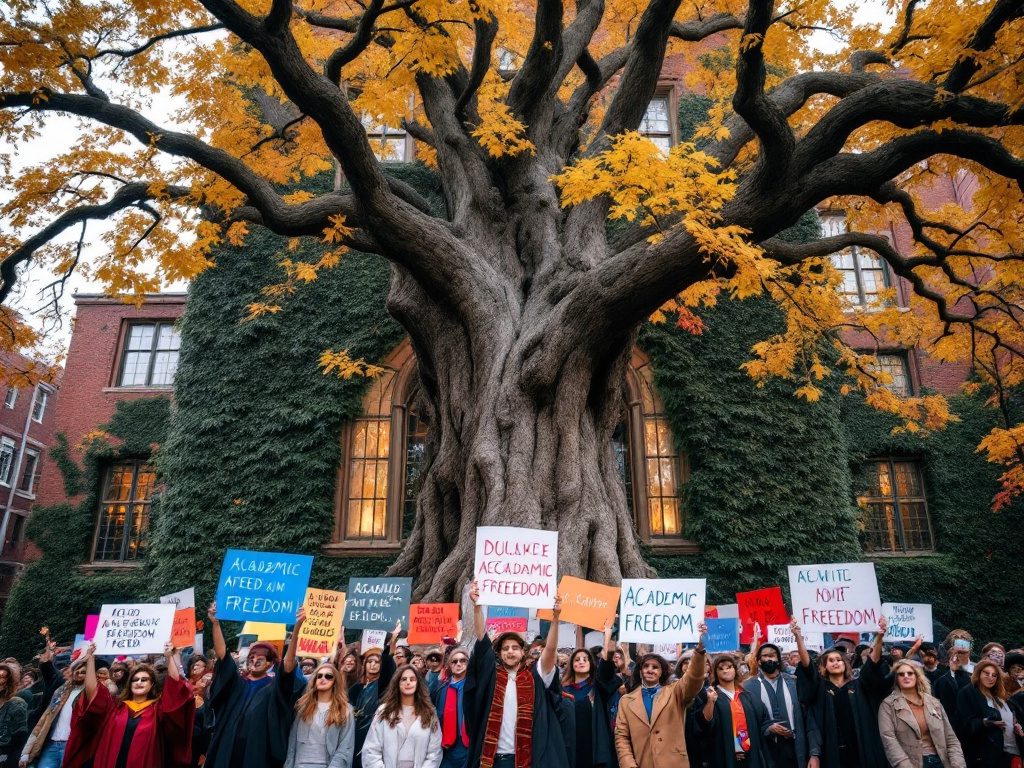
Campus protest swelled outside the seminar room as Biden fielded questions from roughly 50 students behind closed doors. Meanwhile, pro-Palestinian demonstrators unfurled banners to accuse him and the federal government of complicity in international human rights abuses—a scene reflective of the broader turbulence shaking American universities today.
Gaffes, Ice Cream, and the Optics of Leadership
The media optics revolving around Biden’s visit were, predictably, unforgiving. As reports of the 82-year-old confusing Ukraine with Iraq and clumsily dropping his melting dessert swept social media, right-wing pundits seized the moment, framing it as an emblem of Democratic frailty and decline. But hyper-focus on missteps misses the deeper struggle at play: the threat of federal overreach into academic autonomy—a theme as old as the American university system itself.
American politics has no shortage of presidential gaffes. Ronald Reagan once famously addressed a microphone during a test sound check with, “I’m pleased to tell you today that I’ve signed legislation that will outlaw Russia forever. We begin bombing in five minutes.” George W. Bush’s malapropisms were so regular they became late-night fodder. Yet when the dust settles, these moments rarely dictate the real consequences of executive decisions. Harvard’s ongoing standoff with federal authorities isn’t about dessert mishaps or even global geography. It’s about whether educational institutions should be forced to conform to political litmus tests that often stifle diversity, inclusion, and intellectual rigor.
Harvard—like many universities—has come under fire from both sides of the political spectrum, but the recent federal crackdown stands apart for its scope and aggressiveness. The Trump administration’s moves, echoing McCarthy-era loyalty oaths, sought to wield the nation’s checkbook as a cudgel against schools seen as bastions of liberalism. According to John K. Wilson of the American Association of University Professors, coercing compliance through funding freezes is “an attack on the independence of higher education.” The chilling effect is immediate and profound, especially for research on contentious topics such as race relations, climate justice, or systemic inequality.
Lost amid the headlines about Biden’s supposed stumbles is a moment that speaks to the stakes: When pressed on whether Harvard should sue the federal government, Biden demurred. Instead, he placed the onus squarely on university leaders, stating, “I think Harvard should just do what it’s doing—lifting everybody up.” His message was clear, even if cautious: Academic institutions must stand their ground, even when that comes at real cost.
“When politicians threaten to choke off resources unless universities toe a particular ideological line, the entire premise of open, critical inquiry stands in danger.”
The Bigger Picture: Democracy, Dissent, and the Future of Higher Ed
Beyond the swirl of ice cream and student selfies lies a generational debate over the purpose and power of American universities. Harvard’s resistance, praised by Biden and reviled by conservative critics, is emblematic of a broader struggle to preserve campus rights—not only for university personnel, but for students and researchers nationwide. Academic independence has historically been a catalyst for social progress. The university sit-ins of the 1960s, the anti-apartheid protests of the 1980s, and today’s student-led advocacy around climate change and international justice have all depended on the robust protection of dissent inside academic walls.
Harvard’s legal battle underscores a universal dilemma. Accepting federal dollars has always come with strings attached, but recent attempts to leverage those constraints to extirpate DEI programming represent a sharp escalation. According to a December 2023 Pew Research Center report, more than 64% of Americans agree that programs promoting diversity and inclusion make colleges stronger and better for students. Yet a determined minority, emboldened by political winds, seeks to reframe DEI as an attack on merit and objectivity—language frequently weaponized to slow, or reverse, social gains.
A closer look reveals the cascading consequences of such power plays. With billions on the line, universities may be forced to reconsider entire fields of study or research, pushing scholars to either self-censor or abandon lines of inquiry that cater to underrepresented voices or challenge entrenched interests. The American Council on Education warns that, over time, “governmental retaliation undermines not only individual institutions but the competitiveness and innovation edge of our entire higher education sector.” A strong, diverse university is not an enemy of democracy but its engine.
Many Democrats and progressives rightly criticize Biden for not being bolder, but his affirmation of Harvard’s independence—however minor—points to a broader truth. Complex problems don’t need simplistic solutions or heavy-handed edicts from Washington. They require a level of courage and commitment to principles—equality, reasoned debate, and a willingness to learn from imperfect, sometimes messy, democratic processes. In this era of political grandstanding and performative outrage, defending the space for such debate may be the most radically patriotic project of all.
