
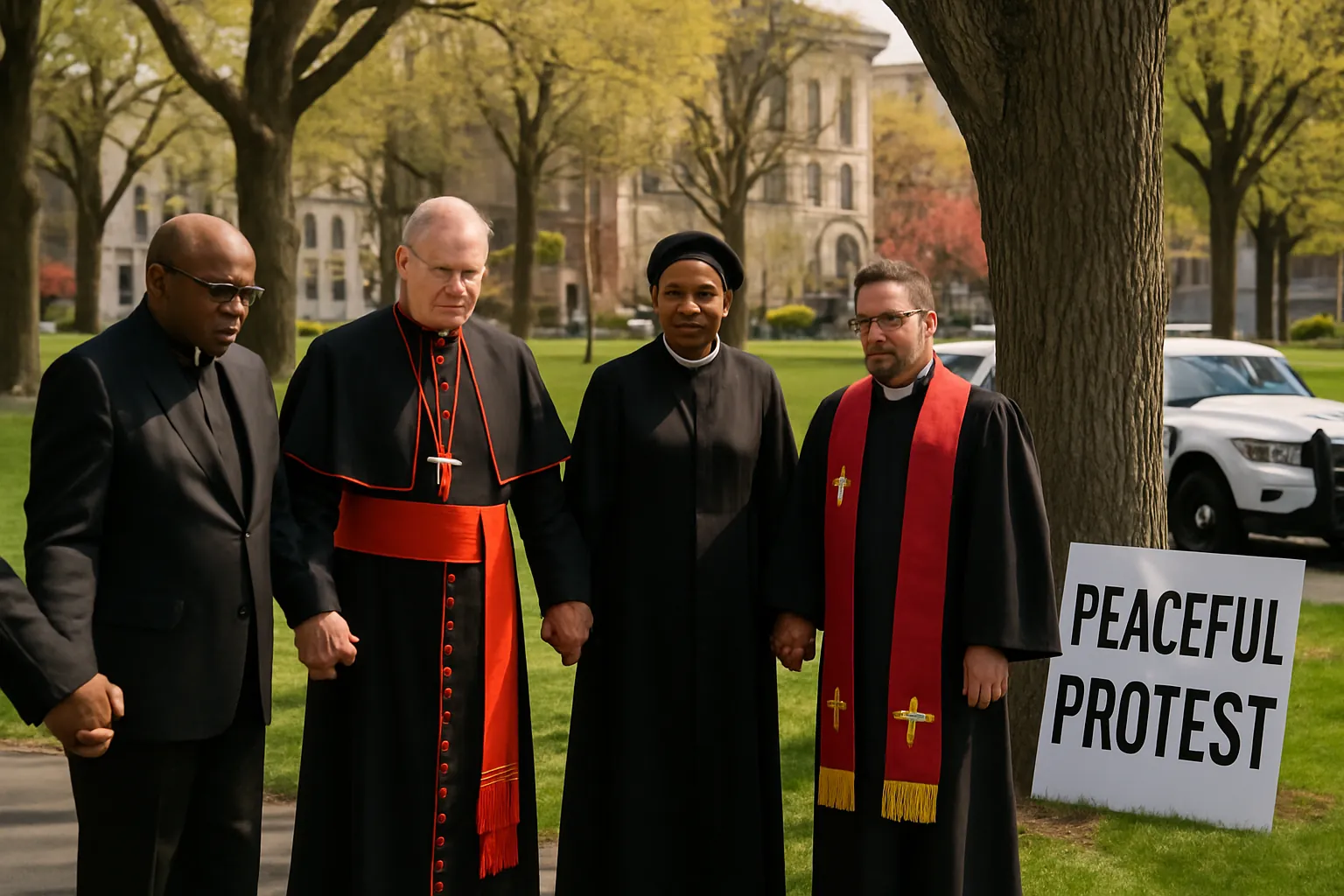
A Sanctuary at the Gates: Faith Leaders Confront ICE in Newark
By midmorning on a humid Monday, hymns echo across the concrete at Delaney Hall Detention Center in Newark. A coalition of priests, rabbis, and imams—nearly fifty strong—linked arms at the gates, refusing to budge. Their demand: transparency, humane treatment for migrants, and a spotlight on the ongoing crisis inside Immigration and Customs Enforcement (ICE) facilities. In the heart of a city synonymous with struggle and resilience, these faith leaders transformed a utilitarian detention center entrance into a sanctuary of conscience, calling America to account for how it treats its most vulnerable.
Behind the demonstration lies a spark: the arrest of Newark’s own mayor, Ras Baraka, just three days prior. Baraka, accompanied by Democratic lawmakers, asserted his right under federal law to inspect conditions inside Delaney Hall—a right met with handcuffs and a five-hour detainment. The optics of an elected Black mayor being arrested while advocating for transparency did not go unnoticed. Faith in N.J., Faith in Action, and progressive allies saw in Baraka’s treatment the latest sign that ICE—and the private prison contractors it employs—are determined to operate with impunity, shielded from oversight even as public anxiety grows over the fate of detained immigrants.
The clergy’s resolve was tested when an ambulance attempted to enter. Protest leaders allege this was an ICE tactic, calculated to provoke police clearance and undermine the movement. “No one here called that ambulance,” insisted Rev. Jeanette Salguero, co-organizer with Faith in N.J. “This is about power, not public safety.” ICE officials, by contrast, painted the protest as a reckless stunt endangering lives—an argument echoed by Homeland Security Assistant Secretary Tricia McLaughlin, who accused demonstrators of “putting law enforcement and detainees at risk.” Few statements could better encapsulate the deep polarization surrounding American immigration policy today.
The Detention Center Divide: Rhetoric, Reality, and the Fight Over Oversight
To understand the stakes, consider the clash on the ground. ICE and Homeland Security maintain that Delaney Hall—and other facilities like it—house only serious criminals, from gang members to terror suspects. Their message, amplified by right-wing media, is consistent: protests like these are misplaced, marshaled on behalf of “the worst of the worst.” But a closer look reveals the complexity beneath the headlines.
Public records, along with accounts from legal advocates and former detainees, indicate that many held at Delaney Hall have no violent record, languishing instead over minor infractions or technical breaches of immigration law. “About 70% of people in ICE detention have no criminal conviction whatsoever,” notes Dr. César Cuauhtémoc García Hernández, immigration law scholar and author. These are not isolated cases, but symptoms of a systemic policy that detains first and sorts out humanity later—a policy fiercely at odds with the progressive faith leaders who led Monday’s protest.
Brutality, overcrowding, and lack of medical care have been documented repeatedly in U.S. detention centers. An ACLU report from 2023 found a persistent pattern of abuse and neglect in privately run facilities like Delaney Hall—operated by Florida-based GEO Group, whose stocks rise on the backs of incarcerated immigrants. Nationwide, nearly half of ICE’s detainees are housed in private prisons, raising hard questions about accountability and profit motives. One has to ask: Who benefits when congressional oversight is not just discouraged but criminalized? When faith leaders are hauled off in zip-ties for demanding basic human rights?
“What we witnessed this week is not just an attack on immigrants, but on the very principle that America’s institutions are subject to the scrutiny of its people. When mayors are jailed for asking questions and pastors are arrested for singing hymns at the gates, we are in dangerous territory.”
— Rev. Sharon Williams, Faith in Action
Polls suggest broad public support for removing violent criminals—Pew Research reports 70% of Americans favor prioritizing deportation for those convicted of felonies. But tales spun by ICE officials often conflate nonviolent and violent detainees, muddying the waters and shaping public opinion. The question is not whether we want safe streets: it’s whether safety can be achieved by trampling accountability and dignity under the guise of enforcement.
The Moral Reckoning: Faith, Resistance, and the Future of Immigration Policy
For many, this protest was more than a fleeting act of civil disobedience. It was a call for moral clarity in a nation adrift, echoing traditions of nonviolent resistance from the civil rights era to Standing Rock. The clergy risked arrest not to shield “the worst of the worst,” but to remind us that our treatment of the marginalized defines who we are as a people.
History is instructive here. Recall the sanctuary movements of the 1980s, when churches across America harbored Central American refugees fleeing U.S.-funded wars. Or the Freedom Rides, where clergy linked arms for a higher justice in the Jim Crow South. Today’s faith activists draw on that legacy, facing down not only ICE but the creeping normalization of secrecy and cruelty in our institutions. For every pundit who derides them as “agitators” or “far-left,” there is a family torn apart by opaque detainment, a congregation mobilized to advocate for humane policy, a community weary of living in fear.
Beyond the theatrics, the Newark protest spotlights a central debate: Should the machinery of immigration enforcement be allowed to operate largely out of public view, insulated from democratic oversight? Or is the demand for transparency, for dignity, not just justifiable but necessary to keep America true to its ideals? The clergy’s actions—singing, praying, and risking their own freedom—pose this challenge, daring elected leaders and everyday citizens alike to decide which side of history they wish to stand on.
As the dust settles at Delaney Hall, the question lingers: Will we heed the call of conscience, or allow fear and bureaucracy to dictate the boundaries of compassion? In moments like this, history reminds us that real change comes not from the comfort of consensus but from the courage to dissent.
