
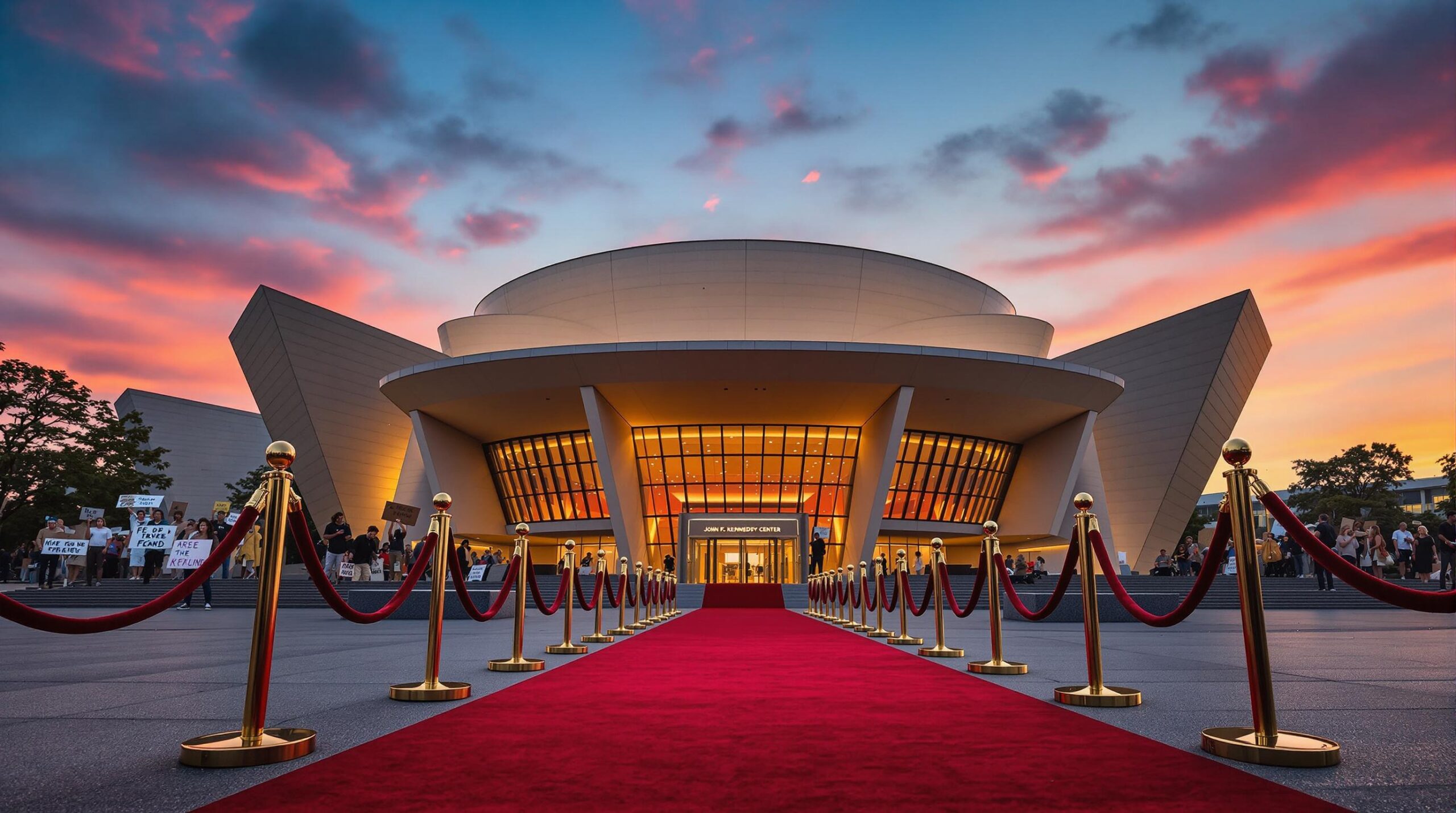
In an event overshadowed by political upheaval, comedian Conan O’Brien is set to receive the distinguished Mark Twain Prize for American Humor at the Kennedy Center this coming March. His illustrious career, spanning nearly four decades of innovative comedy, will be celebrated amidst unprecedented tensions sparked by recent political maneuvers at the Kennedy Center.
A Comic Genius Amid Political Chaos
As Conan O’Brien prepares to step into the Kennedy Center spotlight, the institution itself is engulfed in ideological turmoil. The recent takeover by former President Donald Trump, orchestrating the replacement of venerable, seasoned directors with political loyalists, has sparked public outcry and artist cancellations. Trump expressed via social media an intention to usher in a so-called ‘Golden Age in Arts and Culture.’ However, critics assert this move threatens the nonpartisan, inclusive ethos historically championed by the Kennedy Center.
Yet despite the shadows cast by such upheaval, Conan O’Brien appears committed to leveraging the occasion positively. Far from being merely an affable talk show personality, O’Brien’s uniquely inclusive approach to comedy and his occasional yet profound stances on societal issues consistently resonate with progressive values.
For instance, in 2011, O’Brien took the groundbreaking step of officiating a same-sex marriage live during his show, boldly endorsing marriage equality years before the landmark Supreme Court ruling acknowledged it as a constitutional right. His comedic platform transcends mere humor, embracing social justice and advocating visibly for human rights.
The Troubled Legacy of Conan’s Late-Night Stint
Conan’s journey through the landscape of American comedy has been notably tumultuous yet remarkably resilient. Remember his markedly controversial and short-lived tenure as host of NBC’s “Tonight Show”? The network’s controversial decision to return Jay Leno to his original hosting spot after only a few months drew nationwide attention and stark criticism.
Though professionally embarrassing at the time, this event shaped Conan—empowering him to boldly reinvent his career on cable TV’s TBS, with shows remarkably successful in their innovative, adventurous formats. This pivot proved Conan’s extraordinary adaptability and creative independence, attributes particularly commendable amidst entertainment industry turbulence.
Beyond this televised reinvention, O’Brien expanded his comedic expression throughout other media, such as his universally acclaimed podcast “Conan O’Brien Needs a Friend” and the Netflix travel documentaries, showcasing humor intertwined significantly with cultural exploration and empathy.
“O’Brien’s adaptability in the face of challenges represents not just comedic versatility but a deeper commitment to creative autonomy.”
The Future of Kennedy Center Under Scrutiny
Today, as the Kennedy Center stands at this politically fraught crossroads, supporters and liberals alike are rightfully apprehensive about its direction under Trump’s fleeting yet influential glare. Questions swirl around the potential ideological re-alignment of programming and artistic expression. Will politically charged appointments eventually curb creative voices? Can the Center maintain its historic commitment to free, diverse artistic expression?
These complex, unanswered questions loom ominously over what’s supposed to be a purely celebratory ceremony. Conan’s honoring with the Mark Twain Prize, already notable for past distinguished awardees such as Tina Fey, Eddie Murphy, and Jon Stewart, now serves unintentionally as an emblematic event epitomizing broader cultural anxieties. Progressives worry openly that conservative restructuring could suppress traditionally diverse voices and constrain broader social conversations prompted by artists like O’Brien.
Yet, even amidst uncertainties around its future orientation, the imminent Mark Twain ceremony grants an exciting opportunity to reinforce the Kennedy Center’s proud tradition of diversity and creative freedom. To see Conan O’Brien, known subtly but firmly for championing social inclusivity, recognized in this uncertain moment may in fact help reassure progressives, signaling possible continuities that defy conservative limitations.
If anything, O’Brien’s forthcoming speech will be closely watched—not merely for comedic entertainment, but for the subtle yet powerful commentary it might offer against ideologically driven interference in America’s cherished cultural institutions. It would certainly align with the Kennedy Center’s core values should Conan use his flowingly sharp wit to advocate openly for maintaining its artistic independence.
In commemorating Conan O’Brien’s remarkable career, Americans have yet another compelling reason to stand up not only for laughter but for artistic freedom itself. Regardless of political tides, Conan’s celebrated humor reminds us of comedy’s immense potential: not merely to entertain but to challenge authority, defend social equality, and uphold cultural openness in defiant yet joyful resilience.
