
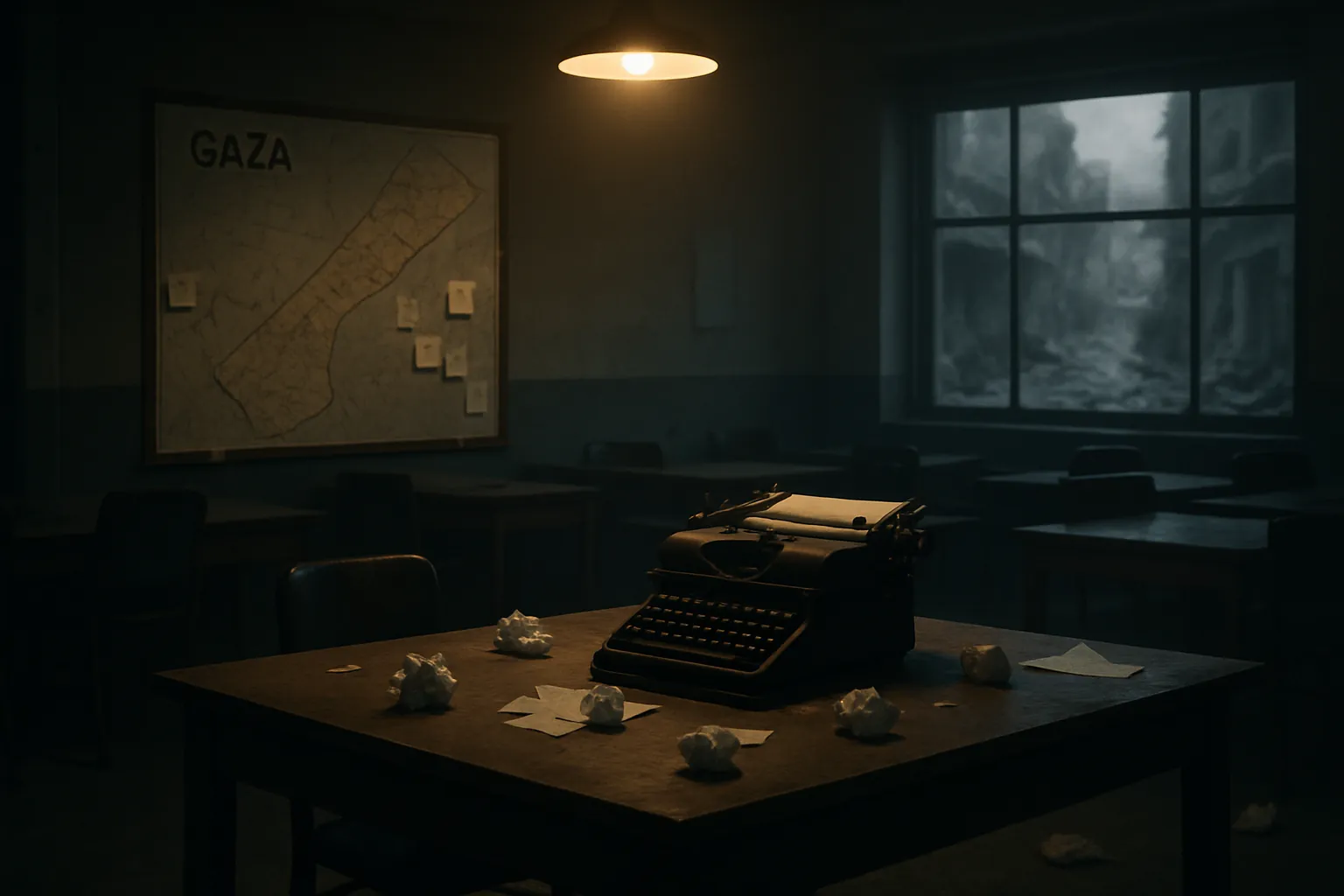
The Collision of Journalism and War in Gaza
Smoke still hung over Khan Younis’s battered skyline last Tuesday when news filtered out: Hassan Eslaih, a well-known Palestinian journalist and director of the Alam24 News Agency, was dead. He had not fallen on the front lines, but inside the supposed safety of a hospital’s burn unit, wounded in a previous airstrike and awaiting treatment. Israel’s military confirmed the targeted strike on Nasser Hospital, stating its objective was a Hamas command center they alleged operated from within the facility. Palestinians, medical staff, and watchdog groups decried the attack as yet another violation of international law—a chilling affront to the sanctity of health care and press freedom in wartime.
Eslaih’s story—spanning his coverage of the October 7 Hamas-led attacks and his eventual killing—has become emblematic of the extraordinary dangers Gaza’s media workers face. According to Gaza’s Government Media Office, 215 journalists have been killed since the war began, while the Committee to Protect Journalists (CPJ) reports at least 178 journalist fatalities in Gaza, the West Bank, Israel, and Lebanon since October 7. The Brown University Watson Institute places the death toll even higher, at over 230.
To grasp the magnitude of these numbers, consider that during the 20-year war in Afghanistan, the CPJ recorded under 100 journalist deaths. Gaza now stands as the world’s deadliest zone for press coverage in modern memory, forever altering the global understanding of media risks under military occupation and siege.
Truth, Propaganda, and the Fog of Combat
Accusations about Eslaih’s alleged Hamas affiliation—and Israel’s assertion that the hospital doubled as a terrorist command post—reflect a deliberate blurring of lines that has become the norm in this brutal conflict. Even as Al Jazeera, Reuters, the Associated Press, and CNN used Eslaih’s frontline images, Israel has continued to cast suspicion on the legitimacy, and thus the safety, of Gaza’s press corps.
Is this a justified security measure in an asymmetric urban war, or a policy designed to suppress unwanted narratives from reaching the international community? The answer depends on whom you ask—and on what you consider the role of journalists under siege.
Harvard media ethics scholar Dr. Mona El-Tabib offers a stark warning: “When governments decide a journalist is a legitimate target simply for documenting war, they destroy one of the core mechanisms for public accountability.” By labeling journalists as combatants or collaborators based on their proximity or coverage, military powers can effectively erase the blurry distinction protecting press civilians under the Geneva Conventions. Without public documentation and watchdog reporting, the machinery of war runs unchecked, its most devastating abuses left in the shadows.
Neither Israel nor Hamas escapes scrutiny here. While Israel’s military claims to provide evidence of terror operations embedded in civilian sites, they rarely make such intelligence independently verifiable. Palestinians and hospital staff in Khan Younis maintained that Nasser Hospital was teeming not with fighters, but with desperate patients and medical workers struggling to survive. The attack on Eslaih—already gravely injured from an earlier strike on a media tent—thus reverberates far beyond Gaza’s borders. It becomes, in the words of CPJ’s Sherif Mansour, “an indictment of the world’s failure to protect truth-tellers during war.”
“If bearing witness can now mean a death sentence, who will remain to document these tragedies? The loss is not only Gaza’s—it is history’s.”
The Perilous Precedent and the Fight for Accountability
This isn’t the first time hospitals have become flashpoints in Gaza. Human Rights Watch and Doctors Without Borders have documented repeated strikes on medical facilities throughout the current conflict—attacks frequently justified by allegations of Hamas’s use of civilian infrastructure for military advantage. Such justifications rely on a dangerously broad interpretation of military necessity that allows the machinery of war to consume the very spaces designed to save lives.
Consider the case of Shifa Hospital, repeatedly bombed and besieged under similar claims. Investigations conducted by Amnesty International found no independently corroborated evidence to support claims that these hospitals functioned primarily as military command posts. The consequences of accepting military logic without independent scrutiny are devastating: not only are patients and caregivers put at risk, but so too are journalists—the chroniclers of the evidence itself.
Are we witnessing a systematic erosion of protections for journalists and civilians, or an extraordinary convergence of circumstance in Gaza? International law is explicit: even in wartime, hospitals and journalists are entitled to special protections unless direct participation in hostilities can be clearly demonstrated. Yet the bar for such evidence seems perpetually low when it comes to Gaza, where the “fog of war” serves as a convenient shield against accountability.
Beyond that, silencing Gaza’s journalists silences not just a people, but a cause. The deliberate or negligent targeting of media workers—even if occasional, rather than systematic—is a clear threat to freedom of the press worldwide. It sets a precedent where governments can justify attacks on reporters not because of proven wrongdoing, but by casting nebulous suspicion based on association, geography, or the nature of their reporting.
According to a recent Pew Research report, American public opinion remains strikingly split on the question of Israeli military tactics versus humanitarian protections, reflecting broader anxieties about the erosion of shared liberal values—chief among them the right to truth and the dignity of human life in conflict zones.
Moving Forward: The Moral Imperative
A closer look reveals why the West, and particularly American policymakers, must confront these uncomfortable truths. Remaining passive, or accepting unsubstantiated claims at face value, plays directly into a cynical calculus that devalues both Palestinian and Israeli lives. Accountability is not optional in a democracy that claims to champion freedom and human rights.
If readers come away with one takeaway: the death of Hassan Eslaih, and those like him, should not merely be counted as tragic collateral. His courage—risking life to document the cost civilians bear—demands a reckoning on the part of all who value truth and justice. No balanced peace is possible while the war against those who bear witness rages on unchecked.
