
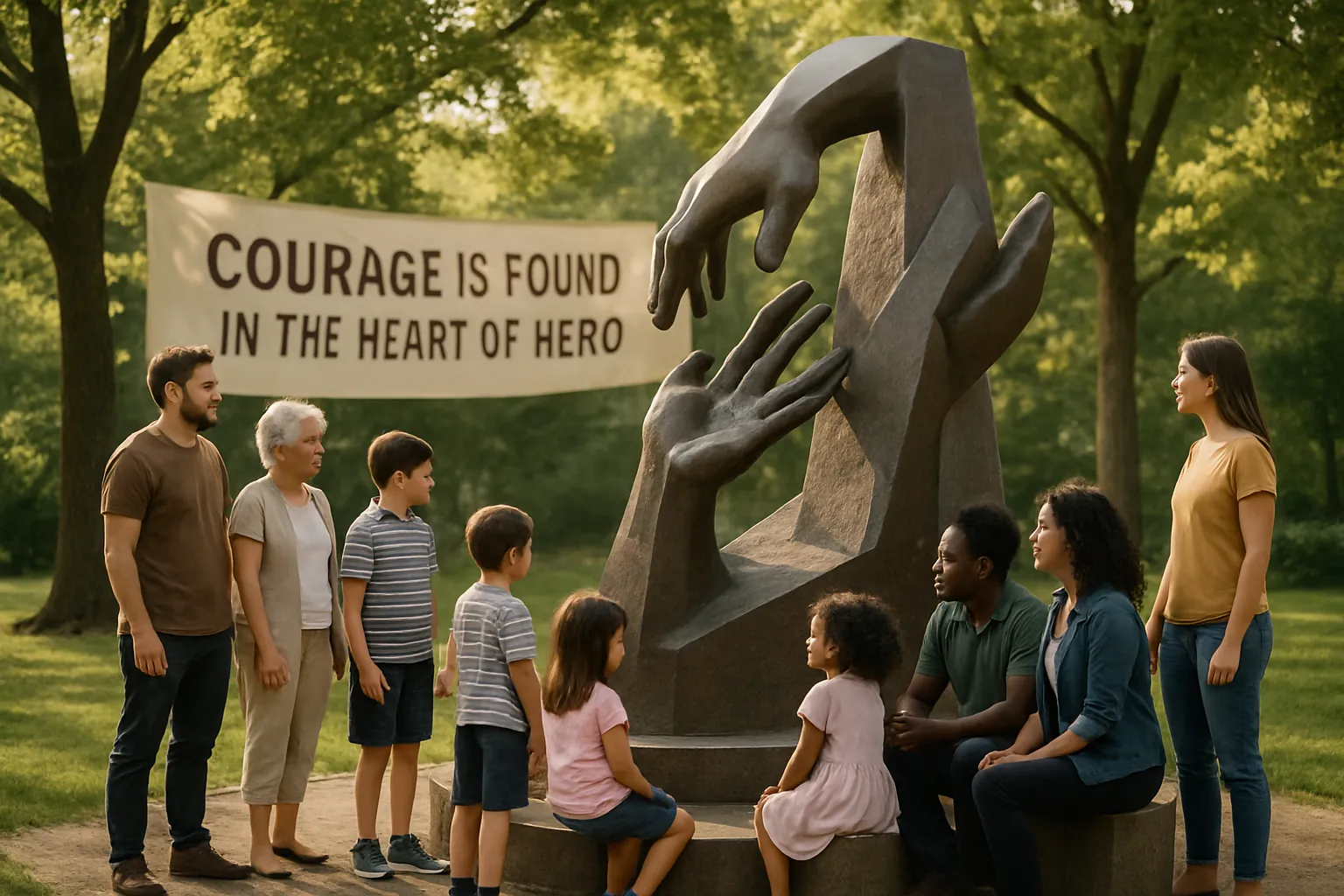
The Final Moments: Two Ordinary Men, One Extraordinary Choice
With Maine’s autumn dusk settling on Lewiston’s “Just-In-Time Recreation” bowling alley, terror painted a new chapter of American tragedy. What sets the Lewiston mass shooting apart, though, is not just its haunting place in the state’s history as the deadliest such event, but the remarkable valor of two lifelong friends.
The selfless actions of Jason Walker and Michael Deslauriers II epitomize the rare, unwavering courage that rises when everyday citizens face the unimaginable. As chaos erupted and gunfire shattered the night, these two men—both 51, both native sons of Sabattus—chose not to run for cover, but to confront death itself in hopes of saving others. Amid the panic, witnesses report Walker tried to kick away the shooter’s jammed rifle. Shot in the knee, he fell. Deslauriers rushed forward, attempting to disarm or subdue the gunman. He, too, was shot down. In that fleeting, ferocious moment, their sacrifice gave others precious seconds to escape alive.
Their stories reach beyond statistics. Walker, a builder active with the Sabattus Historical Society, and Deslauriers, a devoted father whose wit was legendary at neighborhood gatherings, never set out to be heroes. Yet that night, they became nothing less. According to their families, what drove them was simple decency and “the kind of neighbor you hope for”—a testament to the quiet strength very often found far from the spotlight.
“Their sacrifice was the personification of hope in action—proving heroism is not just a word but a choice any of us might make in a moment of crisis.”
Recognizing Heroism: The Carnegie Medal and Its Deeper Lesson
The posthumous honoring of Walker and Deslauriers with the Carnegie Medal for Heroism—North America’s highest civilian award for bravery—spotlights not just their actions, but a troubling reality: America relies heavily on private citizens to fill the gaps when civic safety falters. The Carnegie Hero Fund Commission, established in 1904, investigates each case with exacting rigor before awarding the medal. As Commission officials explained, these awards are less about celebrating individual valor and more about “calling attention to what’s possible when ordinary people put others first, without hesitation.” Previous Carnegie Medal recipients have included teachers, postal workers, and even children—proving that extraordinary courage surfaces in every walk of life.
Yet, as the nation heaps praise on these civilian heroes, hard questions beckon: Why, in one of the wealthiest, most advanced countries on Earth, should the burden of self-sacrifice fall so often on bystanders? Gun violence, especially mass shootings, has become a distinctly American disease, and heroic stories like that of Walker and Deslauriers, however inspiring, also reveal a deeper malaise: a government paralyzed on gun reform, a social contract increasingly frayed.
According to Garen Wintemute, director of the Violence Prevention Research Program at UC Davis, “Widespread civilian heroism is a reflection of political failure. Policymakers should be preventing these tragedies rather than celebrating the exceptional bravery that becomes necessary when prevention collapses.”
The conservative argument that arming more citizens fosters safety crumbles under scrutiny. Real-life courage in a crisis almost never involves a gun-toting civilian hero gunning down a perpetrator—it is, instead, often a story of people like Walker and Deslauriers risking everything, unarmed, in a desperate moment. Pew Research Center data consistently show Americans overwhelmingly support stronger background checks and reasonable restrictions. Yet, when such progress stalls in Congress, the void is filled not just by tragedy, but by the need for ordinary bravery.
Community Healing: Blood Drives, Memory, and Toward a Better Future
Beyond medals and posthumous praise, the town of Lewiston has found avenues for meaningful remembrance and recovery. In partnership with Central Maine Healthcare and the American Red Cross, residents come together each year for a commemorative blood drive, introduced shortly after the shooting. The event is steeped in symbolism—giving blood as a literal and metaphorical act of sustaining life, just as Walker and Deslauriers did in their final moments.
When the shooting shattered the calm of an ordinary night, Central Maine Medical Center burned through its entire blood inventory—39 units in a single day, bolstered by an additional 83 from the Red Cross. As Dr. John Alexander, Chief Medical Officer at Central Maine Healthcare, noted, “Without the quick mobilization of blood donations, we would have lost even more patients. This is how a community saves itself.” A single blood donation, they remind attendees, can save up to three lives—the ripple of compassion echoing far beyond a solitary act.
The annual blood drive now stands as both a memorial and a rallying point for a community striving to stitch itself back together. It draws attention to the urgent need for collective responsibility—not just in moments of headline-grabbing catastrophe, but as a daily ethic. In honoring these two men, Lewiston challenges us all: How much longer will we quietly accept a system that so often abdicates protection to the most vulnerable? What will it take for lawmakers to value prevention as highly as we now lionize reaction?
Not every act of heroism can—or should—be necessary. Walker and Deslauriers are rightly remembered for their extraordinary courage. If we truly wish to honor them, let us fight for a society where such sacrifices become the exception, not the unspeakably tragic norm.
