
Political Theater vs. Smart Policing: Moore’s Stand in Baltimore
Step onto the streets of Park Heights—a community that’s seen more than its share of yellow tape and grieving families—and one can sense both fatigue and resilience. As Governor Wes Moore walked those blocks recently alongside Mayor Brandon Scott, the message radiating from his presence wasn’t just one of official concern, but of state-level reinvestment in public safety after years of reactive, divisive policies.
For years, Baltimore’s homicide rate became national fodder, used as a political weapon rather than a call to nuanced action. Then came a new approach: Governor Moore announced the return of Maryland State Police and Maryland Transportation Authority Police resources to bolster Baltimore’s own officers—not with brute force, but with data-driven, targeted support. The collaboration, as Moore’s office highlights, marks a sharply different path than the theatrics of troop deployments seen or threatened in recent years.
Where President Trump once pointed fingers and threatened to unleash the National Guard—a move Moore dismisses as “performative and theatrical”—the new administration insists on tactics that actually work for residents. As Governor Moore put it: “National Guard members are not trained for local policing. Sending them is not only disrespectful but ineffective.” It is a firm stand for thoughtful, community-based intervention, not military occupation masquerading as crime prevention. Public safety, the governor argues, can’t hinge on spectacle or sound bites.
Data backs this up. According to the Baltimore Police Department’s own reports, violent crime has reached its lowest point in years, a trend experts like John Jay College criminologist Jeffrey Butts attribute largely to targeted enforcement and genuine partnership with the community, not blunt force.
Reviving Partnerships: Why the Past Matters and the Future Is Data-Driven
Baltimore’s current approach is a deliberate reversal of the previous administration’s policy. Between 2015 and 2022, violent crime in Charm City hovered at rates unseen since the 1990s, with more than 300 homicides per year—a grim milestone, and a political talking point exploited by critics to demand draconian measures. The hasty end to state-city coordination, under past leadership, left local departments overburdened and under-resourced. Now, the renewed partnership brings not just boots on the ground, but a coordinated, intelligence-led response that leverages statewide resources.
The strategy? State police and transportation officers are being deployed to “hot spot” neighborhoods based on up-to-date crime mapping. They focus on gun and narcotics offenses, boost investigative capacity, and, crucially, tackle outstanding felony warrants for violent crimes—homicide, carjacking, armed robbery. Collaboration with federal agencies like the FBI, ATF, and DEA enhances this effort, creating interlocked rings of accountability and support.
Harvard sociologist Robert Sampson notes that crime reduction is rarely about one-off surges—it’s about “institutional trust, neighborhood buy-in, and persistent engagement.” Those are not qualities associated with National Guard rollouts. Instead, they arise when police work alongside social services, faith leaders, and neighbors themselves.
Beyond enforcement alone, the partnership is built to restore community trust. It’s what Moore calls an “all-of-the-above” approach: tough on organized crime and illegal guns, but laser-focused on fairness and transparency. Recent high-profile community walks aren’t political stunts—they’re invitations, signaling a willingness for real dialogue, even after grim reminders like the three Park Heights fatal shootings in August.
“Public safety cannot be secured through the politics of fear or militarization. Our residents want and deserve partnership, not occupation.”
— Governor Wes Moore
What should Baltimoreans—and anyone watching urban America—take from this shift? Results speak louder than rhetoric: violent crime is dropping, and the tools are smarter. This is an object lesson in what happens when evidence-based policy wins out over posturing.
Community Over Showmanship: Delivering Real Safety for Baltimore
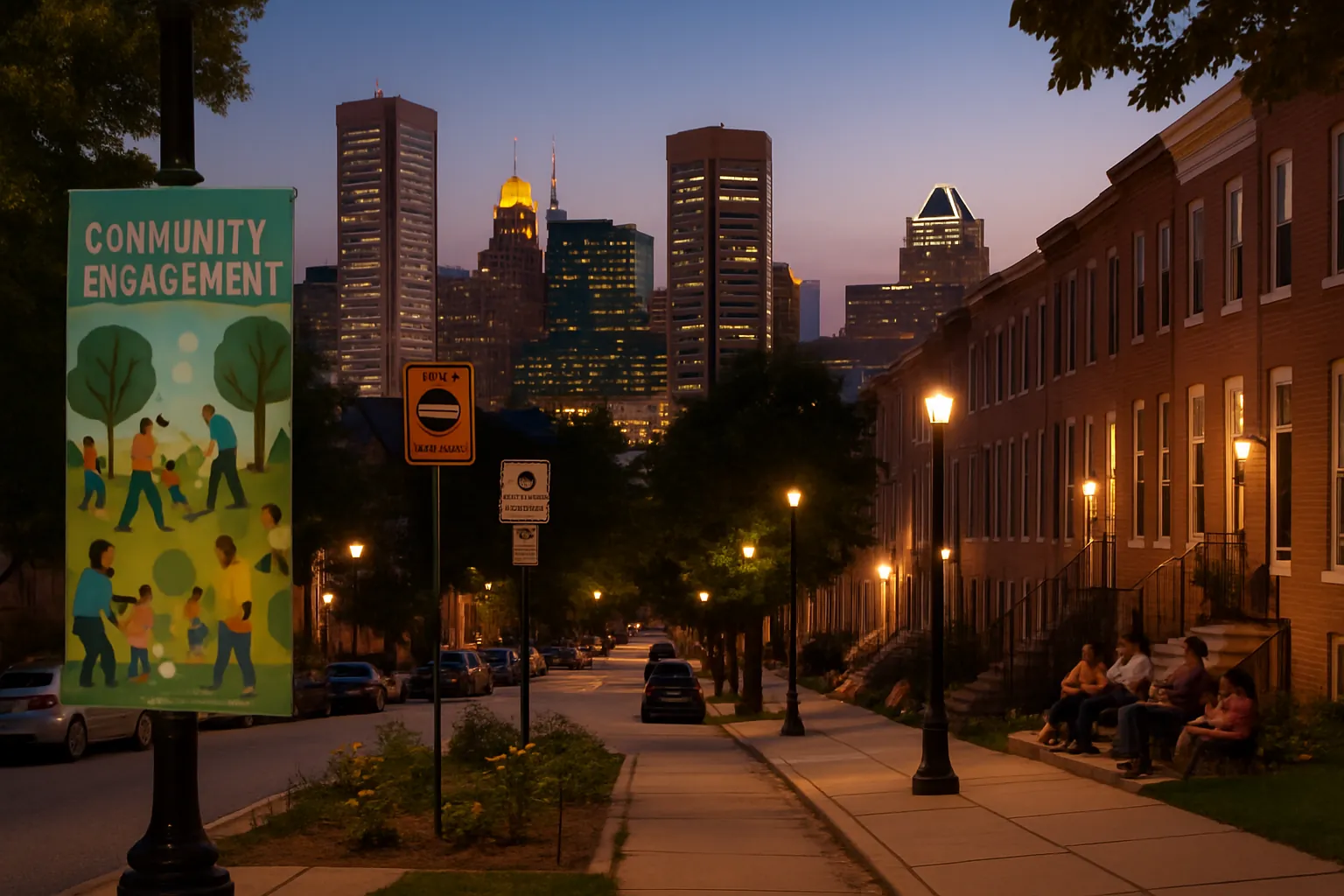
What matters most—to people in Park Heights, Sandtown, or the Inner Harbor—is not whose face appears on cable news. It’s whether children can play outside, elders can walk to church, and communities aren’t living in fear. Governor Moore and Mayor Scott are betting that coordinated, pragmatic government can deliver on these everyday hopes.
A closer look reveals that community engagement is not just a talking point. The city’s support network now includes trauma counselors, youth programs, and employment services that intervene before headlines become grim statistics. According to a 2023 Pew Research survey, neighborhoods with higher trust in local institutions see significantly less violent crime—up to 22% lower rates—than those where alienation and mistrust run high. Baltimore’s leadership is putting that insight into practice.
Critics will say it’s not enough—pointing to any remaining violence as evidence of failure. But holding progressive policies to standards of absolute perfection is a tactic as old as the War on Crime itself. The alternative—militarization, criminalization, isolation—has been tried and failed, leaving deep scars and deeper divides. Moore’s repudiation of federal troop deployment is, by design, a signal that history need not repeat itself.
Baltimore is not alone. Cities from Los Angeles to Philadelphia are experimenting with similar approaches, shifting away from “zero tolerance” to community-driven, multi-dimensional safety solutions. The conversation in Maryland’s largest city is just one chapter in a larger national reckoning on what effective public safety means—and who profits from policies rooted in fear.
As Baltimore moves forward with Moore’s “all-of-the-above” blueprint, you don’t have to look far to see the stakes at play. Crime and safety are more than statistics—they’re the measure of whether a city believes in its own future. Progressive leadership, when trusted with evidence and compassion, can chart a course out of crisis. Residents—not pundits—will be the ultimate judges.
