
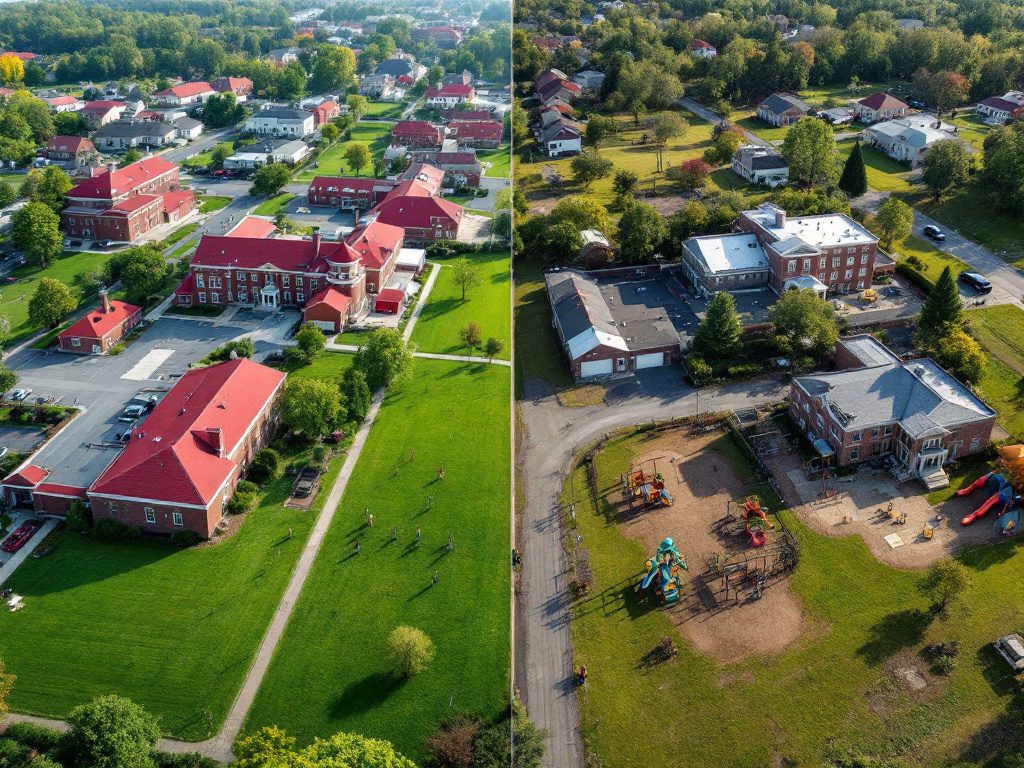
The Price of “Local Control”: Uneven Playing Fields Across New Hampshire
The image of New Hampshire as a state of well-resourced schools is only partly true—a fact that may come as a shock to many Granite Staters. Scratch the surface of the latest National Education Association (NEA) reports, and it becomes clear: qualified students in less affluent towns are falling behind because of systemic funding gaps. New Hampshire now spends more per public school student than all but five other states—an impressive $22,252 per pupil for the 2023-2024 academic year. Yet, when it comes to the state’s share of that support, New Hampshire ranks dead last.
Instead of the state providing a stable funding foundation, local property taxes shoulder a staggering share of the cost. The NEA found that about 63 percent of public school funding came from local sources, with only 29 percent from state coffers. Wealthier towns—flush with high property values and, in some cases, collecting more than their fair share through the Statewide Education Property Tax (SWEPT)—are allowed to keep any excess. That means resource-rich districts can offer robotics teams, advanced placement classes, and state-of-the-art facilities, while students just a few miles away may attend crumbling schools with outdated textbooks.
The consequences run deeper than surface disparities. Sweeping legal action has landed the current funding system in the crosshairs of the New Hampshire Supreme Court. Critics argue it violates the state’s constitutional obligation to provide a “constitutionally adequate” education to all its students. Jane Doe, a Harvard education policy expert, warns, “When states abdicate responsibility, educational opportunity becomes a lottery based on your ZIP code, not your potential.”
The Human Toll: Teachers, Students, and the Fight to Recruit Talent
Ask any New Hampshire teacher what keeps them up at night and you’ll hear a common refrain: the squeeze of trying to do more with less in underfunded schools. The NEA’s latest reports highlight a chronic issue—educator wages lag well behind the cost of living, with the average teacher salary, $67,170, still falling far short of New Hampshire’s estimated $88,074 living wage (NEA, 2024). Pay increases in recent years have not closed the gap or stemmed the exodus from classrooms. Districts in struggling communities simply can’t match the offers in well-funded enclaves, leading to recruitment challenges and high turnover. For students, that means fewer experienced teachers and larger class sizes.
Beyond that, the lack of professional respect is pushing dedicated educators out. According to a Pew Research Center study, teachers nationwide cite respect and compensation as top reasons for leaving the profession, but New Hampshire’s funding structure exacerbates these problems locally. Why invest long-term in a school that can’t guarantee funding for professional growth or competitive pay?
Parents, too, are feeling the pressure. In a small town like Claremont, the downstream effects can’t be ignored. With limited resources, local schools have cut enrichment programs and extracurriculars that once gave students a fighting chance at college scholarships or broadening their horizons. A closer look reveals this is not an isolated problem: nearly 90 percent of all New Hampshire students—95 percent for students with disabilities—attend their community’s public schools, a figure that underscores just how many families this crisis touches (New Hampshire Department of Education, 2024).
“When states abdicate responsibility, educational opportunity becomes a lottery based on your ZIP code, not your potential.” – Jane Doe, Harvard education policy expert
Political Battles and the Quest for Equity
With the stakes set so high, it’s no wonder New Hampshire’s educational funding debate is fiercely political. On one side, House Republicans have pushed for modest state spending increases while backing proposals that would cut contributions to the Education Trust Fund by over a quarter of a billion dollars. Their favored model expands so-called Education Freedom Accounts, effectively diverting public funds to private alternatives. The underlying message? Let competition fix what the state will not fund.
Progressive voices, including many local Democrats, unions, and teacher advocacy groups, counter that the real issue is structural. They demand a greater state commitment and equitable redistribution of resources to level the playing field, especially for low-income and rural communities. As the New Hampshire Supreme Court reviews lawsuits challenging the fairness of the current system, public pressure is mounting for broad reform. “No child’s education should be determined by parental wealth or the town line,” says NEA-New Hampshire president Megan Tuttle, echoing a sentiment that resonates with working- and middle-class families across the state.
History reminds us that New Hampshire is not alone in this fight. In the late 20th century, states from Kentucky to New Jersey faced similar reckonings, ultimately forced by courts to correct wildly uneven funding formulas. These efforts, according to Brookings Institution research, not only improved academic outcomes but also strengthened communities and boosted local economies. Why, then, does New Hampshire continue a system that benefits the few at the expense of the many?
The answer circles back to the question of priorities. Voters regularly affirm their support for public education—demonstrated by the overwhelming majority choosing community public schools for their children. Isn’t it time for state lawmakers to reflect that resolve in their policies?
Where Do We Go From Here?
Legal showdowns and legislative standoffs promise high drama in the months ahead, but the path forward is clear to anyone who values equality and collective responsibility. Raising the state’s share in education funding, closing loopholes that allow districts to hoard surplus property tax revenue, and strengthening teacher pay and retention all serve a singular goal: giving every New Hampshire child a fair shot at success, regardless of where they’re born. The evidence is undeniable. When state leaders invest substantially and equitably in education, the dividends are paid not just in student achievement but in the social and economic strength of the entire state. New Hampshire’s motto is “Live Free or Die”—shouldn’t that freedom include access to a world-class education for all?
