
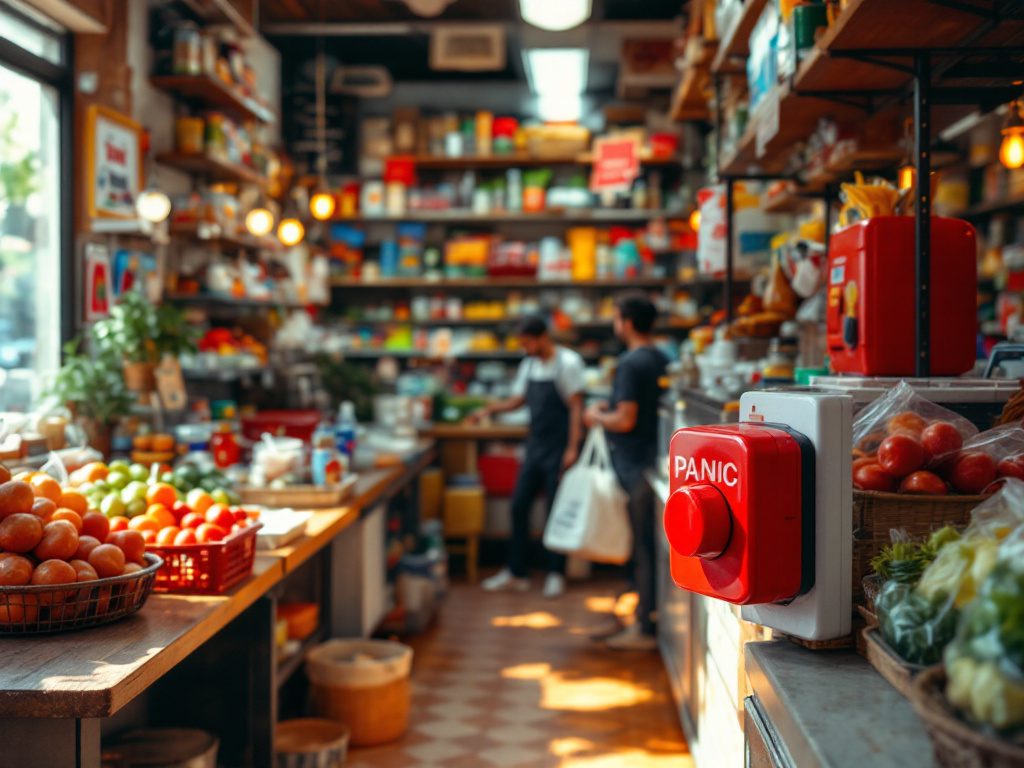
A Cry for Help Amid Tragedy
It’s 2 a.m. in Inwood, the fluorescent lights humming as a lone worker tidies up Ameer Deli. Suddenly, a violent attack erupts—by the time help arrives, one life is lost and two more are forever changed. This isn’t a cinematic imagining but the grim reality faced by New York City’s vulnerable bodega workers, who have become frontline witnesses and victims of the city’s unfolding crisis of violence. The past week marked two deadly incidents in different boroughs within just 48 hours, reigniting an old but urgent plea: Give us panic buttons.
United Bodegas of America’s Fernando Mateo, a tireless advocate since the 2018 stabbing of 15-year-old “Junior” Guzman, points to years of promises left unkept. City and state officials have voiced support for panic buttons and real-time NYPD monitoring, yet the vast majority—out of 25,000 to 30,000 bodegas—remain without this basic safety measure. According to Mateo, barely 50 shops have been equipped with pilot technology to send direct alerts to police headquarters.
Is this the best one of America’s most iconic entrepreneurial communities can expect from its leaders? The cost of inaction mounts, quite literally, in blood. “We shouldn’t be burying workers because of bureaucracy,” Mateo said in a statement at a recent community gathering outside Ameer Deli. According to NYPD data, hundreds of violent incidents are reported annually in city bodegas, making these workers some of the most exposed, least protected essential employees in New York.
The Policy Gap—and Its Human Toll
Despite the drumbeat of promises from City Hall and Albany, funding remains infuriatingly elusive. A bill dubbed the “Bodega Act” has been drafted in Albany to provide grants for panic buttons and surveillance equipment. Still, political will lags while headline-grabbing tragedies ebb, leaving the communities most impacted without the tools they need. State Senator Jessica Ramos, a progressive voice in the legislature, acknowledged the inertia: “It’s not just dollars and cents—it’s about priorities. Bodega workers deserve speedy, effective protection, not performative concern.”
Those on the front lines are left in limbo. The June 2023 pilot program, rolled out by the advocacy group and public safety tech company SaferWatch, succeeded in launching panic buttons in selected high-crime bodegas. But integration with NYPD headquarters has proven rocky at best. Dispatchers often respond as if these are ordinary calls, and response times remain inconsistent or slow. According to a May 2024 audit by the NYC Comptroller’s Office, “Of the 50 locations equipped during the pilot, nearly half faced response delays exceeding 6 minutes—sometimes the difference between life and death.”
Bystander trauma ripples through these neighborhoods. Local residents, often recent immigrants, carry anxiety with every errand. Community advocates point to the harsh reality: The city calls bodega owners and staff “essential,” yet places the burden of safety—and its financial cost—on immigrant families already navigating COVID aftermath, inflation, and an uptick in hate crimes. “We are the heartbeat of our neighborhoods,” said UBA President Radahmes Rodriguez. “Our lives must matter as much as anyone else’s.”
“What’s outrageous,” said Mateo, “is that only 50 of 25,000 stores have functioning panic buttons. Imagine telling Wall Street banks or major chain pharmacies to fend for themselves—there would be public outcry and immediate legislative response.”
Beyond that, no arrests have been made in the most recent deadly cases, amplifying a sense of injustice and skepticism toward official reassurances. A closer look reveals that violence against bodega workers disproportionately targets Latino and Black communities—a sobering reflection of wider systemic issues. These workers frequently toil through the night alone, an easy target for desperate or unstable individuals.
Toward Real Safety: Rethinking City Priorities
What would authentic safety for bodega workers look like? Panic buttons are one tool, not a cure-all. Criminologist Candace McCoy of John Jay College, who specializes in urban public safety, warns, “Technology is only as strong as the systems backing it up.” In her view, a meaningful reduction in violence requires fully integrated NYPD monitoring, swift response protocols, and community-based violence interruption programs. The latter, she notes, empower neighborhoods to address root causes like mental health crises and poverty, addressing the reasons desperate people commit desperate acts in small businesses.
Progressive advocates call for a multi-pronged approach, emphasizing that piecemeal solutions rarely work for vulnerable groups. Strengthening partnerships between city government, law enforcement, and immigrant-owned businesses is vital. The city’s economic recovery, critics argue, should include funding for safety infrastructure—panic buttons, shatterproof glass, security cameras—as well as resources for trauma counseling for workers affected by violence. Investment in social equity is inherently an investment in public safety.
History records New York’s capacity for swift, decisive action when influential interests are at stake: After the infamous 1972 airport robbery, security was overhauled overnight. Imagine a world in which city government moved with the same urgency for bodega workers—a population keeping the city fed and moving at all hours, rain or shine. Why is their safety so readily negotiable?
Relying solely on panic buttons risks entrenching a system where help is always reactionary, not preventative. Genuine progress means meeting violence where it starts, not just after it erupts behind a bodega counter. Community leaders and policymakers have a choice: extend real, material solidarity, or continue offering empty platitudes while the violence continues unchecked.
