
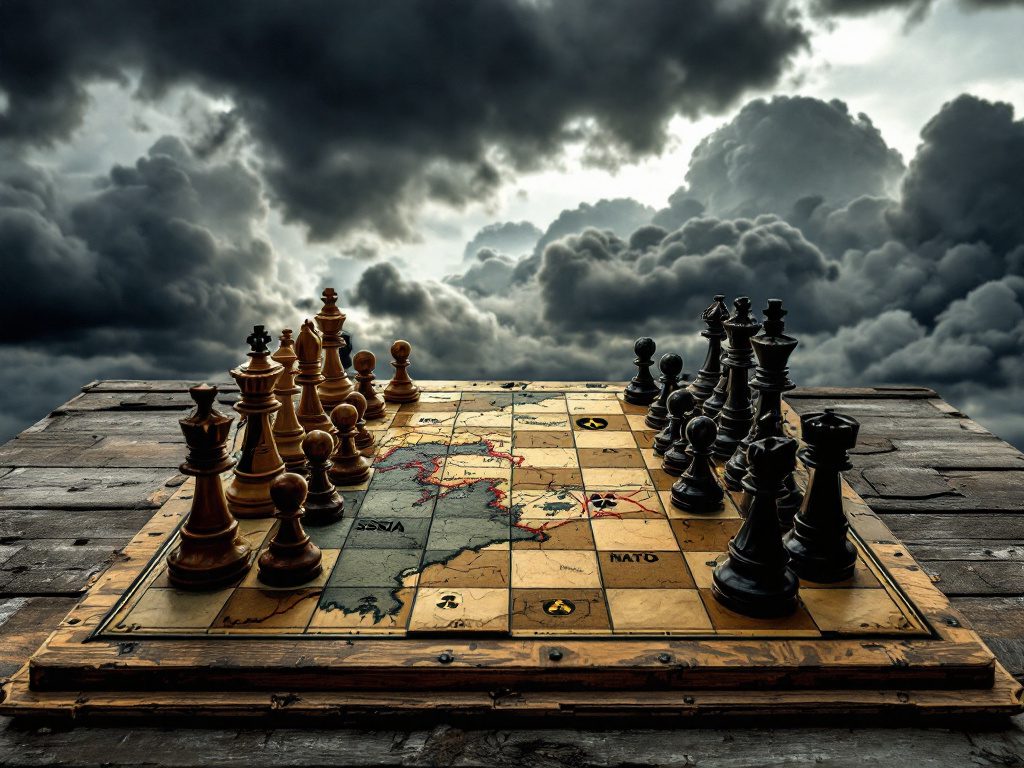
Shadow of the Bomb: Putin’s Calculated Words
Chilling uncertainty has once again swept across Europe, as Vladimir Putin flirted with the nuclear threat—then claimed restraint. In an interview broadcast over Russian state television, the Russian president announced that he saw “no need” to use nuclear weapons in Ukraine “for now.” Yet, for Ukrainians enduring nightly drone barrages and global leaders gauging every syllable from Moscow, such rhetoric only stokes anxiety. Eleven recently injured in another Russian attack on Kyiv serve as grim evidence that, even short of nuclear arms, this war delivers its own forms of terror.
A closer look reveals how the specter of a nuclear escalation is not merely idle talk. October 2022 witnessed Western media in a frenzy, whispering that Putin had come alarmingly close to deploying tactical nuclear arms as Ukrainian forces advanced. Although that nightmare did not materialize, these episodes underscore a cycle where (often vague) threats become a strategic tool. Putin’s language is carefully chosen—the intent less about immediate action and more about creating ambiguity and exerting leverage over the West. This is sometimes dubbed “nuclear blackmail,” and, according to Major General Ilya Pavlenko, it’s been used to prompt the Kremlin’s suspension of aid to Ukraine in the past.
“Will he or won’t he?” becomes less a theoretical debate than a constant, uneasy calculus for NATO and Kyiv alike. Even as Putin claims a reluctance, Russia’s military doctrine—recently revised in November 2024—now embeds a much looser threshold for launching nuclear weapons, not only in response to nuclear attack but also in retaliation for assaults conducted by conventional means if tied to a nuclear power. This revision signals not comfort, but an expansion of red lines.
History Repeats: Cold War Echoes and New Realities
To those who remember the Cuban Missile Crisis, this moment feels eerily familiar. But unlike the 1960s, today’s nuclear landscape is clouded by misinformation, rapid digital escalation, and a Russian leader whose aims remain opaque to even seasoned diplomats. International fears of miscalculation are not unfounded; by extending his nuclear doctrine, Putin invites more uncertainty into an already volatile conflict.
U.S. and European leaders recognize these hazards. Former President Donald Trump quite publicly boasted about diplomatic efforts that—he claims—brought Russia and Ukraine to the verge of a deal. Skeptics might ask how much substance was behind the scenes, but the very claim underscores the acute desire in the West to avoid scenarios where nuclear brinkmanship overshadows negotiation. Harvard’s Graham Allison, author of “Destined for War,” argues that the real danger is not premeditated launch, but accident or miscommunication. Under stress and fog, history shows, small blunders can snowball into irrevocable disaster.
Yet, when Putin proposes a 72-hour ceasefire around Russia’s Victory Day, President Zelenskyy promptly rebuffs it as little more than a publicity stunt—insisting that Ukraine needs a genuine, sustained pause, not short-lived symbolism. These dueling proposals reveal the deep mistrust at the heart of the war, and how every overture is doubted for hidden motives.
“Nuclear signaling is the last refuge of insecure strongmen. When your conventional forces falter, you rattle the world’s deadliest saber—hoping fear will give you what you can’t win on the battlefield.”
— Julie Smith, NATO U.S. Ambassador, 2023 Interview
Beyond that, conservative cheerleaders for Putin often dismiss these moves as mere negotiation tactics—ignoring the wider, destabilizing impact on global nuclear norms. If other authoritarian regimes see rewards for menacing their neighbors with nuclear capabilities, the risk of repeat crises skyrockets.
Human Stakes and the Price of Ambiguity
It’s tempting, from safer shores, to treat Putin’s nuclear hints as idle bluff. Yet, every threat exacts tangible costs—not just in humanitarian anxiety, but in hollowing out the world’s confidence in nuclear restraint. Each day of uncertainty undermines nonproliferation efforts built painstakingly over decades.
Ukraine’s battered civilians bear the consequences. Eleven injured in the recent drone attack on Kyiv are hardly isolated; these are the “small tragedies” that accumulate in the backdrop of bigger, nuclear anxieties. Sanctions, diplomatic logjams, and arms races—these follow the logic of fear, not hope. According to a May 2023 Pew Research survey, more than 55% of Europeans now believe nuclear war is a real possibility in their lifetime, a sharp spike from pre-2022 sentiment.
The world finds itself at a crossroads. Will it allow fear-driven policies to dictate the pace of peace, or demand a new seriousness from all nuclear powers—especially those threatening to use their arsenals as bargaining chips? Past lessons urge caution: deterrence works best when the rules are clear and the actors predictable. Today, ambiguity is the weapon, wielded more recklessly than ever.
Building a humane peace requires more than ceasefires or saber-rattling. Progressive values—honesty, transparency, and unyielding support for civilian protection—must guide every negotiation. Short-term fixes cannot substitute for genuine, enduring security, and it’s time global leaders, especially those in Washington and Brussels, call Putin’s bluff for what it is: an affront to reason and a gamble with our collective future.
