
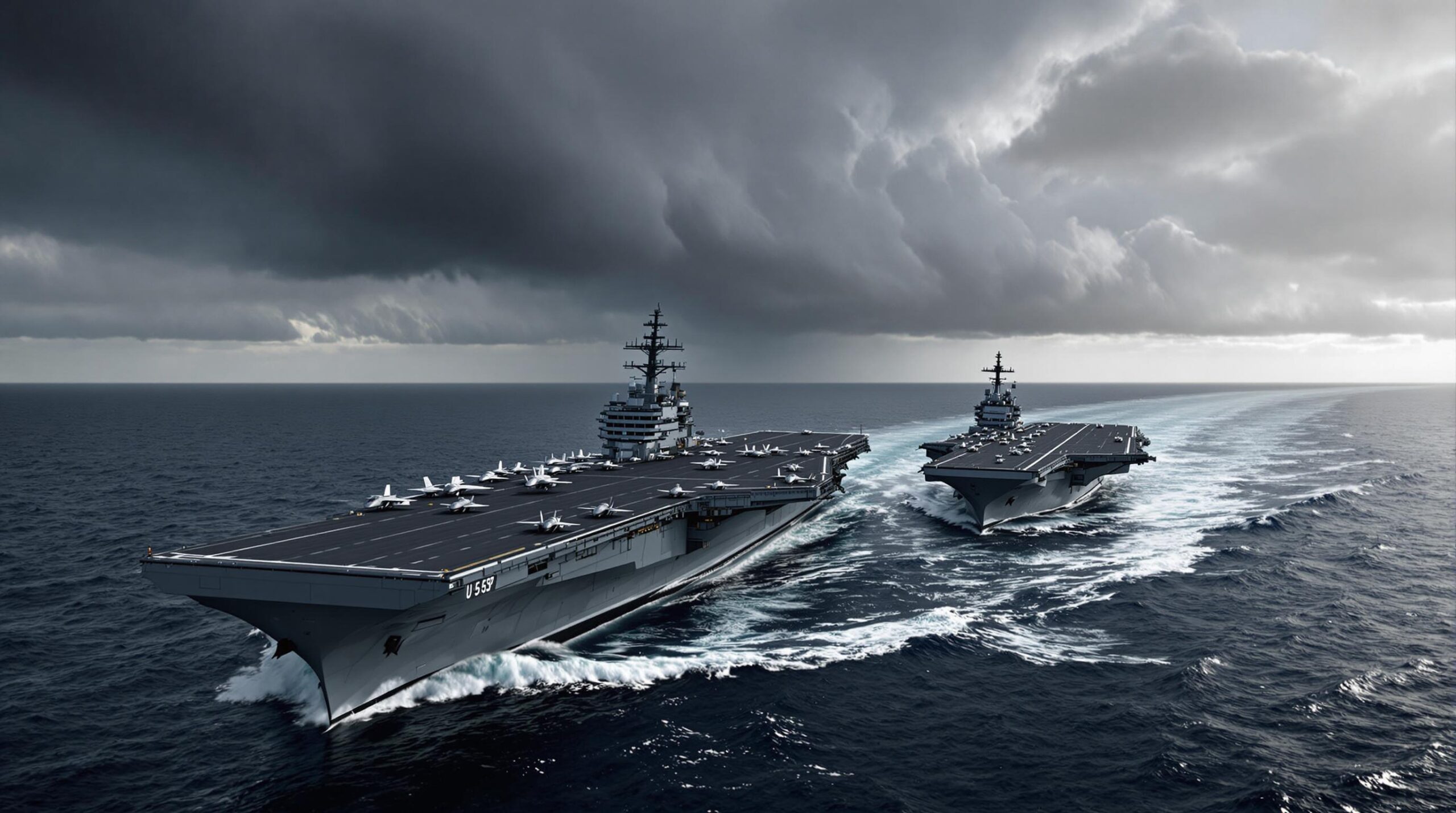
Amid escalating tensions and deepening violence in the Middle East, the Trump administration has made a decisive—and controversial—move: deploying a second aircraft carrier, the USS Carl Vinson, to join the USS Harry S. Truman in confronting Houthi rebels in Yemen. While supporters hail this show of force as necessary to secure regional stability, critics are wary, suggesting heightened military aggression may exacerbate, rather than solve, regional tensions.
A Grave Escalation or Necessary Deterrence?
For only the second time in just six months, two U.S. aircraft carriers have simultaneously been dispatched to the same region—a military strategy echoing heavy-handed approaches from earlier administrations. These carriers, emblematic of American military might, bring formidable firepower close to Iran’s doorstep, explicitly targeting Yemen’s Houthi movement, which Washington accuses of repeated provocations.
Defense Secretary Pete Hegseth—no stranger to ideological battles both within and outside the military establishment—has unequivocally supported the buildup. He claims that the expanded presence will grant commanders broader autonomy and give them more extensive options to neutralize threats. This pivot from the cautious stance of the previous Biden administration removes previously required senior-level approvals and restraints, and suggests a readiness to engage aggressively.
However, history warns us of the potential consequences of military bravado. Past interventions in Iraq and Afghanistan vividly illustrate how aggressive tactics and a heavy military footprint can backfire, amplifying rather than reducing anti-American sentiment. This historical reminder should give pause to policymakers considering escalations that carry profound human and geopolitical consequences.
What’s Behind the Houthis’ Resilience?
Over the last few months, the Houthi militia has alarmingly intensified its assaults, targeting over 100 ships since November 2023, resulting in considerable losses, including the sinking of two vessels and the tragic deaths of four sailors. Their actions claim justification from the broader geopolitical landscape, explicitly linking their aggression to the conflict between Israel and Hamas—a connection that complicates the scenario even further.
The Houthis also receive significant backing from Iran, a geopolitical rival of the United States. Through this lens, the decision to bolster American naval capabilities is unambiguously directed toward Tehran—a caretaker war as much about deterring Iranian ambitions as confronting Houthi aggression.
Yet, this inherently provocative move raises thorny questions. Will American actions quell violence, or serve as tinder to a larger conflagration? Experts remain divided. Karen Hollister, a geopolitical strategist with the Peace and Security Initiative, has described the move as “an inherently risky strategy. It could effectively expand rather than contain conflict if the delicate line of deterrence crosses unintentionally into provocation.”
“When military presence spirals upwards, so does the chance of accidental conflict. Diplomacy should be prioritized to prevent another endless war,” Hollister cautions.
Risks of Regional Destabilization
Beyond direct geopolitical impacts, there’s concern over operational strain the dual deployment places on the U.S. Navy itself. Moving USS Carl Vinson out of the Indo-Pacific—long identified by many as a critical strategic priority—could risk gaps elsewhere, notably with China watching and ready to capitalize. The decision highlights longstanding concerns about U.S. military overstretch, which has often led to delayed maintenance schedules, reduced strategic agility, and, ultimately, higher operational risks.
Moreover, skeptics worry that a muscular American military presence might unintentionally bolster anti-American narratives, reinforcing extremist propaganda that portrays the United States as an imperialistic aggressor. Yemen’s civilian population, already devastated by relentless conflict and humanitarian crises, could face further deterioration of conditions, risking inflamed tensions across the Arabic world.
Alim Shafiq, founder of Middle East Peace Dialogue, emphasized, “Sustainable peace is dependent not on forceful domination but diplomatic engagement and targeted humanitarian aid. Anything less risks deepening hostilities against the U.S. and worsening civilian suffering.”
Thus, as the USS Carl Vinson makes its way toward Yemeni waters—estimated to fully join operations within two to three weeks—global eyes watch anxiously. Will this show of force achieve the stated goals of deterrence and stability, or will it ignite further instability in an already volatile region?
This bold escalation indeed constitutes a defining moment. Whether it leads toward a peaceful resolution or deeper chaos remains uncertain. What is undeniable, however, is that America’s decisions today will shape not only immediate Middle Eastern geopolitics but could reverberate for generations to come.
