
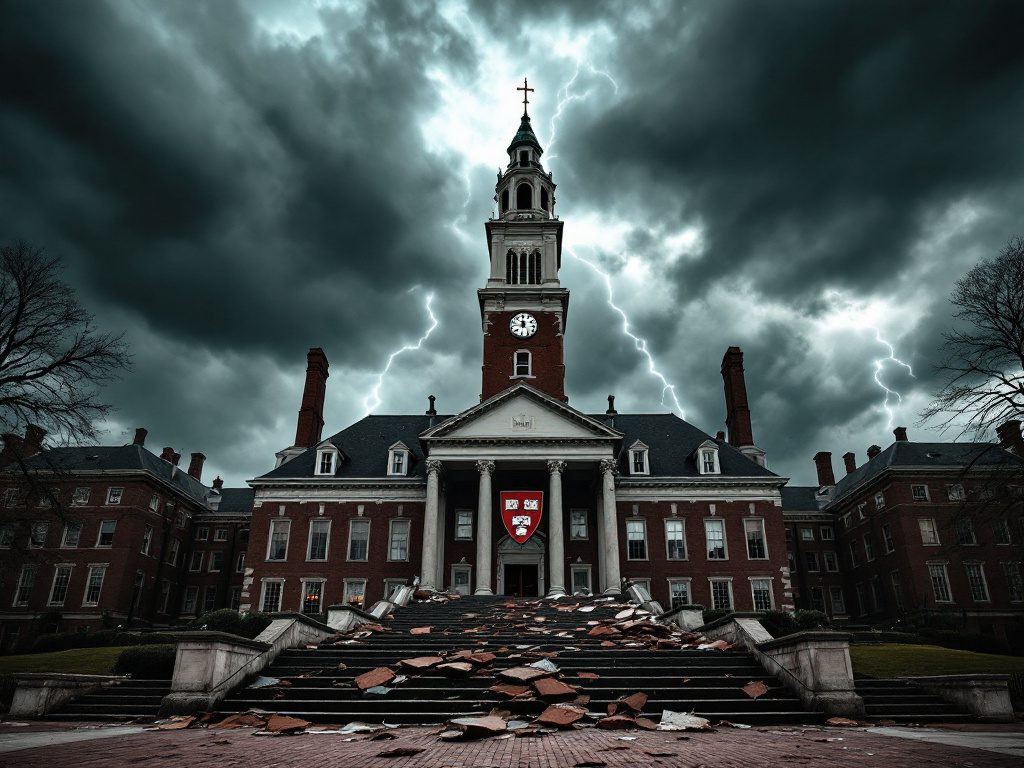
A Stark Assault on Academic Independence
If you thought the culture wars were a sideshow, the latest salvo from Donald Trump proves just how high the stakes have become. Declaring that Harvard University “deserves” to lose its tax-exempt status, Trump is not simply picking a fight with an Ivy League institution—he’s undermining the very ideals that anchor America’s system of higher education. The question on everyone’s mind: Will this unprecedented political intervention in the academy set a chilling precedent for all non-profits and universities?
An unmistakable escalation, Trump’s announcement comes after months of tension stoked by campus protests linked to the Gaza conflict and broader outcry over diversity, equity, and inclusion (DEI) practices at America’s elite colleges. The White House has already frozen more than $2 billion in federal research grants for Harvard and other universities, leveraging federal funding to force changes in campus speech and inclusion policies. The Department of Justice has formally requested the IRS to strike Harvard’s 501(c)(3) nonprofit status—a move with potentially devastating consequences for one of America’s most storied academic institutions.
According to educational historian Dr. Nancy Kantor, “This is the most direct federal challenge to university independence in living memory. If allowed to stand, it will fundamentally destabilize the social contract between higher education and the American public.” The stakes reach far beyond Cambridge, threatening a ripple effect for institutions up and down the educational hierarchy.
Campus Protests and Federal Retaliation
What triggered such an aggressive response from the White House? Trump and his allies have cast pro-Palestinian campus demonstrators not merely as students voicing dissent, but as “foreign policy threats”—accusing them of antisemitism and sympathy for the Hamas terror group. The Department of Homeland Security even went so far as to demand detailed records on foreign student protestors, threatening to revoke Harvard’s right to host international students under visa programs unless it complied. An administration willing to threaten academic visas signals a willingness to leverage immigration law for political ends.
Beyond Harvard, Columbia and other top-tier universities have also seen federal funding withheld over their responses to the campus protests. In a country where peaceful protest is enshrined as a defining feature of constitutional democracy, the willingness to use financial muscle as a tool of political compliance is deeply troubling. According to a Pew Research Center study, clear majorities—across party lines—support maintaining campus protest rights even when they conflict with government policy or donor interests.
This is not Harvard’s first moment of contention over protests or outside scrutiny. The late 1960s saw widespread unrest on American campuses, with then-president Lyndon B. Johnson largely resisting calls to intervene directly in university affairs, recognizing the risk of chilling free inquiry. Today’s moves represent a sharp break from that precedent—and raise the specter of overt political punishment for institutional autonomy.
The Unintended Consequences of Political Retaliation
Critics of Harvard and other elite universities point to high-profile failures to address antisemitism and scapegoating on campus, charges acknowledged by Harvard President Alan Garber, who conceded the university “failed to address both antisemitism and Islamophobia” during recent unrest. Yet, defenders argue that placing these failures in the crosshairs of federal power does more harm than good. Threats to revoke tax exemptions—a core pillar shielding educational nonprofits—could eviscerate funding not only for research but for scholarships and public-interest programs serving tens of thousands of students across the social spectrum.
If you believe universities should be citadels of robust debate and innovation, ask yourself what happens when political muscle overrules academic freedom. What happens to scholarship, to dissent, to the fragile fabric of America’s pluralism?
Harvard’s legal team has already filed suit, arguing the government’s actions constitute an unconstitutional infringement on free speech and academic governance. Conservative pundits, on the other hand, claim that elite institutions have exploited their privileged nonprofit status to promote “radical agendas” and sidestep meaningful oversight. But historical evidence offers a sobering reality check: Heavy-handed political intervention rarely yields thoughtful policy outcomes—instead, it stifles competition of ideas, undermines faculty and student independence, and discourages global talent from investing in American educational life.
Harvard is not alone in the legal battle. The American Council on Education, representing more than 1,700 colleges, declared, “Federal retribution against universities over protected speech isn’t just unprecedented. It’s dangerous—and it weakens America in the eyes of the world.” Their warning underscores a central tension: Are our universities accountable to public good, or political whims?
Where Does Higher Education Go from Here?
For progressives, this moment encapsulates twin crises: the erosion of academic independence and the weaponization of federal power for ideological ends. One doesn’t have to be an admirer of Harvard to see that forcing ideological conformity through financial coercion undermines not just elite universities, but the foundational American commitment to pluralism and robust debate. These threats mirror authoritarian tactics—using tax law and funding as levers to silence unwanted dissent—as much as they do genuine concern about campus climate.
What comes next could reshape American higher education for years. Should the IRS accept the DOJ’s recommendation, Harvard’s model could serve as a test case for broader federal crackdowns on universities that resist conservative policy agendas—from DEI initiatives to climate research to sexual and gender diversity programs. It’s not just about Harvard; it’s about the politics of knowledge itself.
Might we imagine a country where every university’s tax status hangs on the whims of whoever occupies the White House? If so, as Justice Louis Brandeis once warned, “the greatest dangers to liberty lurk in the insidious encroachment by men of zeal, well-meaning but without understanding.” For all who value openness, diversity, and innovation, the battle for Harvard is a battle for the soul of American education.
