
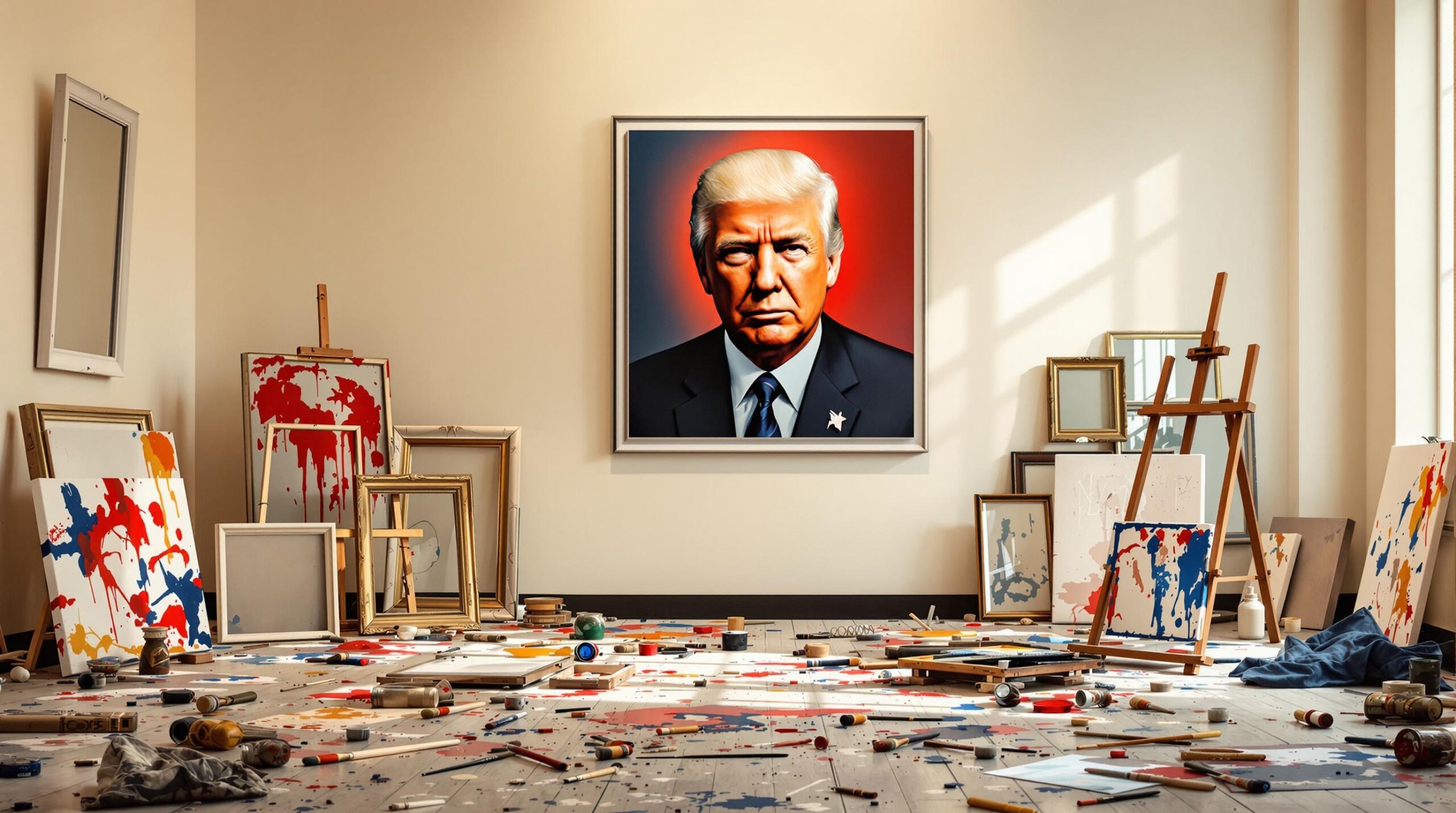
Former President Donald Trump has once again captured headlines, not by discussing policy or diplomacy, but because of his latest artistic tantrum. His recent demand for Colorado to remove a “purposefully distorted” portrait of himself hanging in the state’s Capitol building has reignited ongoing debates about political image, freedom of artistic expression, and governmental conflicts. Trump, known for making his dissatisfaction heard via his own Truth Social platform, criticized the portrait by Colorado artist Sarah Boardman, describing it as “the worst,” adding with characteristic vigor, “the one on me is truly the worst.”
This colorful reaction has once again spotlighted the complexities of public art—and the thin skin of powerful men.
An Artistic “Attack” Or Merely Interpretation?
Trump was particularly sharp in his criticism, attacking artist Sarah Boardman’s capability by comparing his portrait unfavorably against hers of Barack Obama: in Trump’s view, Obama’s portrait “looks wonderful,” while his own depiction was simply bad artistry. Boardman, who described her work as “thoughtful, non-confrontational, not angry, not happy, not tweeting,” seems to have sought neutrality in representation.
Yet Trump’s framing has positioned this neutral intent as a deliberate distortion of his image, exposing a wider conservative discomfort with representations not within their controlled narrative. Trump’s indignation might, in fact, reveal more about his anxieties than the actual artistic merit or intention of the painting itself, turning the discourse into a broader reflection on the fragility of authoritarian egos.
Moreover, reactions on social media have been swift and widespread, with countless individuals humorously spreading images of the controversial portrait. Trump’s attempt to halt the image’s circulation has predictably backfired spectacularly, demonstrating that attempts at censorship or control often amplify the message.
Fact Checks and False Blame
Perhaps as striking as Trump’s artistic disapproval is his targeting of Colorado Governor Jared Polis, whom he accused directly of positioning the painting “to embarrass me.” Yet this criticism reflects Trump’s familiar political tactic of casting blame quickly and inaccurately. Governor Polis’s office responded gracefully, emphasizing surprise at Trump’s criticism, stating clearly that the commission process was neutral and community-oriented: “We appreciate the President and everyone’s interest in our capitol building and are always looking to engage the public on art and history.”
Trump’s pointed critique also morphed into political attacks targeting Polis’s governance, accusing him of being “radically weak on crime,” particularly concerning the Venezuelan gang Tren de Aragua in Aurora. This effort to tie portraiture to crime policy feels contrived, yet highlights how a single ironic dissatisfaction can spiral into broader ideological attacks, a classic Trump strategy.
Indeed, the artwork itself was neither funded nor commissioned by the governor or his office; instead, it followed a grassroots crowdfunding campaign driven largely by Republicans. In fact, Colorado Senate Republicans under former State Senator Kevin Grantham raised over $10,000 to commission the portrait in 2018, aiming to replace a mischievously installed Putin image orchestrated by Democrats.
“By railing against an art portrait, Trump has inadvertently revealed the uncomfortable relationship conservatives sometimes maintain with artistic freedom.”
The Consequence of Artistic Freedom
What does this portrait’s controversy say about the intersection of political power and artistic expression? In societies where leaders cannot tolerate even mildly unflattering depictions, art’s role as a medium of subtle commentary and indirect critique becomes crucially important. It is exactly because art slightly evades direct governmental control—particularly in democracies—that it poses such significant discomfort to autocratic tendencies.
Trump’s emotional reaction to this neutral representation reveals how political images hold power far beyond themselves. Portraits aren’t simply passive representations of leaders; they form part of an ongoing public dialogue about values, perceptions, historical legacies, and power. Trump’s demands illuminate again the tension between self-presentation and public perception inherent in political iconography.
Historically, leaders uncomfortable with their public images—whether through portraits, photographs, or satire—have struggled with art’s independence. This intolerance has often been a hallmark of autocratic sensibility. Leaders such as Napoleon Bonaparte and more recent figures globally have shown intense sensitivity towards visual depictions that mar their carefully constructed images. Trump’s ire thus places him in distinctly un-ideal historical company.
For progressive values, Trump’s discomfort underscores the precious freedom artistic endeavors possess in liberal democratic societies. Rather than concerning himself with artistic neutrality, Trump’s reaction instead inadvertently confirms the significance and strength of American public art as a dialogical space between the governed and their governors—reflecting a robust democracy.
Indeed, the repercussions of Trump’s art tantrum offer a valuable lesson: artistic freedom and public dialogue remain quietly powerful forms of checking authority. Those in public power who attempt to distort or control artistic expressions ironically uncover their own vulnerabilities.
In the end, Trump’s portraiture protest may have achieved little apart from becoming a viral sensation. But his outcry underscores an essential truth: the potency of art lies precisely in its power to elicit reactions, provoking viewers and depicted alike into unexpected truths about ourselves and our leaders.
