
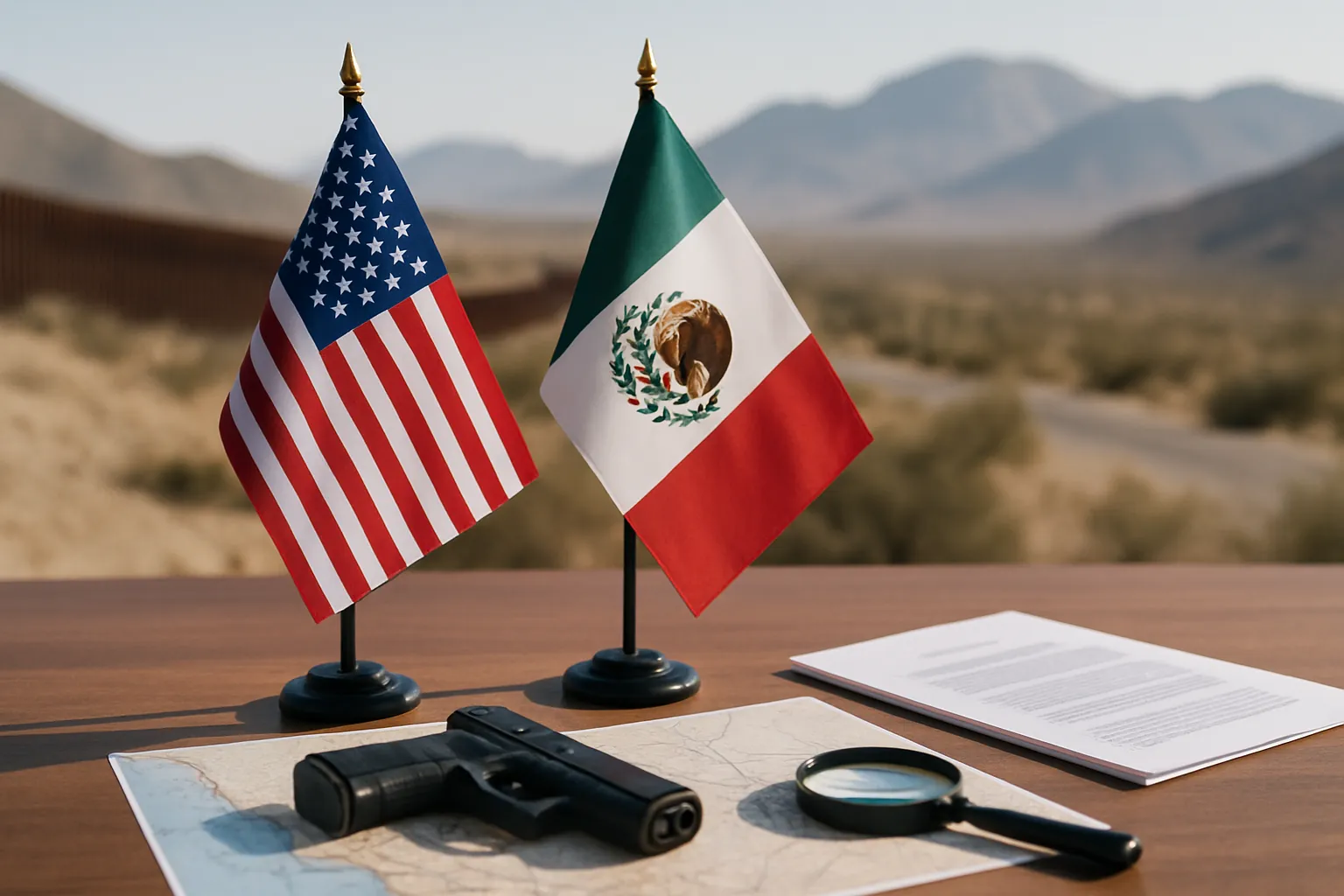
Lighting a Firewall: Can Bilateral Action Stem the Flow of Guns?
In a climate of escalating cartel violence fueled by American firearms, the United States and Mexico have unveiled a historic joint initiative — “Mission Firewall” — aimed squarely at stemming the deadly tide of illegal guns crossing their border. At first glance, it may seem like another bureaucratic memorandum. But when you listen to U.S. Ambassador Ronald Johnson call this a “new chapter” in binational cooperation, or see Mexico embarking on its first nationwide roll-out of U.S. tracing technologies, it’s clear something fundamentally different is at play.
Why does this matter? Every year, tens of thousands of firearms purchased legally in U.S. border states like Texas or Arizona end up powering the arsenals of Mexican drug cartels, intensifying violence and destabilizing entire regions. According to a 2023 Government Accountability Office report, nearly 70% of firearms recovered from Mexican crime scenes are traced back to U.S. origins. For decades, both nations have debated — and too often, deflected — responsibility for this tragic pipeline. With Mission Firewall, that political dodge ball may finally be coming to an end.
Beyond the headlines, these new measures signal a recognition that you can’t fight the epidemic of cross-border violence by tightening drug interdiction in isolation. Guns, as much as narcotics, are the fuel that keep cartel engines running. The joint rollout of U.S. tracking technology (like the eTrace ballistics platform) in all 32 Mexican states is more than a technical upgrade; it’s an act of shared acknowledgement and joint resolve.
From Hollow Promises to Joint Action: The Security Implementation Group
How did we get here? The groundwork was laid in September 2025, during high-level talks in Mexico City between U.S. Secretary of State Marco Rubio and Mexican Foreign Minister Juan Ramón de la Fuente. Out of those meetings emerged the U.S.-Mexico Security Implementation Group, tasked with overseeing real-time information sharing, joint inspections at the border, expanded investigations, and—critically—increasing the odds that traffickers will actually see prosecution on both sides of the Rio Grande.
This is where Mission Firewall claims its historic status. Conservative talking points have long blamed Mexico for failing to address cartel violence, overlooking that U.S. laxity on gun sales is an inextricable part of the equation. Critics on the right argue that tightening U.S. controls or sharing law enforcement technology is too great a concession, a risk to national sovereignty or gun owner rights. Yet the facts, and the cost in lives, tell a harsher story.
Real bilateral law enforcement means more than just conference calls and sharing data points. It requires forging genuine trust: a willingness for U.S. agents to conduct stricter inspections of southbound vehicles — often the preferred route for traffickers smuggling bulk firearms. The plan also harmonizes case handling, so prosecutions aren’t stymied by jurisdictional loopholes or the inertia of divided bureaucracy.
“What the U.S. and Mexico are attempting now is to break the old pattern—no more finger-pointing, but sustained, verifiable action that targets the money, the weapons, and the networks simultaneously.”
Harvard political analyst Dr. Marisol Reyes notes, “You simply cannot flatten the curve of narco-violence until you tackle both supply and demand for weapons—across both sides of the border. Only a root-and-branch approach stands any chance of success.”
Historic Stumbles, Hard Lessons: What Sets Mission Firewall Apart?
History is littered with failed cross-border efforts — from Operation Fast and Furious’s disastrous gun-walking fiasco under the Obama administration, to the fits and starts of the Merida Initiative, which critics slammed for its top-down approach and inconsistent funding. So what, if anything, makes this moment different? Mission Firewall’s emphasis on integrated investigations and shared technology is a radical shift, designed to bypass both the red tape and the finger-pointing that unraveled prior efforts.
Unlike its predecessors, this initiative grants Mexican authorities direct, sustained access to U.S. tracking tools. This isn’t just about hardware; it’s about changing the entire mindset toward shared justice. For the first time, Mexico can trace seized weapons in real time—uncovering not just the who, but the how and where of gun smuggling routes. U.S. authorities, meanwhile, are expanding scrutiny of suspicious gun sales and cracking down on so-called “straw purchases,” where legally eligible buyers purchase guns on behalf of cartels.
Data sharing will be cross-verified through the Security Implementation Group, aiming to avoid past incidents where turf wars and secrecy allowed smugglers to slip through the cracks. “An operation of this scale, if it sticks, could begin to dry up the supply of American guns to criminal groups in Mexico,” says Jane Fielding, senior fellow at the Council on Foreign Relations.
Of course, progressive skepticism should linger. Real reform requires not only political will but active checks against the inertia of bureaucracy and the corrosive influence of arms lobbyists. The NRA and its Congressional allies have already signaled their discomfort, railing against perceived threats to gun rights while downplaying the carnage south of the border. Those arguments have moral costs as well as material ones; as study after study has shown, stricter firearm oversight does not have to mean trampling constitutional rights, but it can mean saving lives.
Can Progressive Values Endure This New Era?
At its core, Mission Firewall embodies the values of collective responsibility and cross-national solidarity. A closer look reveals this initiative is not just about law enforcement, but about affirming the human stakes: the children growing up in cities wracked by street battles, the journalists silenced for exposing gunrunning, and the families in Texas and Tamaulipas alike who crave safety in their communities.
The road ahead is fraught. Lasting progress will depend on lawmakers resisting domestic demagoguery, championing evidence-based gun regulation, and holding both governments accountable to their promises. As history reminds us, policy is only as good as its implementation. True security—in the progressive sense—means fostering justice, equality, and peace for the many, not the few.
The new US-Mexico partnership stands as a litmus test for 21st-century diplomacy: Will we retreat to walls and blame, or will we choose collaboration, data, and courage? Mission Firewall is only a first step, but in an era of global interconnectedness and persistent threats, it may be among the most consequential.
