
The Unseen Web: How Precision and Patience Redefined Ukraine’s War Strategy
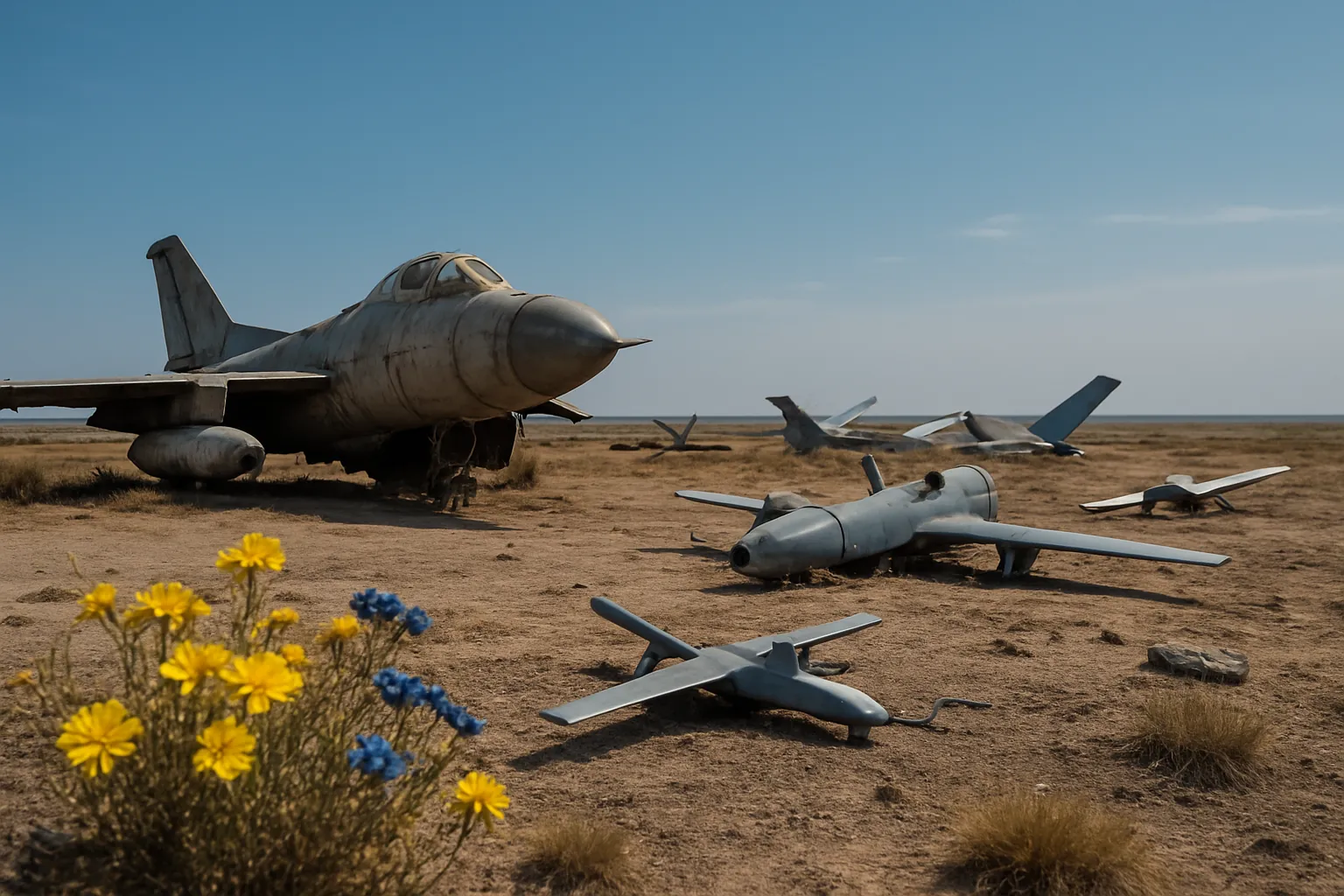
Late one spring night, dozens of Russian airmen awoke not to the familiar rumble of bombers taking flight, but to explosions—unmistakable and unplanned. Reports lit up Ukrainian Telegram channels: four military airfields inside Russia’s borders—Belaya, Dyagilevo, Olenya, Ivanovo—were burning. Strategic aircraft, from the vaunted Tu-95 long-range bombers to the A-50 surveillance planes, were aflame. For the architects of Ukraine’s most ambitious covert campaign yet, this was the culmination of meticulous planning, courage, and technological ingenuity.
This wasn’t just another drone strike. The Security Service of Ukraine (SBU), under direct supervision by President Volodymyr Zelenskyy, orchestrated one of the most complex operations in modern European warfare—Operation “Pavutyna,” or “Spider Web.” According to multiple Ukrainian outlets and Censor.NET, the SBU spent more than 18 months preparing an assault that would send shockwaves from Moscow’s command centers to the Kremlin’s propaganda apparatus. The mastermind behind the operation, SBU chief Vasyl Maliuk, became emblematic of Ukraine’s evolving approach: innovation against overwhelming odds, patience over desperation, and a readiness to strike when least expected.
Instead of brute-force assaults, this campaign embraced a distinctly 21st-century toolkit: FPV (first-person view) drones shipped covertly into Russia concealed within the roofs of mobile wooden houses. When the moment arrived, remotely triggered mechanisms silently lifted the roofs, releasing waves of drones to attack Russian aircraft parked on tarmacs—bombers that had been raining terror onto Ukrainian cities for months. For Ukraine, these attacks represented not just a technical feat but a game-changing triumph in the psychological and strategic dimensions of the war.
Beneath the Surface: The Stakes and Symbolism of “Demilitarization”
What does it mean for a nation, routinely outgunned and outpaced, to maneuver so daringly deep into hostile territory? The answer lies in both cold military calculus and the symbolic stakes at play. The SBU’s destruction of over 40 aircraft—valued at more than $2 billion according to Censor.NET—landed an unmistakable blow to Russia’s ability to wage air raids on Ukrainian cities and infrastructure. The psychological toll may be even greater for the Kremlin: Reports of “panic” echo through Russian media, while citizens question what once seemed impenetrable defenses at the very heart of Russian military might.
This operation unfolded with remarkable finesse. According to investigative reporting by Censor.NET and corroborated by open-source geointelligence analysts, SBU operatives spent over a year and a half embedded and preparing. Not a single significant leak, not a single finger pointed at Kyiv before the burn marks appeared on Russian runways. This underscores what Harvard security scholar Fiona Hill described as “the fog of war’s new face”: an era when innovation outpaces brute force, and offensive operations depend as much on cleverness as they do on courage.
“The whole world can now see that Ukraine’s fight for survival is not just about holding territory—it’s about rewriting the entire playbook for 21st-century conflict,” said political analyst and Kyiv School of Economics professor Tymofiy Mylovanov. “When you force your adversary to question their own security, you change the very nature of deterrence.”
For Ukraine, the message sent to both Moscow and its Western partners is clear: resourcefulness, not just hardware or cash, is at the core of strategic success. It’s a lesson the international community should heed. Ukraine’s reliance on innovation and the creative use of asymmetric technology is what has kept Russian advances at bay, despite chronic shortages and wavering Western aid. The Biden administration’s most recent $60 billion military aid package may be substantial, but events like Operation “Spider Web” remind us that ingenuity—not just materiel—defines survival and resistance on 21st-century battlefields.
False Equivalence and the Folly of Conservative Critiques
Predictably, some conservative voices in the U.S. have seized upon Ukraine’s cross-border strikes as evidence of “escalation” or as a reason to scale back support. Yet such criticisms miss the forest for the trees. A closer look reveals these arguments traffic in a dangerous moral equivalence: They paint Ukraine’s self-defense as somehow provocative, yet ignore Russia’s months-long campaign of missile and drone terror against civilian targets in Odesa, Kharkiv, and beyond. This rhetorical sleight of hand risks emboldening authoritarian aggression while undermining victims of aggression fighting for their very existence.
The facts, as reported by Western intelligence and independent observers, are illuminating. Not only have Russian forces struck schools, hospitals, and apartment blocks with impunity, but their sustained air attacks have forced millions of Ukrainians from their homes. Any strategy that ties Kyiv’s hands while leaving Moscow’s free is not “restraint”—it’s a recipe for unchecked violence.
Historic parallels are instructive. In Vietnam and later Afghanistan, cost-effective and unconventional tactics forced technologically superior militaries to rethink everything. The lesson, according to RAND Corporation’s 2023 assessment of modern drone warfare, is that “adaptability wins battles, not just bigger arsenals.” Ukraine’s Operation “Spider Web” put that lesson into practice—reminding policymakers in Washington, Brussels, and elsewhere that underdogs forced to improvise can tip the scales of war far more than predicted by spreadsheets or Pentagon projections.
Beyond that, operations like this signal hope and resilience—a reminder to democracies worldwide that standing with progressive, embattled nations is not just moral posturing but a pragmatic stance for global security. Our world cannot afford a retreat into cynical isolationism. Helping Ukraine isn’t about charity—it’s about setting a precedent that may one day safeguard our own cities, our own values, our own sense of justice.
