
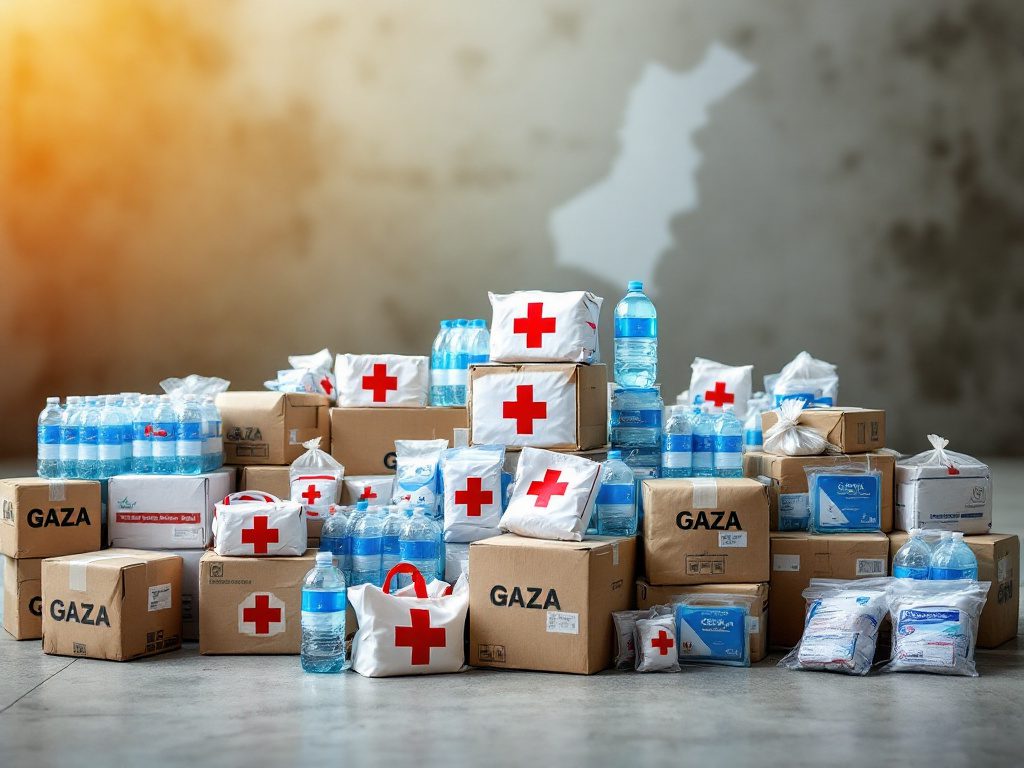
New Humanitarian Aid Mechanism: Hope Amid Crisis
What happens when desperate need collides with geopolitical brinksmanship? That question haunts Gaza today, as the United States and Israel move closer to finalizing a new international aid mechanism for the war-ravaged enclave. This emerging agreement is both a lifeline and a high-stakes experiment in delivering humanitarian aid to a population beset by months of blockade, scarcity, and fear.
Israeli officials claim that Hamas previously commandeered much of the international aid entering Gaza—profiteering from the shadow economy of the besieged territory. The rationale for Israel’s clampdown, which began after a collapsed ceasefire and an end to hostage negotiations, rests on concerns that humanitarian shipments were being diverted or sold, funding militant operations. These allegations have fueled mistrust, but the facts on the ground remain stark: since March, nearly all supplies of food, water, and medicine have been halted, pushing Gaza’s humanitarian system to the edge of collapse.
International organizations—from the United Nations to Oxfam—have repeatedly sounded the alarm. According to a recent report by the Integrated Food Security Phase Classification (IPC), a staggering 80% of Gaza’s population is facing acute food insecurity. UN Secretary-General António Guterres warned, “The threat of famine is no longer looming. It is here.” The chronic shortages aren’t political abstractions; they’re measured in empty shelves, parched wells, and the palpable anxiety of parents who can’t feed their children.
Logistics Without Hamas: A Delicate Balance
A closer look reveals the proposed solution’s delicate tightrope act. The agreement, as outlined by US and Israeli officials, would channel aid through an internationally managed trust fund—bypassing both Hamas and, critically, Israel’s direct military involvement at the point of distribution. Instead, a private American logistics firm would secure and run the aid hubs inside Gaza, distributing weekly packages to families. Israel’s role, meanwhile, becomes twofold: providing indirect security and building the necessary infrastructure for these compounds, but remaining at arm’s length from the actual handoffs.
This effort to sideline Hamas is unlikely to be seamless. Excluding the de facto governing authority from the logistics raises thorny questions about implementation and long-term stability. Aid agencies have publicly warned that unless the distribution hubs are genuinely accessible and protected, black-market networks could re-emerge, or civilians could be caught in the crossfire of yet another fragmented bureaucratic system.
Previous efforts offer cautionary tales. In Yemen, for example, convoluted restrictions on aid under the guise of countering armed groups led to bottlenecks, duplication, and ultimately increased suffering for ordinary people. According to Harvard economist Jeffrey Sachs, “Humanitarian logistics fail when policymakers confuse control with access—it’s the families who pay the true cost.” The specter of repeating such mistakes hangs over the Gaza plan.
The scale of the challenge is hard to overstate. As the Israeli Security Cabinet greenlights expanded military operations—calling up more reserves and reorganizing battalions—the compounding insecurity magnifies risks for aid workers and recipients alike. Humanitarian experts warn that unless combat operations are coordinated with aid deliveries, any logistical mechanism, however well-intentioned, will founder on the shoals of real-world violence.
“When humanitarian aid becomes hostage to military priorities, it’s the most vulnerable—children, the elderly, the sick—who stand to lose the most.”
Political Gaps and Ethical Imperatives
Critically examining the logic of exclusion raises uncomfortable questions for progressive policymakers and ordinary Americans alike. Can a system designed to block a group, however maligned, realistically avoid entrenching new inequalities or fueling resentment? When the Israeli government insists on barring Hamas from the process, is it upholding security—or undermining the implicit social contract with those civilians most at risk?
The broader ethical imperative is clear: Lifesaving relief ought not be a bargaining chip in a high-stakes diplomatic chess match. As Nobel laureate and humanitarian advocate Malala Yousafzai has argued, “Denying basic needs to a population as leverage is both counterproductive and morally indefensible.” Yet for months, aid has served exactly that function in Gaza—dangling on political strings, given or withheld in response to battlefield calculations and international headlines.
Some on the American right have attempted to frame new aid agreements as capitulations to terrorism—insisting that every dollar or kilogram of food risks empowering Hamas. But this position wilfully ignores both the overwhelming evidence of suffering and the basic norms of international law. Article 55 of the Geneva Conventions requires occupying powers to ensure the population’s access to food and medical supplies. There are no footnotes excluding populations governed or oppressed by hostile actors.
Beyond that, this new arrangement highlights sharper questions about American complicity, global solidarity, and our shared responsibility for peace. Progressive voices, from Senator Bernie Sanders to groups like Jewish Voice for Peace, have consistently pressed for unconditional, safe aid access—warning that moral clarity often disappears under the debris of armed conflict. The U.S. role, as the orchestration of both diplomacy and warehousing, implicates our nation in each missed meal and every life saved or lost.
Looking backward, the lessons are sobering. During the Berlin Airlift of 1948-49, humanitarian resolve broke the Soviet blockade, even as geopolitical tension ran high. Yet that effort was underwritten by a genuine commitment to civilians—not tactical gamesmanship meant to punish a population into submission. Shouldn’t the same humanitarian imperative apply in Gaza today?
Toward Lasting Solutions and Progressive Leadership
The world stands at a crossroads. This latest mechanism, if finalized and implemented with honesty and oversight, could represent a critical first step toward reaffirming the value of every human life—and the possibility of post-war reconstruction built on trust, not punitive deprivation. But half-measures and political theater, history reminds us, have only deepened suffering.
Progressive leadership is needed—not in orchestrating clever workarounds, but in demanding open borders for relief, robust protections for aid workers, and transparency above expediency. Policies must prioritize collective well-being and human dignity over security paradigms that too often dehumanize en masse. Our obligations, as Americans and as global citizens, require us to demand that humanitarian aid flows not according to the whims of militant groups or conservative governments, but on the simple, urgent basis of human need.
Failure in Gaza is not inevitable. The architecture of hope is possible—even in war’s bleakest corners—if the world has the courage to build it.
