
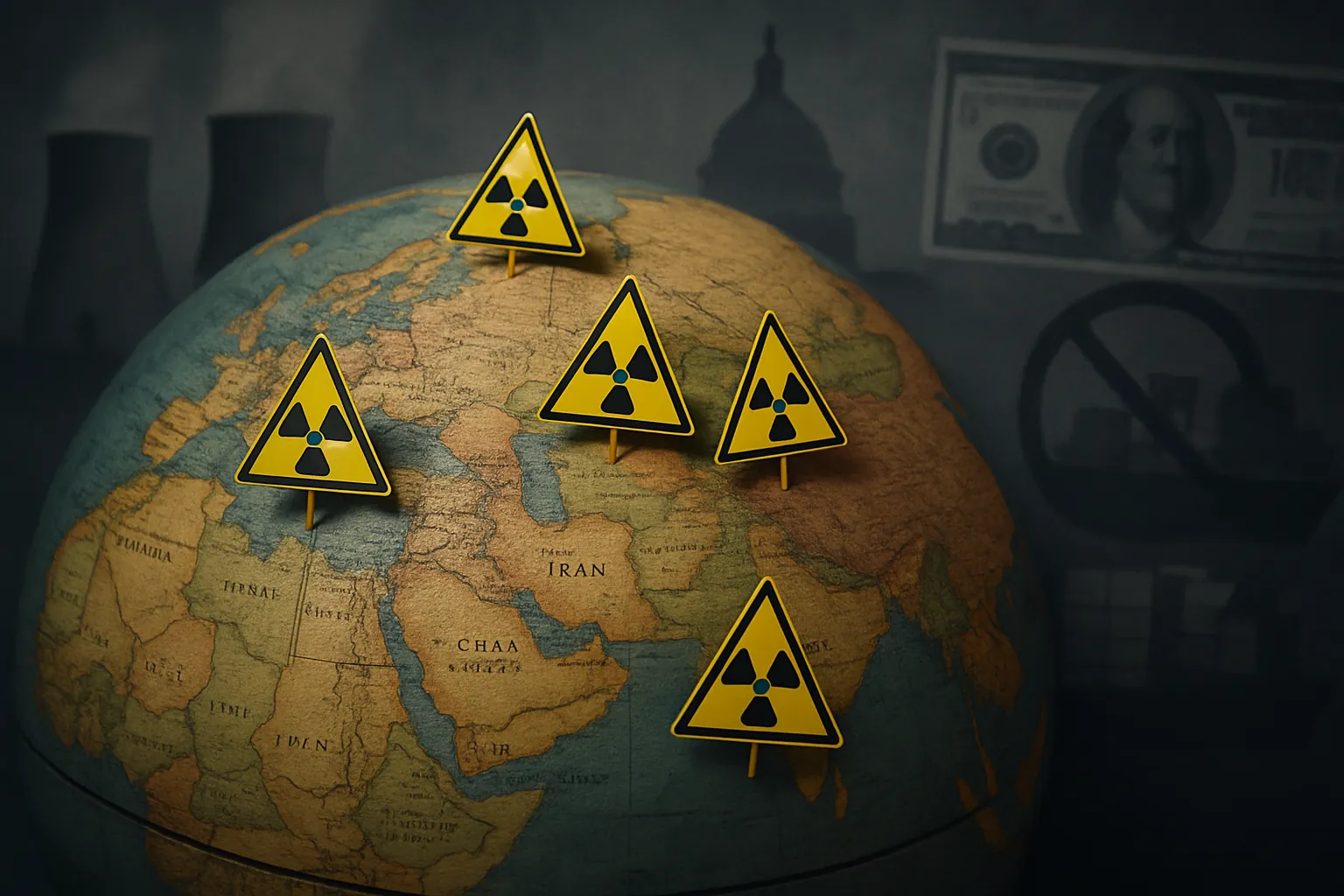
From Sanctions to the Nuclear Comeback: A Dangerous Balancing Act
The United States’ latest sanctions against Iranian individuals and entities tied to Tehran’s clandestine nuclear research are more than just another volley in the never-ending joust with the Islamic Republic. They encapsulate a world teetering between two starkly different nuclear realities: the resurgent, hopeful narrative of nuclear energy as a climate savior, and the sobering persistence of nuclear weapons as instruments of deterrence, coercion, and existential threat.
It’s a story that raises profound questions: Can the world embrace nuclear technology for its environmental promise without fanning the fires of proliferation? Or will old fears be reinvigorated as nations like Iran—long suspected of vying for weapons capability—chase the atom’s double-edged potential?
Three Iranians and a key entity have been sanctioned under Executive Order 13382, a move aimed at delaying and degrading Iran’s efforts to revive aspects of its pre-2004 nuclear weapons program, known as the Amad Project. According to the US Department of State, these sanctions specifically target Iran’s Organization of Defensive Innovation and Research (SPND), which continues, despite international scrutiny, to stockpile uranium enriched up to 60 percent—an activity no other non-nuclear weapon state conducts.
A closer look reveals that Iran has consistently used opaque procurement channels and front companies to obscure its acquisition of dual-use materials, an approach reminiscent of the shadowy networks that proliferated nuclear technology during the 20th century. According to Harvard’s Belfer Center, “Iran’s technical advances and procurement methods make it a unique nonproliferation challenge in the 21st century.” For progressive policymakers attuned to the nuances of global security, such developments underscore the raw urgency of reinvigorating and modernizing international arms control architecture.
Nonproliferation at a Crossroads: Lessons from Ukraine and Erosion of the Old Order
What makes these sanctions especially fraught is their context within an eroding nonproliferation regime. The Nuclear Nonproliferation Treaty (NPT), long regarded as the bulwark against atomic anarchy, shows unmistakable cracks. Experts point to the widening availability of nuclear know-how and materials—not just in Iran, but also across Asia and the Middle East. As nuclear expertise migrates, so do the risks.
This dilemma is only magnified by contemporary geopolitical tremors. The collapse of U.S.-Russia arms control agreements and the spectacle of Russia’s nuclear saber-rattling during its invasion of Ukraine have deeply unsettled America’s allies. Imagine being a policymaker in Warsaw, Seoul, or Berlin, cautiously reading the tea leaves about American security guarantees. Doubts are not just hypothetical; they shape decisions at the very heart of national survival. Recall, after all, that Ukraine surrendered its nuclear arsenal in exchange for promises of sovereign respect—promises that were shattered in 2014.
International pundits now wonder aloud: If nuclear arms bring security, what rational state would choose to disarm? This rhetorical loop, dangerous and dispiriting, feeds into the broader backsliding of global arms control. The recent moves by Germany to reconsider nuclear “sharing”—the deployment of U.S. nuclear weapons on German soil—illustrate an old logic revived by new threat perceptions.
“The new nuclear age is here, and it is more complicated, fragmented, and unpredictable than the Cold War calculus ever was.”—James Acton, co-director, Nuclear Policy Program, Carnegie Endowment for International Peace
Now, with even nations like Saudi Arabia openly weighing their own nuclear options as part of civil nuclear pacts with the U.S., the margin for error grows perilously slim.
The Paradox of Progress: Nuclear Energy, Climate, and Cost
Despite—or perhaps because of—this fraught nuclear landscape, the renaissance of atomic energy is quietly underway. Environmental groups that once campaigned with iconic radiological symbols now accept that decarbonizing the global grid requires every low-carbon tool, and that includes nuclear power. The Union of Concerned Scientists and even some corners of Greenpeace have grudgingly acknowledged that solar and wind, while vital, simply can’t fill the baseload gap alone.
Small Modular Reactors (SMRs) have become the portfolio darlings of investors, policymakers, and climate advocates alike. These innovative designs promise faster construction, improved safety protocols, and scalable deployments—attributes that have eluded the industry since its mid-20th century heyday. Firms from NuScale Power to Rolls-Royce are racing ahead, backed by government incentives and, increasingly, international cooperation. China’s audacious blueprint to bring 150 new reactors online by 2035 casts the West’s fitful progress in sharp relief.
There’s a catch, though: the lingering specter of nuclear waste. France’s national nuclear agency has revised its cost estimate for a next-generation waste storage project to a staggering 37.5 billion euros ($42 billion), according to AFP and Reuters reporting—a sum that exposes the enduring financial and ethical headache of long-term radioactive stewardship. Each new reactor built for climate benefit must grapple with this legacy, reminding us that there are no magic bullets.
Beyond that, academia is stepping forward as a crucial partner. The Institute of Chemical Technology in Mumbai, under the stewardship of former Atomic Energy Commission chairman Anil Kakodkar, has pushed India onto the map of nuclear innovation, launching its own Centre for Energy Science and Technology. By fostering independent research and nurturing talent in cutting-edge fields like hydrogen generation and modular reactors, these centers act as counterweights to the dominance of entrenched nuclear states.
Debates surrounding nuclear energy reveal deep-seated political divides as well. Conservative policymakers often portray atomic energy as a panacea, ignoring or downplaying real challenges: regulatory complexity, community opposition to storage facilities, the outsized influence of incumbents, and, notoriously, the open-ended fiscal burden on future generations. On the other hand, liberal and progressive voices—while acknowledging nuclear’s climate advantages—insist that genuine safety, community consent, and democratic oversight are non-negotiable. Jane Flegal, a climate policy expert at Stanford, puts it bluntly: “Nuclear energy can be part of the solution, but only if we don’t repeat the mistakes that have historically fueled distrust and opposition.”
A Path Forward: Collective Responsibility in a New Nuclear Era
The interconnected escalation of both nuclear weapons risk and civilian nuclear energy underscores a critical truth: global security and social justice are inextricably tied to how we govern the atom in the decades ahead. Will we double down on exclusive alliances and opaque statecraft, or will we build the inclusive, transparent mechanisms necessary to ensure that atomic power serves humanity’s needs—not just the whims of the powerful?
Experience teaches that wishful thinking is no substitute for vigilance and collaboration. Policymakers, scientists, and citizens must confront uncomfortable realities: the inadequacy of old treaties for a new technological era, the necessity of multi-layered oversight, and the imperative to invest in communities that bear the risks of both nuclear weapons and energy.
The crossroads of the new nuclear age invite neither hysteria nor complacency. They demand honest reckoning, technological courage, and a persistent moral imagination—a vision that refuses to cede the atom’s promise to either profiteers or autocrats alone. Only by embracing this challenge with eyes wide open can we steer a course toward a future where *clean power and peace reinforce rather than undermine each other*.
