
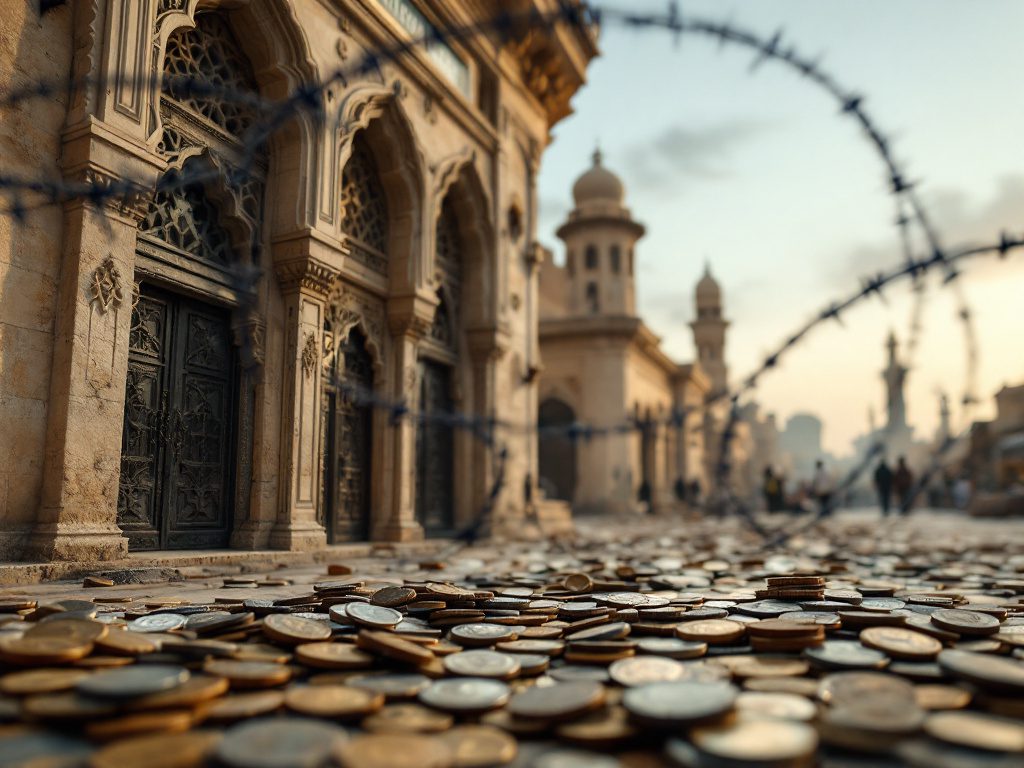
Setting the Stage: Sanctions Amid Unrest in Yemen
Even for those familiar with the cycles of crisis in Yemen, the United States’ decision to sanction the International Bank of Yemen (IBY) arrives as a telling chapter in a saga of conflict, shifting alliances, and fraught policymaking. In early March 2025, Washington placed the IBY and leading officials—including Kamal Hussain Al Jebry, Ahmed Thabit Noman Al-Absi, and Abdulkader Ali Bazara—on its blacklist, citing their financial support for the Iran-aligned Houthi movement. This latest move intensifies a campaign of pressure meant to curb Iranian influence, disrupt the Houthis’ ability to strike at commercial shipping across the Red Sea, and secure global trade routes increasingly vulnerable since the onset of heightened Houthi aggression.
From the halls of the Treasury Department to the corridors of the State Department, officials cast the action as a “whole-of-government approach.” The U.S. designated Ansarallah—the formal name for the Houthis—as a Specially Designated Global Terrorist (SDGT) organization in February 2024 and subsequently as a Foreign Terrorist Organization in March 2025 under section 219 of the Immigration and Nationality Act. These escalating labels reflect frustrations not only with the rebels’ military activity, but also with their sustained ability to finance conflict. At stake: the fragile arteries of global commerce and the hope for enduring peace in one of the world’s most impoverished nations.
Deciphering the rationale and real-world impact of these sanctions, however, demands more than simply tracing official announcements. A closer look reveals the complex interplay of geopolitics, humanitarian realities, and the limits of U.S. policy, especially when set against the backdrop of Yemen’s long, tortured conflict.
Disrupting Iran’s Network—or Disrupting Yemeni Lives?
“Disrupting Iran’s threat network.” That phrase echoes in every Treasury Department press release—and, undeniably, the Houthis’ rocket and drone attacks on commercial vessels in the Red Sea demand a response. But sanctions, especially those targeting a nation’s banking sector, arrive with significant collateral impact.
Historically, U.S. sanctions have produced mixed results. Economic historian Kimberly Elliott, writing in Foreign Affairs, highlights that over the past fifty years, only about a third of comprehensive sanctions were deemed partially successful in changing state behavior. The effect on autocratic or non-state actors—flush with alternative support, be it from shadow banking or sympathetic state actors—is even less certain. Iran’s resilience in the face of years of American and European financial blockades stands as a sobering case in point (Harvard economist Djavad Salehi-Isfahani warns that sanctions often “punish the wrong people”).
The IBY in particular has filled a critical gap in Yemen’s shattered economy. For civilians, this bank offered rare access to hard currency and cross-border transactions. Blocking its access to the international financial system doesn’t simply hurt Houthis’ accounts; it risks further isolating millions of Yemenis already struggling to pay for food, medicine, or remit small sums from relatives abroad. The United Nations has repeatedly warned that sanctions of this kind can “exacerbate humanitarian catastrophe,” a caution that demands progressive scrutiny in policy deliberation.
“By targeting banks essential for civilian remittances and local commerce, these sanctions risk deepening an already dire humanitarian crisis while the Houthis—resourceful as ever—may simply reroute their finances through informal networks.”
Beyond that, while U.S. measures aim to support Yemen’s internationally recognized government, they risk inadvertently fortifying the Houthis’ propaganda—a narrative painting the United States as indifferent to ordinary Yemeni suffering. Diplomatic nuance, so often absent in these decisions, could mean the difference between strategic progress and yet another cycle of heightened resentment and violence.
The Limits of Pressure: A Path Forward for Peace?
Conservative policymakers routinely embrace sanctions as a default tool—a box to check when direct military action proves too risky or costly. But real-world outcomes rarely justify such faith. “Sanctions alone don’t transform local realities,” cautions Middle East analyst Farea Al-Muslimi, “especially when there is no ongoing diplomatic support or relief for the most vulnerable.” The long history of U.S. sanctions, from Cuba to Iran to North Korea, clearly demonstrates that without a parallel focus on humanitarian relief, dialogue, and inclusivity, even the most well-intended measures can harden rather than soften adversaries’ resolve.
This is more than a question of economic statecraft. It’s a question of justice—for Yemen, yes, but also for a world that must balance security with compassion. Progressive policy would demand transparent humanitarian carve-outs, robust accountability measures, and ongoing diplomatic outreach—not only because it’s morally right, but because it’s practically more effective. Ambassador Barbara Bodine, now at Georgetown University, has repeatedly warned that “sanctions without relief mechanisms function more as tools of collective punishment than instruments of peace.”
What should concern us all is the risk that, while Washington tightens the economic vise, opportunities for peacemaking, nation-building, and true stability continue to slip away. The Biden administration’s “whole-of-government” approach is right to see the Houthis as part of a regional challenge orchestrated by Iran. But it must also recognize that lasting peace hinges on economic dignity, inclusive governance, and protecting Yemen’s vulnerable.
America stands at a crossroads: will it reinforce a spiral of suffering and resentment, or champion a more holistic, just pathway to peace? Congressional oversight, international humanitarian input, and persistent engagement with regional actors must be the benchmarks now. The world is watching—not simply to see if sanctions pinch the Houthis or the IRGC, but if American values bend once again in the breeze of expediency, or take root in the fertile ground of justice and empathy.
