
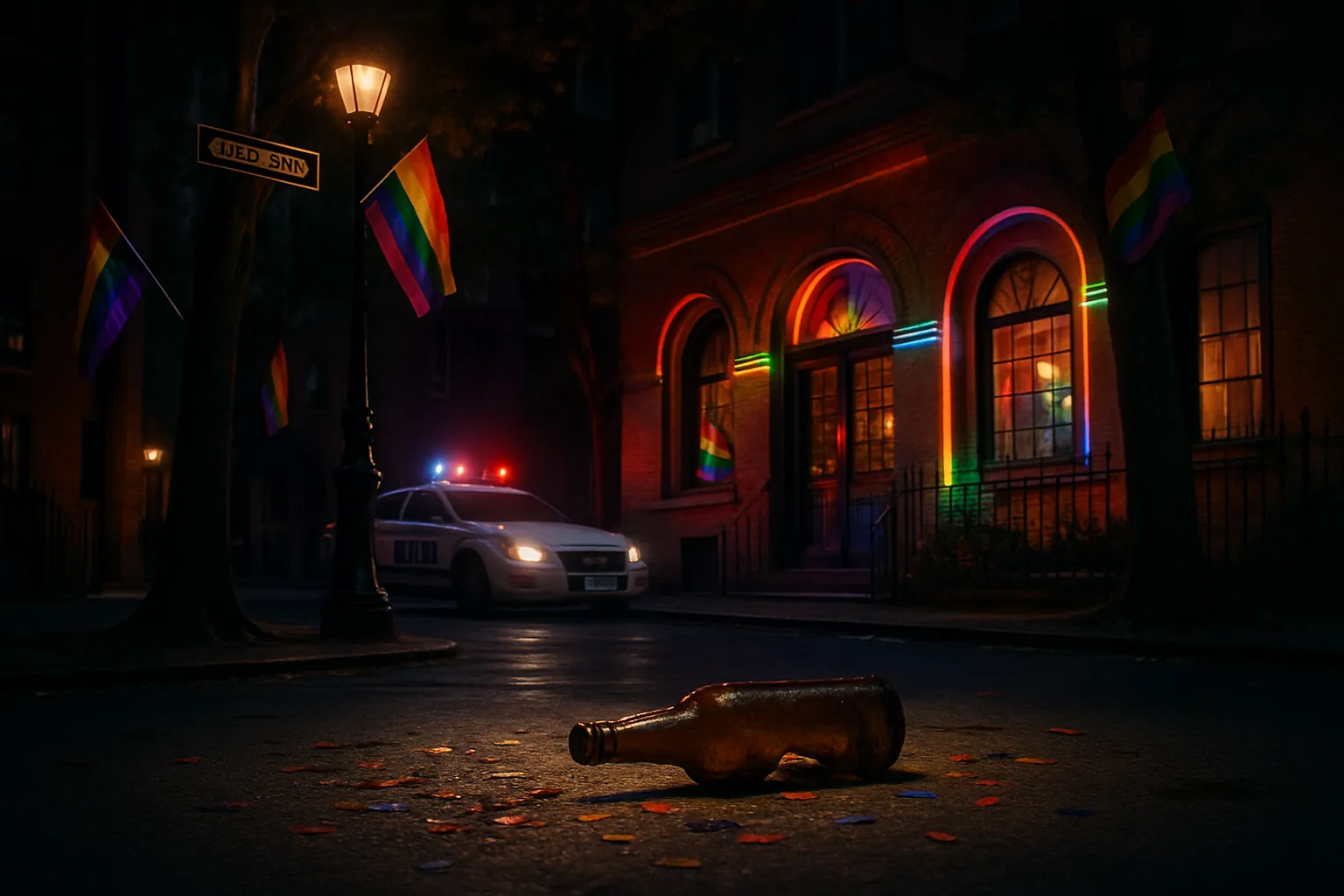
Pride’s Promise Shadowed by Gunfire at Stonewall
New York City’s Pride March, meant to symbolize progress and resilience, ended Sunday night under a pall of violence that clashes with the celebration’s spirit. As hundreds of thousands filtered out of the city’s exuberant festivities, two teenage girls were shot near the Stonewall Inn, a monument synonymous with the birth of the LGBTQ+ rights movement. The incident occurred just after 10 p.m. at 3 Sheridan Square, directly adjacent to the historic bar where the 1969 Stonewall Riots ignited decades of activism. According to NYPD reports and eyewitness accounts, a dispute between groups escalated until gunfire erupted, leaving a 16-year-old in critical condition with a head wound — an injury law enforcement believe resulted from accidentally shooting herself after attempting to fire at a rival group. The other victim, a 17-year-old bystander, was struck in the leg and is listed as stable at Bellevue Hospital.
The juxtaposition of celebration and sudden violence stunned a community that had just been buoyed by what many described as the largest North American pride event this year, drawing over one million attendees. As rainbow flags waved and voices chanted for equality hours earlier, few could have imagined that a landmark of liberation would witness a tragedy echoing the very dangers Pride seeks to defy. No arrests have been made, and investigators continue to probe the specifics, but police and city officials have confirmed that the shooting is not currently being investigated as a hate crime.
The shock of gunfire outside Stonewall underscores enduring tensions around public safety, gun access, and the persistent fragility of hard-won safe spaces for marginalized groups. Mayor Eric Adams described the incident as “devastating,” emphasizing that violence has no place at moments meant to commemorate progress and community togetherness. For many, the night’s events underline both how far we’ve come and how much work remains to ensure the assurance of security for all.
Public Safety, Guns, and the Persistent Challenge of Safe Spaces
Gun violence in America remains an unyielding crisis, its ramifications felt in communities of every background. Not even the sanctity of historic sites like Stonewall or the energy of a major city’s largest pride event provide immunity from firearm-fueled tragedy. According to the Gun Violence Archive, as of mid-2024, the U.S. continues to average over one mass shooting per day — a statistic that, for many New Yorkers, became deeply personal Sunday night. Greenwich Village, famous for its bohemian culture and progressive causes, is hardly a neighborhood steeped in violent crime. Yet, the steady ubiquity of guns and ease of access, especially to firearms among young people, tears through even places thought to be safe havens. Harvard public health researcher Dr. Sheena Patel emphasizes, “When firearms are present in any heated dispute, the risk of unintended injury — especially among adolescents — skyrockets. This isn’t just a policing problem; it’s a public health emergency.”
Why is it that a country purportedly committed to freedom and safety for all can’t ensure that people celebrating love and identity don’t have to fear stray bullets? Policies that restrict gun access, invest in youth outreach, and expand mental health resources have repeatedly shown measurable impact — yet conservative resistance in Congress and at state levels keeps meaningful reform gridlocked. In New York, state leaders have made strides tightening gun laws and bolstering red flag protections, but as Sunday’s events reveal, progress remains incomplete when guns continue to circulate through illegal channels and fall into the hands of minors.
Beyond the shootings, the evening’s chaos was punctuated by a separate incident in nearby Washington Square Park, where a shirtless man unleashed bear spray into a crowd, sending over 50 people scrambling for safety and leaving six with minor injuries. Authorities quickly apprehended one individual, but such episodes highlight the relentless challenge of policing both visible and invisible threats during major public gatherings.
Pride, Protest, and the Changing Face of LGBTQ+ Solidarity
2024’s NYC Pride march was widely anticipated, not only for its size, but as a bellwether for the state of LGBTQ+ advocacy in a country at a political crossroads. Organizers estimate over one million attended, waving flags and marching past businesses that — unlike recent years — offered reduced or muted corporate support. As brands across the country face backlash from right-wing pressure groups, Pride’s funding and visibility have fluctuated, with some organizations scaling back in response to anti-LGBTQ sentiment.
“The violence that marred the evening is a chilling reminder: visibility is not invincibility, and hard-fought rights always require vigilant defense.”
So, what does solidarity look like after Stonewall’s shadow is cast anew? A closer look reveals a community continually forced to protect and defend its spaces, both physically and politically. The resilience on display Sunday — from the first responders who rushed into the chaos to the crowds who refused to let fear erase the day’s meaning — typifies the heart of protest and Pride alike. Generations after 1969, the struggle has shifted: from police brutality and decriminalization toward the ongoing battle against gun violence, institutional neglect, and political opportunism that treats LGBTQ+ rights as a wedge, not a promise.
A national climate of charged rhetoric and legislative backlash — especially against trans youth and drag artists — intensifies the need for gatherings like Pride to double as demonstrations of unity and determination. The shooting near Stonewall isn’t just a local crime story. For advocates and allies, it’s a pointed question: will we yield to intimidation and division, or reassert our commitment to collective security and justice for all?
The answer, much as it was in 1969, will depend not on individual action, but on unflagging solidarity, pressure for meaningful reform, and the unshakable belief that every step forward matters — especially when the path is steep.
