
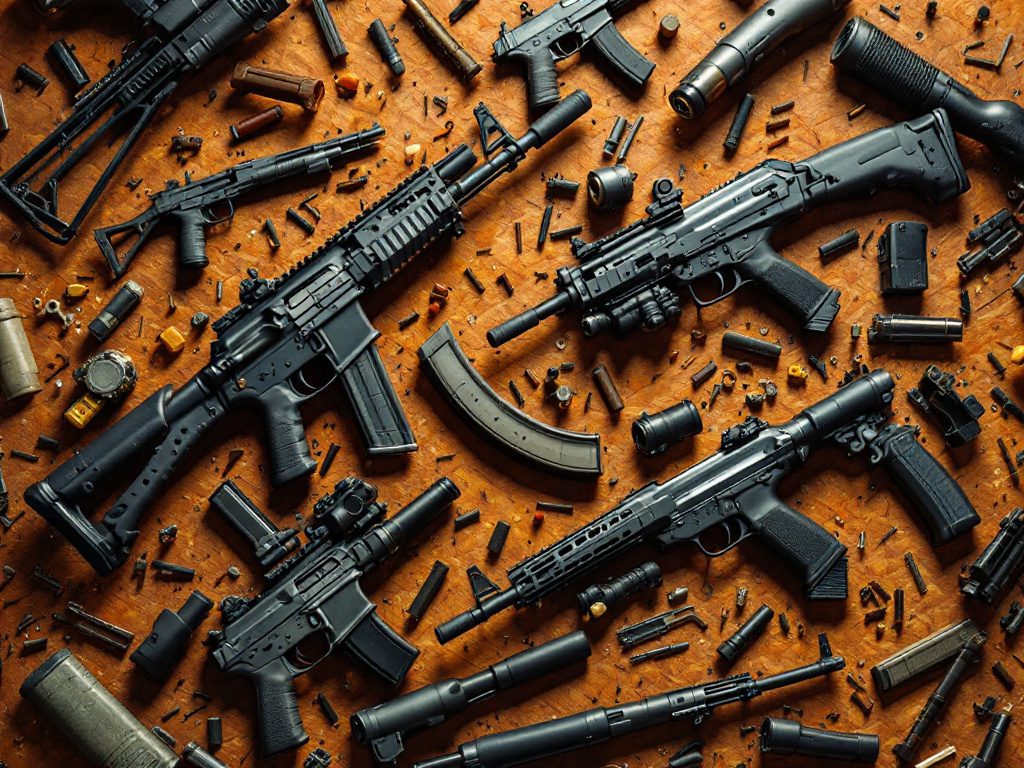
The Grim Cycle: Guns, Crime, and Consequence
It’s a scene that repeats itself too often in America’s headlines: felons, already barred by law from possessing weapons, nevertheless armed and emboldened by access to deadly firearms. The past year has seen a spate of federal convictions for gun offenses, with stories as disturbing as they are illustrative of deeper societal cracks. Guns continue to proliferate even among those legally prohibited from owning them, fueling violent crime and raising urgent questions about the state of gun laws, enforcement, and our collective willingness to act.
Consider the 46-month sentence handed down to Darneko Yates in Richmond. Law enforcement found him—with a fully automatic handgun—hiding the weapon in the pants of his six-year-old nephew. The image alone conjures outrage and disbelief. How does society tolerate a climate where a child is made an unwitting participant in this lethal game? Yates’s criminal past—ranging from carjacking to solicitation to commit murder—should have meant an unequivocal wall between him and firearms. Yet, the reality was starkly different.
Not far away, in our nation’s capital, 20-year-old Charles Wesley Monroe embarked on a brazen crime spree while already on probation, brandishing a gun to threaten a delivery driver and recklessly firing shots on a public street. DNA analysis, surveillance, and social media posts led investigators directly to him—modern detective work revealing both the risk and the reach of today’s gun culture.
Then, in West Virginia, Todd Matthew Houston’s prison sentence followed a domestic violence call. Here, the weapon was not only used to threaten, but was also obtained through a “straw purchase”—a gun bought legally by one person and passed illicitly to another—in exchange for heroin. Officers found Houston attempting to pawn over 2,000 rounds of ammunition; the scope of the operation extended well beyond a single criminal act. The pattern is unmistakable: a repeated braiding of illegal guns, drugs, and violence, with communities caught in the crossfire.
Broken Safeguards and Political Inertia
As these cases demonstrate, the problem runs deeper than individual decisions or moral failing—it’s systemic. Weaknesses in existing gun laws, combined with political gridlock, have allowed criminal access to firearms to become almost routine. Even the most basic restrictions, such as bans on felon possession or regulations on straw purchases, are clearly porous. The bipartisan infrastructure for meaningful reform remains deeply fractured, thanks in no small part to intense lobbying from organizations like the NRA and the political right’s obsession with absolute Second Amendment interpretation.
Harvard public health researcher Dr. David Hemenway points out that the United States accounts for less than 5% of the global population but roughly 45% of all civilian-owned guns worldwide—a staggering figure. The result isn’t merely a statistical anomaly; it’s families and neighborhoods locked into a daily struggle with the risk of violence. A Pew Research study released in 2023 found that 63% of Americans say gun laws should be stricter, yet legislative action remains stubbornly out of sync with public consensus.
So what stops real systemic change? Political scientist Jennifer Carlson, author of “Policing the Second Amendment,” argues that conservative policy makers have worked assiduously to shield the firearms industry, defund regulatory agencies like the ATF, and frustrate the sharing of gun trace data with the public. Even Project Safe Neighborhoods—an initiative lauded by Justice Department officials—serves as a reminder of how reactive rather than proactive our approach has been. We’re locking up offenders after the fact, not closing the loopholes before tragedies occur.
“America’s gun problems aren’t random acts—they’re structural failures enabled by policy, profit, and the political power of those who benefit from the status quo.”
The True Cost: Lives Disrupted and Communities Under Siege
The toll of these failures is not just measured in prison sentences, but in lives permanently altered or ended. A child forced to carry a firearm, an innocent Uber Eats driver staring down the barrel of a gun, families forever haunted by the trauma of violence. Each headline marks a ripple of pain, fear, and lost potential, stretching across generations.
The Justice Department’s recent high-profile prosecutions, while necessary, amount to triage. As U.S. Attorney Erek Barron remarked following a similar spree of gun convictions in Maryland, “No one agency or law enforcement initiative can solve the epidemic of gun violence alone. It requires everyone at the table—policy makers, communities, and citizens.” Buried in that statement is a call not just for enforcement, but for prevention, education, and above all, political courage.
What does it look like when communities take this challenge seriously? In cities that have invested in violence interruption programs—where social workers and mediators step in before disputes escalate—gun violence has dropped, sometimes dramatically. Scholars like Thomas Abt of the Council on Criminal Justice argue that a comprehensive, multi-faceted strategy, combining law enforcement with social investment, leads not just to lower crime, but to the healing of neighborhoods long written off as lost causes.
Americans face a choice: defend the failed status quo, or chart a new path prioritizing public safety, prevention, and smart regulation. Do we want to be the country forever stunned by another felon with a gun—or the country that finally learns from its pain?
