
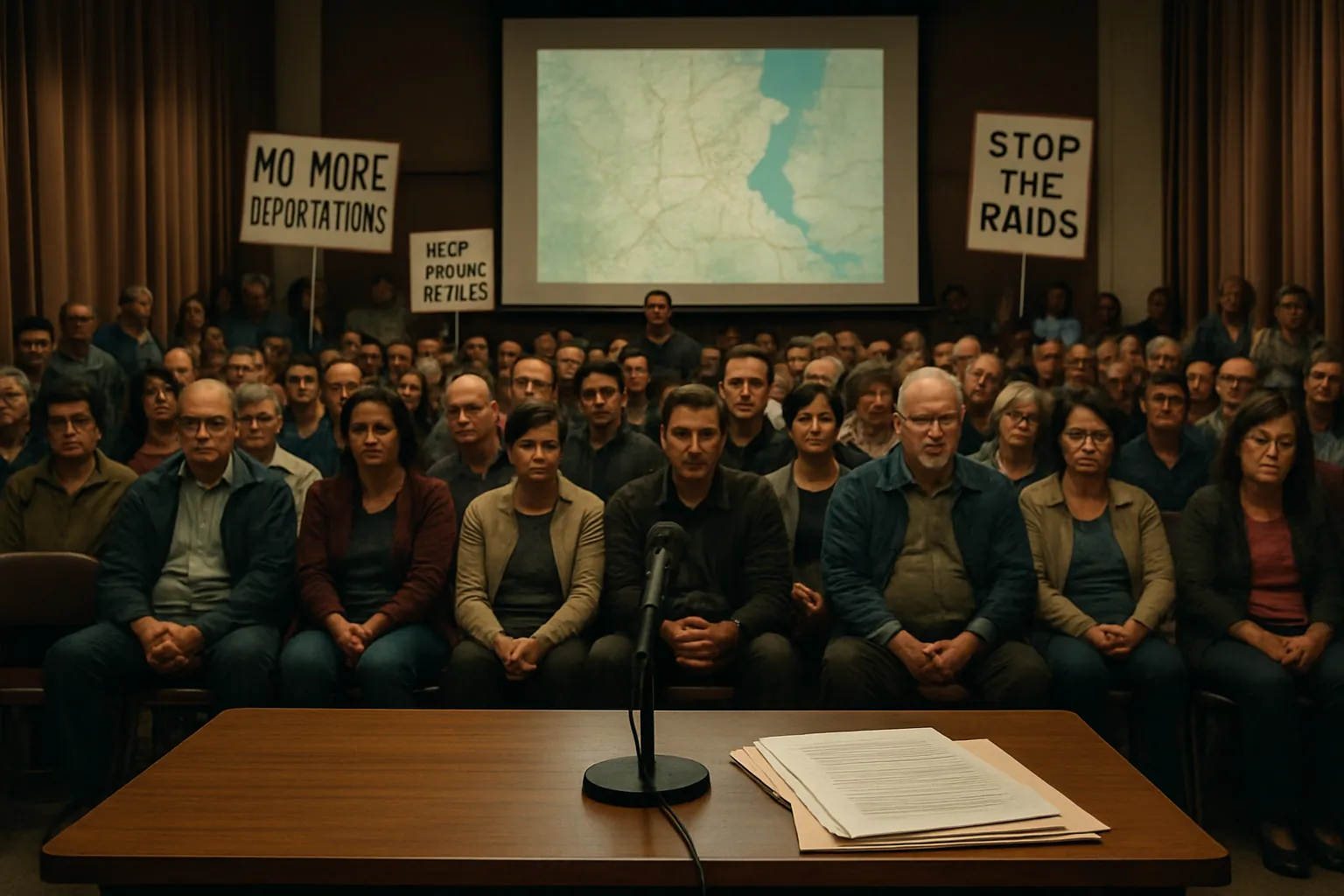
Antioch’s Rapid Response: Community Gathers, Demands Accountability
Four hundred voices—multiracial, multi-faith, multi-generational—filled Cane Ridge High School’s gymnasium with a vibrancy that’s rare in southern political halls. The occasion? A “Rapid Response” town hall hosted on just three days’ notice by Tennessee State Rep. Justin Jones and U.S. Rep. Ilhan Omar. Their mission: give voice to working-class and immigrant communities so often ignored by political powerbrokers in Nashville’s downtown corridors.
This was not Nashville’s usual forum for polite political theater. Instead, the gathering crackled with raw energy, highlighting a growing frustration with Republican leadership’s failure to address—let alone understand—the real anxieties of ordinary families. Rep. Omar, who flew in from Minnesota, opened proceedings by urging attendees to “go out and talk to their neighbors” about the tough topics at hand: immigration enforcement, the surging cost of living, and the federal legislation signed by President Donald Trump, misleadingly nicknamed the ‘Big Beautiful Bill.’
Unlike their Republican counterparts, Omar and Jones didn’t evade the public; they invited it, listened for two hours, and engaged directly with a crowd that came seeking more than platitudes. According to high school senior Breckyn Forcey, whose poem “The Empire Eats Itself” drew raucous applause, the voice of the next generation continues to ring out with a “clarity and courage that will not be silenced,” as Jones put it. In a bold contrast, Rep. Andy Ogles—criticized heavily throughout the event for his staunch support of Trump’s policies—has avoided in-person town halls in his district.
The Human Cost of Conservative Policy: Immigration and Social Safety Nets
It would be all too easy to consider the recent federal cuts to social programs a mere line-item in a congressional spreadsheet. Yet for the attendees in Antioch—many of whom shared personal stories—the consequences are alarmingly real. The so-called ‘Big Beautiful Bill,’ championed by Trump and backed by Rep. Ogles, was a lightning rod throughout the evening’s discussion. Attendees described how new restrictions put housing security, health care access, and even their families’ very presence in the United States at risk.
Rep. Omar did not mince words when confronting the alarming escalation of Immigration and Customs Enforcement (ICE) raids in South Nashville’s heavily Latino neighborhoods. She described them as actions that “increasingly resemble domestic warfare.” From the stage, Omar called the federal government’s policies “designed to sow fear, not safety.” As she highlighted, families in Antioch are left wondering if their next knock at the door will be from an agent, not a neighbor. Immigrant communities see their contributions erased by presidential edicts, even as they prop up Tennessee’s economy.
What drives this recklessness? The anti-immigrant fervor gripping the Republican party, cemented in legislative ambitions that ignore both compassion and basic economics. Harvard sociologist Roberto Gonzales notes in his writings that “communities where immigrants feel constantly surveilled and targeted do not thrive; they survive, at best.” That survival mentality was palpable in the room.
“It’s not just about politics — it’s about people. When the government passes laws that keep families apart, that’s not safety. That’s cruelty, plain and simple.” — Breckyn Forcey, 17, Cane Ridge High School student
Jones and Omar highlighted a stark—and damning—reality: conservative leaders like Rep. Ogles are quick to investigate city leaders over imagined sanctuary policies, but slow to directly engage with the working families who feel targeted by the very laws they promote. Weeks before the town hall, Ogles publicly accused Nashville Mayor Freddie O’Connell of obstructing federal immigration enforcement—allegations lambasted by the mayor, who pointed out that Nashville remains committed to public safety without scapegoating its immigrants.
Breaking Political Barriers: The Meaning of Meaningful Representation
Why hold this event in Antioch, far from the marble-centric politics of downtown? Rep. Jones answered this himself: “This is a community that’s too often invisible to the politicians who claim to represent Tennessee. We can’t keep ignoring these voices.” Town halls like this are more than listening sessions—they are acknowledgments of communities deliberately kept on the political sidelines, especially by Republican power structures.
Many attendees confessed it was their first political event. Time and again, they shared that attempts to reach out to their state legislators—especially conservatives—went unanswered. This silence, much more telling than words, exposes a critical gulf between those who make policies and those forced to live with their consequences.
History offers a telling parallel. During the civil rights era, town halls and teach-ins across the South became sanctuaries for those denied a seat at the table—often drawing young, diverse crowds much like Antioch’s. Today’s progressive leaders like Omar and Jones channel that legacy. New York University historian Tom Sugrue argues that “meaningful change has always come from local movements pushing national conversations, especially in the South, where political machines resist reform.” The energy in Antioch hinted that such a shift could be brewing again.
Progressive leaders aren’t just filling a gap left by disengaged conservatives—they’re building entirely new bridges between government and people. That means showing up, empowering youth, and refusing to cede moral ground on immigration, healthcare, or basic dignity. As Omar told the crowd, “It will always be easier to divide than unite. But the future belongs to those brave enough to listen and act in solidarity.”
The path forward isn’t simple. Conservative lawmakers continue doubling down on reactionary politics that dismiss the lived experiences of Tennessee’s most vulnerable citizens. Yet the overwhelming turnout and fervent discussions in Antioch underscore a truth Republicans would do well to heed: political winds inevitably change.
