
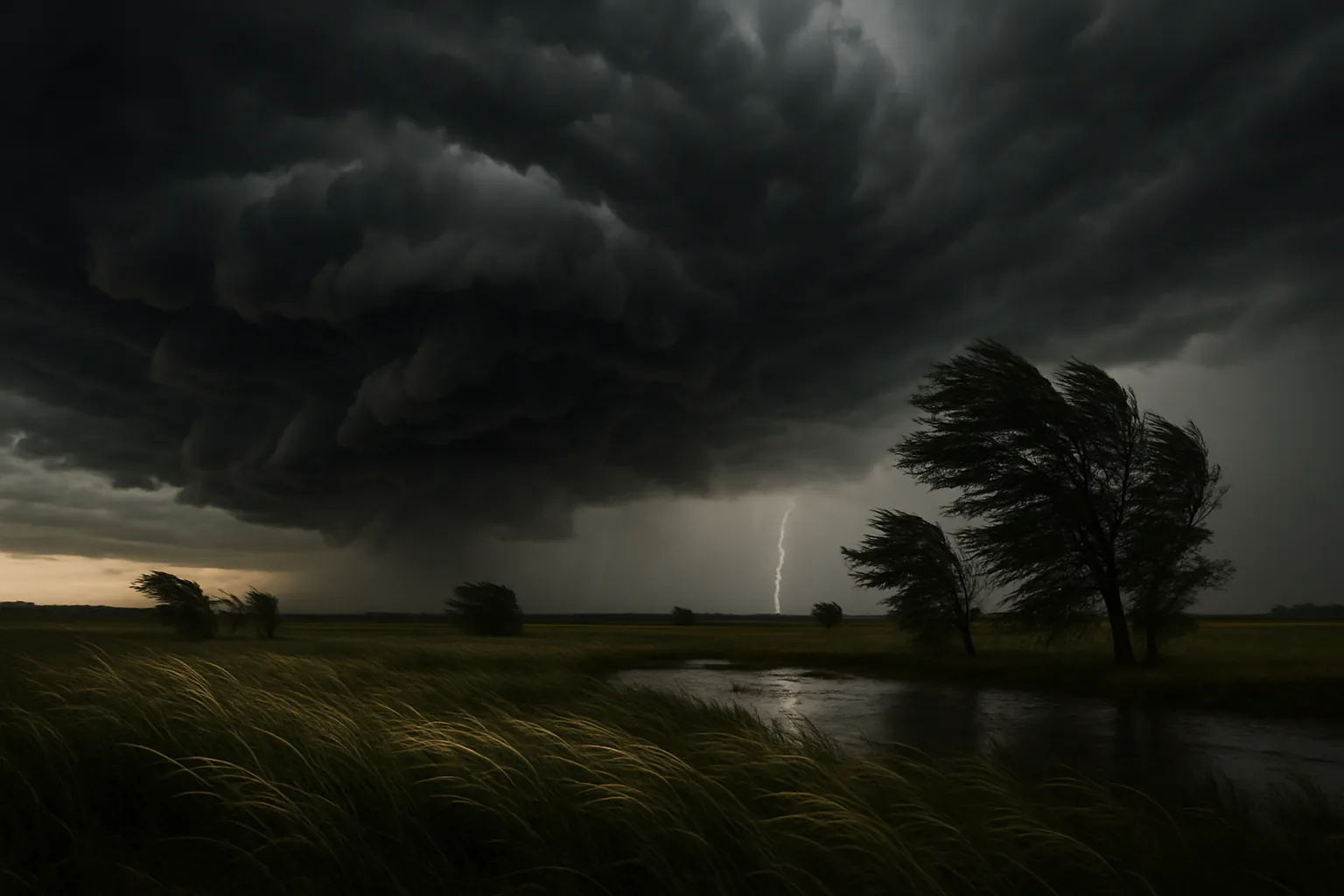
Rolling Thunder: The Midwest Prepares for a New Derecho Threat
One brutal weather word still haunts the Midwest: “derecho,” the massive, fast-moving windstorms infamous for flattening entire swaths of the plains in mere hours. As Monday dawns across the Northern Plains, a familiar unease settles over families in South Dakota, Nebraska, Minnesota, and Iowa. Weather forecasters, their voices tense with urgency, warn that a potentially catastrophic derecho—capable of hurling winds up to 100 mph—is poised to carve a destructive path from the Dakotas to the Twin Cities. Warnings blanket the region, travel alerts multiply, and emergency officials brace for what could be the second derecho of the summer, following a June event that battered communities with hurricane-strength gusts.
The National Weather Service and Storm Prediction Center aren’t mincing words. Their rare Level 3 and 4 severe weather risk declarations (out of 5) underscore the seriousness of the situation. They expect this volatile storm system—fed by scorching July heat and record-breaking humidity trapped beneath a stubborn heat dome—to lash the Plains with squall lines, tornadoes, pounding hail, and potentially days-long power outages. Meteorologist Donna Dubberke, recalling the $11-billion devastation of Iowa’s 2020 derecho, emphasizes, “While this one likely won’t reach 140 mph winds, it will bring widespread hazards and unpredictable destruction.”
Questions roll through the community faster than the advancing clouds. Will this be another tragedy on par with recent catastrophic derechos, or will strong preparation spare lives and homes? In large swaths of Minnesota—especially the Twin Cities—families line up for bottled water, charge devices, and double-check tornado shelter plans, dreading what meteorologist Sven Sundgaard calls a “potential superhighway” of severe weather, where the storms “ride the CAPE gradient”—a meteorological sweet spot, thanks to high Convective Available Potential Energy (CAPE), that drives the most intense outbreaks.
The Science—and Stark Consequence—Behind Derechos
What sets a derecho apart? The National Oceanic and Atmospheric Administration (NOAA) defines it as a long-lived, fast-moving windstorm that unleashes gusts of at least 58 mph along a swath more than 250 miles long. But those numbers conceal the lived reality: roofs peeled from homes, 100-year-old oaks snapped like twigs, high-voltage transmission towers tangled across highways. Unlike a localized tornado, a derecho can cause tornado-like devastation over hundreds of square miles. In recent memory, such as Iowa’s 2020 disaster, entire cities went dark as 140 mph winds wrought chaos rarely seen outside the hurricane belt.
This time, while peak gusts may sit closer to 90–100 mph, forecasters remain concerned because of compounding threats. Flash flooding looms for regions already waterlogged by recent storms, while supercells embedded in the derecho line could spin up tornadoes at a moment’s notice. Sven Sundgaard, broadcasting for WCCO and closely tracking regional radar (
“This corridor of instability looks primed for a rapid-fire evolution—anything less than an hour’s notice could leave communities blind to the coming wall of wind”), urges vigilance.
“The derecho’s power lies not just in its wind speed, but in its unpredictability—what looks like a mere band of storms at lunch can topple whole towns by dinner.”
Severe convective systems like derechos rarely materialize without greater climatic context. The Intergovernmental Panel on Climate Change (IPCC) warns that unchecked greenhouse gas emissions will sharply increase the frequency of these destructive weather extremes. In the panel’s landmark assessment, experts urge nations to halve emissions by 2030 to avoid global warming surpassing 1.5°C—an escalation that could turn today’s 50-year storm into tomorrow’s annual headline.
What we’re witnessing is no isolated fluke. Extreme rain, epic wildfires, record drought, and heat-induced wind storms—scientists attribute this new normal to the fingerprints of climate change. According to a 2023 Pew Research Center survey, more than 70% of Americans now recognize that climate instability is not a theory, but a creeping reality manifesting quite literally in our own backyards.
Vulnerability and the Cost of Denial
Beyond that, the Midwest’s perennial vulnerability to environmental destruction has become a political issue, especially as right-wing lawmakers dilute, delay, or outright deny the connection between fossil fuel policy and weather chaos. In states regularly ravaged by storms, what explains the persistent legislative reluctance to fund adaptation—from strengthening the grid to reforming disaster response?
Historical records show the consequences when policymakers turn a blind eye. The Midwest’s agricultural backbone nearly buckled in June’s derecho, which left fields flattened, small towns powerless, and residents waiting weeks for assistance. Without robust investment in resilient infrastructure, insurance, and climate adaptation, working families bear the brunt, and rural schools and health clinics become ground zero for suffering each storm season. According to Harvard economist Julia Schapiro, “Every billion-dollar disaster unchecked by proactive planning costs taxpayers triple in relief and recovery versus up-front investment.”
Instead of doubling down on pro-corporate, anti-regulatory orthodoxy, progressive policy offers a framework for shared security. This means restoring federal flood insurance standards, incentivizing renewable grids, and directly supporting local governments that must shoulder the costs of climate resilience. Imagine a future where every derecho warning spurs not just defensive action, but proactive investment in clean energy, smart infrastructure, and inclusive emergency planning.
Many Midwesterners are climate realists. As the clouds gather, you hear more people ask—if storms keep coming, why not meet them with hope and action rather than resignation? True security requires political courage: the courage to confront systemic causes, and to demand leaders fund a resilient, sustainable Midwest where safety is not just a privilege, but a right.
