
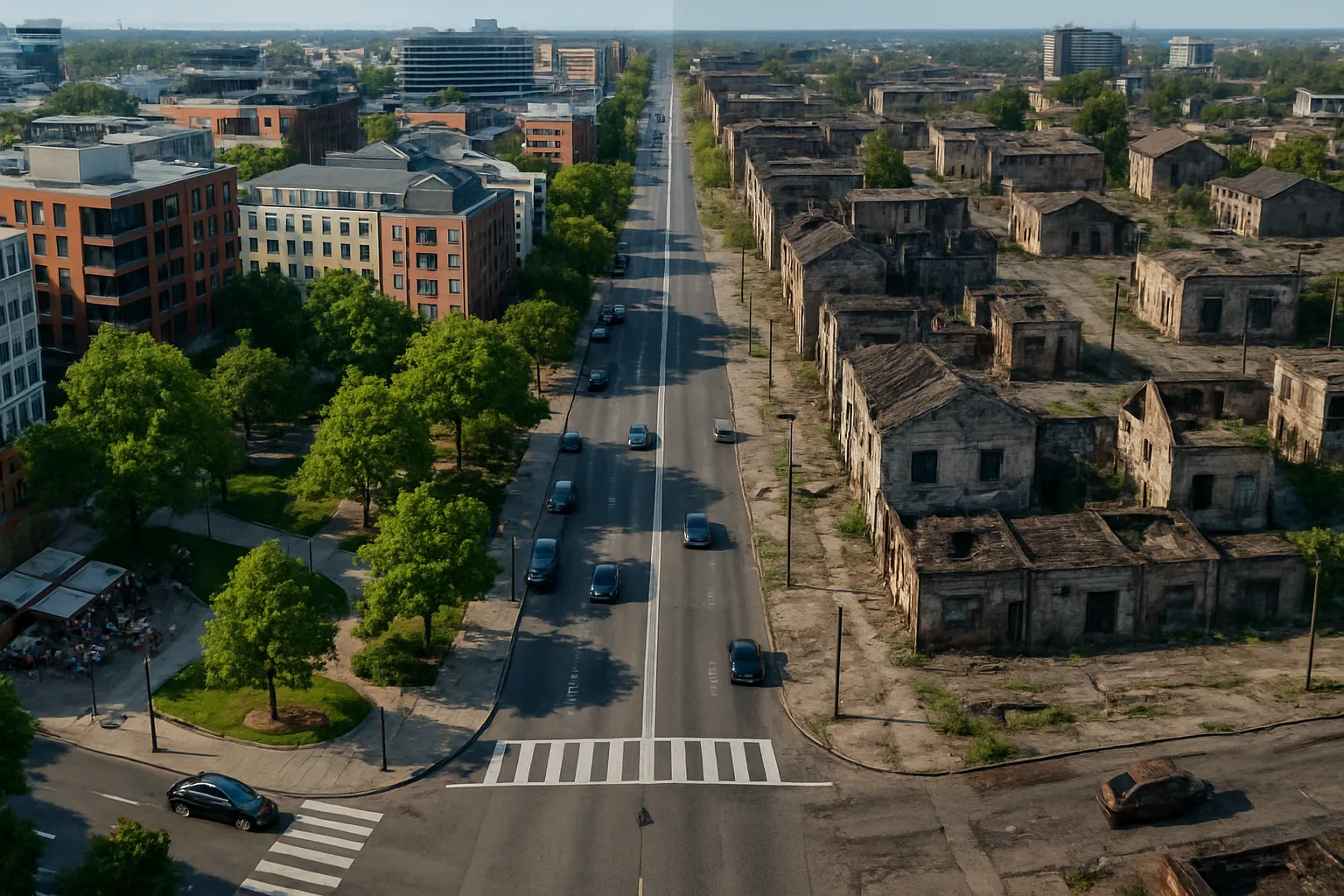
Stagnation at the Heart of America: The Cities Left Behind
In cities like Raleigh and Nashville, the American Dream may seem very much alive—rising skylines, bustling tech hubs, and a steady influx of new talent. But beneath this surface of prosperity, a darker reality festers in less fortunate corners of the nation. According to a sweeping new analysis by background screening firm Checkr, six of America’s largest cities now rank dead last for both available work opportunities and earning potential. The disparities—rooted in decades of deindustrialization, political neglect, and shifting economic tides—have left entire urban populations feeling abandoned by the country’s much-touted economic boom.
Checkr’s study, which drew from the Bureau of Labor Statistics, U.S. Census Bureau, and Bureau of Economic Analysis, paints a sobering picture. Once-vibrant industrial centers have seen their core industries—manufacturing, mining, or steel—wither under the dual pressures of automation and offshoring. The jobs that do remain pay considerably less than those in the innovation-centric metropolises driving America’s post-pandemic recovery. Sam Radbil, a research strategist for Checkr, emphasizes the stakes: “Struggling urban economies aren’t merely slow-growing; they often fail to provide competitive wages and any real shot at upward mobility for residents.”
Contrast this with the transformation of cities like Austin, Denver, or Seattle—places flush with venture capital and sustained municipal investments in high-growth industries. The gap between the ‘have’ and ‘have-not’ metros, stretching from the Rust Belt to the deep South, marks a new era of American inequality. Policies that treat urban renewal as an afterthought only deepen this divide; without targeted investments and meaningful economic development, tens of millions remain locked in a cycle of stagnation and despair.
The Hidden Crisis: Low-Wage Jobs and the New Face of Poverty
Look past the glossy job numbers in headline-grabbing sectors, and another story becomes clear: the proliferation of America’s lowest-paying jobs is dragging down entire communities. According to data compiled by Stacker using Bureau of Labor Statistics figures, the 50 lowest-paying occupations in the country cluster overwhelmingly in service, care work, and entry-level labor—roles often celebrated as “essential” but rarely compensated as such. From fast-food cooks and home health aides to farmworkers and cashiers, these jobs offer a median annual wage a fraction of the national average.
The situation is dire: as inflation hovers at 2.7% and shows no sign of abating, low-wage workers see their paychecks eroded at every turn. Cost increases for food, gas, and rent—spending categories that represent the lion’s share of low-income household budgets—hit hardest. The Federal Reserve Bank of Dallas has warned repeatedly that low-income families are disproportionately affected by inflation, since they have little luxury spending to cut and often lack savings. Their ability to economize is limited; according to the Dallas Fed, buying necessities in bulk or online for discounts is simply not feasible for most.
States like California and Oregon have attempted to respond, pushing minimum wages upward in hopes of stemming the bleeding. But with inflation consistently outpacing wage growth, critics warn that these adjustments are little more than band-aids on a gaping wound. As Harvard labor economist Anna Stansbury told NPR, “Raising minimum wages is necessary—it’s just not sufficient. Without robust investments in affordable housing, childcare, and transportation, we’re asking low-income Americans to solve systemic problems with ever-thinner wallets.”
“The gulf between America’s top-earning cities and those with stagnant wages isn’t inevitable—it’s the result of choices, both public and private.”
This hard reality has roots in policy decisions dating back decades. From the 1980s onward, bipartisan enthusiasm for deregulation and free trade hollowed out critical industries, leaving many cities without viable replacements. The result: rising poverty, distressed city budgets, and neglected infrastructure, all of which compound the difficulty of attracting new employers or improving public services.
Inflation, Tariffs, and Policy: Why Half-Measures Aren’t Enough
Why haven’t these struggling cities or their working poor caught a break in recent years? Inflation’s relentless march is part of the answer, but tariffs and inconsistent federal action have made matters worse. President Donald Trump’s trade wars with partners like China, Mexico, and Canada packed a one-two punch: increasing the cost of goods while driving uncertainty for already fragile local industries. The move, criticized by economists from the Brookings Institution and MIT, failed to produce significant job growth and instead raised prices for everyday families.
Beyond that, federal minimum wage policy remains mired in dysfunction. The benchmark has been stuck at $7.25 an hour since 2009 despite labor productivity and corporate profits surging year after year. According to Elise Gould of the Economic Policy Institute, this “policy paralysis” has done permanent harm: America’s minimum wage, adjusted for inflation, is now worth less than at any point in the last 60 years.
State-level minimum wage hikes—while vital—simply don’t have the reach or magnitude to close the gap. A closer look reveals that many low-wage workers live in states or cities where increases are fiercely resisted by Republican legislatures. The ideological resistance to higher wages and investments in public goods—hallmarks of conservative governance—leave vulnerable American families in a perpetual state of precarity. Harvard’s Stansbury highlights, “Piecemeal fixes won’t change the underlying calculus. We need a commitment to living wages, equitable infrastructure, and the public investments that create resilient economies.”
So, what will it take to bridge the gap between America’s economic winners and losers? Experts converge on a familiar answer: robust, targeted investments in education, affordable housing, green energy, and 21st-century industries. These aren’t luxuries—they’re necessities if any semblance of shared prosperity is to be regained. The cost of inaction is stark: as more Americans resign themselves to dead-end jobs and threadbare safety nets, our social fabric weakens, and the nation risks drifting even further from its founding promise of opportunity for all.
