
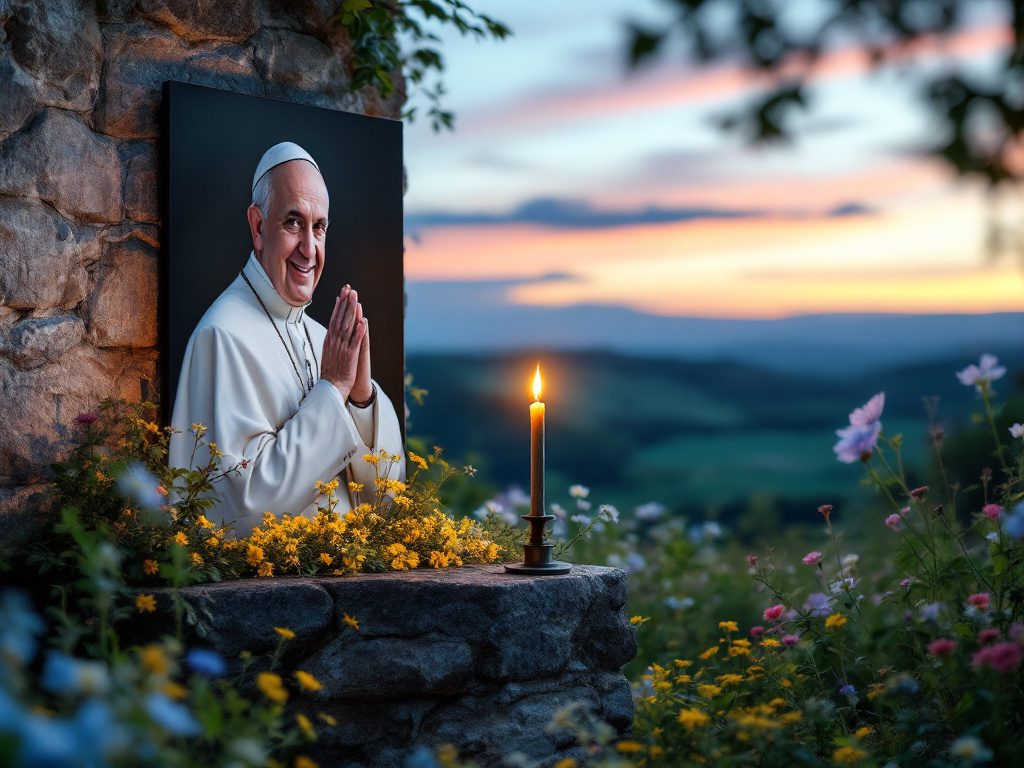
A President’s Loss: Mourning a Pontiff of the People
On a gray morning marked by solemn bells tolling in Vatican City, the world learned the news: Pope Francis, the Catholic Church’s first Latin American leader and a figure often called the “People’s Pope”, had passed away. For former President Joe Biden—just the second Catholic to occupy the White House—this was far more than another headline. It was, as he wrote in his deeply personal tribute, the loss of a spiritual guide and a global moral compass.
Biden’s words, shared on social media and echoed in interviews, painted a poignant picture: Pope Francis was “a light of faith, hope, and love,” and his life embodied a devotion to uplifting society’s most vulnerable. “He was unlike any who came before him,” Biden recalled, referencing not just Francis’s Argentine heritage—the Church’s first pontiff from the Southern Hemisphere—but his relentless focus on the poor, on immigrants, and on justice, even when that meant rattling the church’s own hierarchy.
Personal connection underscored Biden’s tribute. Their relationship, cultivated over years and four personal meetings—including a final encounter at the 2024 G7 Leaders’ Summit in Apulia, Italy—went beyond diplomatic courtesy. Like many American Catholics, Biden drew a certain comfort and pride from Francis’s example of compassionate leadership, even as their views sometimes diverged on social issues. As historian and Georgetown professor Paul Elie notes, “Biden shared a very American Catholic identity with Francis: at once rooted in tradition and open to the world.”
Shared Values with the “People’s Pope”
Biden’s admiration for Pope Francis comes as no surprise to close observers of both men. The former president has often cited his faith as the “bedrock foundation” of his life; the late pope, known for his humility and focus on those “on the peripheries,” became an inspiration for Catholics exhausted by dogma but yearning for social change. What made this bond most profound, however, was the emphasis both placed on social justice and collective responsibility.
Pope Francis’s tenure was defined by outspoken advocacy for the world’s marginalized: the poor, refugees, and victims of war. He spoke unambiguously against economic inequality and called on governments to address the “root causes” of migration. Under his papacy, the Vatican became a strong voice for climate action, challenging industrialized nations to curb emissions and protect what Francis famously called “our common home.” In this, he found an eager interlocutor in Biden, who made climate leadership a pillar of his own presidency.
“Pope Francis didn’t just talk about the poor—he walked with them,” says Sister Simone Campbell, executive director of NETWORK Lobby for Catholic Social Justice. The pontiff’s words, she notes, spurred tangible shifts, from churches opening their doors to migrants to a growing Catholic involvement in climate protests worldwide.
“He became the conscience of the world’s most powerful and the comfort of its weakest. His voice carried hope, not only to believers but to all who seek justice.”
It’s no footnote that Biden, in a rare move, awarded the Presidential Medal of Freedom to Francis—underscoring, in the words of Harvard religion scholar Michelle Sanchez, “how closely aligned their modern visions of faith in action truly were.” While American conservatives frequently bristled at Francis’s progressive stances, his approval ratings among U.S. Catholics and non-Catholics alike soared to historic highs after landmark environmental encyclicals and open-hearted encyclicals.
Navigating Differences—and Finding Common Purpose
No honest tribute to Francis should ignore areas of contention. Biden and the late pope parted ways on issues like abortion and certain aspects of Catholic doctrine. Yet, as both leaders demonstrated, unity does not require uniformity. At the height of America’s culture wars, both men modeled civility and mutual respect, emphasizing shared goals: combating climate change, standing up for migrants, and tackling the hard work of global poverty reduction.
Public encounters between Pope Francis and Biden reflected a rare ability to find common ground in an era rife with polarization. While American conservative commentators often criticized Francis for what they saw as a “politicization” of the church, the truth is more nuanced. As NPR religion correspondent Sylvia Poggioli observed, “Francis understood that to remain relevant, the Church must respond to the injustices of the present—without losing the soul of its tradition.”
Biden’s eulogy pointed not just backward to the moments they shared, but forward to the enduring challenge Francis left behind: a call for empathy, solidarity, and “radical hope.” He wrote, “Francis’s legacy is not only one of words, but of action—an invitation to see our neighbors, and our planet, as sacred trusts for whom we all share responsibility.”
How many leaders can we say that about today? In an age of transactional politics, Francis’s example—and Biden’s tribute—remind us that moral courage isn’t the purview of saints; it’s the daily work of those who insist, however imperfectly, that the arc of history will bend toward justice if we all push together. The resonance of that message persists, now more than ever.
