
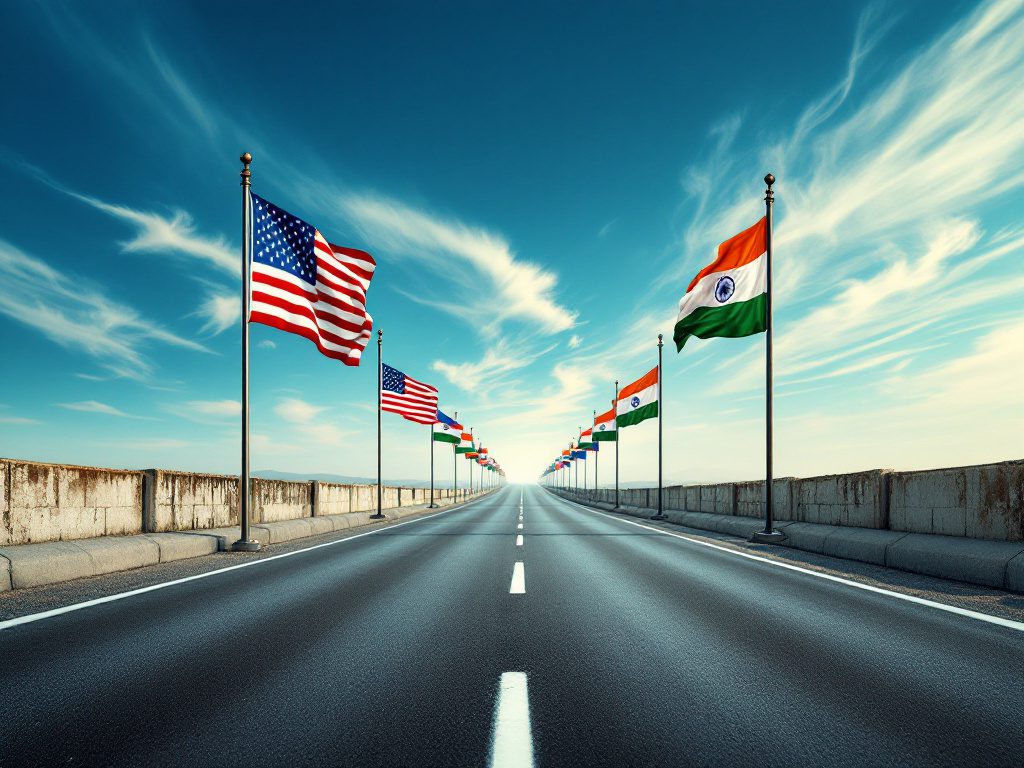
A High-Stakes Roadmap: Progress Amidst Political Tensions
Stretching from the bustling corridors of New Delhi to the stately salons of Washington, the prospect of a final US-India trade deal is once again dominating headlines. In a development suffused with both economic ambition and political calculation, US Vice President JD Vance emerged from meetings with Prime Minister Narendra Modi declaring “significant progress” and a finalized “roadmap” for negotiations. Against the backdrop of a looming 90-day deadline to stave off punishing US tariffs on Indian exports, both governments seem poised at a crucial crossroads for global partnership.
Vice President Vance’s trip was more than diplomatic choreography. On a personal note, he visited his wife’s family homeland—an anecdote that, for a moment, humanized the sharp, transactional rhetoric around free trade. What’s at stake is colossal: President Trump and Prime Minister Modi have set a shared goal of doubling bilateral trade to $500 billion by decade’s end—a leap that, according to International Trade Centre figures, would make India one of the US’s most vital trading partners, rivaling Pacific heavyweights like Japan and South Korea.
Why the sudden urgency? The Trump administration had imposed up to 26% tariffs on Indian exports, but a 90-day pause temporarily eased those penalties. With that reprieve set to expire soon, Indian negotiators are racing the clock. As Vance emphasized at a public address in Jaipur, “We’re working hard because this deal will shape not just our economic future, but the global balance of power in the 21st century.” His words land with extra weight given the rising friction in the Indo-Pacific—where, as Georgetown’s Center for Security Studies notes, closer US-India ties are seen as a bulwark against Chinese regional dominance.
The Conservative Trade Paradox: Openness or Protection?
Within the rhetoric of “rebalancing global trade”—a favorite slogan of the current White House—the uncomfortable details begin to show. While Vance praised Modi as a “tough negotiator,” his real objective was clear: push India to slash its stubborn non-tariff barriers (NTBs) that have long frustrated US exporters, from tech giants to soybean farmers. At first glance, calls for openness may sound like vintage free-market ideology, yet the paradox becomes glaring when viewed alongside the Trump administration’s own protectionist bent. After all, how can Washington demand unfettered access abroad while threatening new tariffs at home?
Policy experts like Harvard economist Arvind Subramanian stress that “trade deals built on coercion and asymmetry rarely endure.” Data from the World Bank shows that since 2017, India’s average applied tariff rate has dropped, but non-tariff barriers—testing requirements, local content rules, and opaque regulations—have climbed in sectors the US covets, especially technology and agricultural goods. For India, these measures are more than just bargaining chips; they shield a burgeoning middle class and vital small businesses still vulnerable to unfettered competition.
The pressure from America may feel familiar. Just a few years ago, the Trump administration unilaterally yanked India from the Generalized System of Preferences (GSP), which had given duty-free access to billions in Indian goods. Indian officials still smart from that episode, which led to retaliatory tariffs and a chill in relations that took years to thaw. Trade historian Doug Irwin points out that abrupt, punitive changes rarely inspire trust—and usually, it’s workers and consumers who pay the price when trade wars escalate.
Strategic Stakes and the True Cost of Missed Partnership
Beyond that, there’s a bigger game at play. The US and India share concerns around regional security and supply chain resilience, especially as geopolitical instability rattles markets worldwide. The roadmap Vance touts includes more than just tariff schedules—it extends into joint defense production, clean energy cooperation, and the supply of critical minerals. These areas might prove even more consequential for the globally-minded reader than tariff lines or market access disputes.
Yet negotiating from a position of threat—“drop your barriers by our deadline, or tariffs return”—risks igniting the very instability both sides wish to avoid. Enduring partnerships demand mutual respect and give-and-take. Indian observers, bolstered by memories of historic colonial exploitation, are keenly sensitive to perceived imbalances. As Yamini Aiyar of the Centre for Policy Research in New Delhi noted, “Lasting economic ties happen when both sides see themselves as co-authors of the deal, not when one feels coerced into compliance.”
“History teaches us that trade grounded in fairness, not force, is what propels societies toward prosperity and peace.”
A closer look reveals that the very ethos behind this purportedly “America First” approach—threatening tariffs, transactional concessions—stands at stark odds with what actually made postwar American power so durable: alliances based on shared values and mutual trust. For progressive readers, the imperative is clear. The US can—and must—embrace trade as a tool to build inclusive growth, strengthen worker rights, promote sustainable development, and support democracy abroad. Yet that requires ditching the zero-sum mentality and recognizing the needs of global partners, particularly in the Global South, who often lack America’s economic muscle.
Failure to finalize a fair and forward-looking deal could deepen distrust and leave both economies more vulnerable. Research from the Brookings Institution found that when nations embrace open, rules-based trading systems, average incomes rise, inequality shrinks less dramatically than populists fear, and innovation flourishes.
So, can this roadmap survive the pitfalls of protectionism and the ghosts of trade wars past? Only if both countries set aside the transactional jargon and invest in a partnership—rooted in respect and equality—that matches the grand vision so often summoned in public statements. The alternative is a world inching back toward fragmentation precisely when collective solutions are most urgently needed.
