
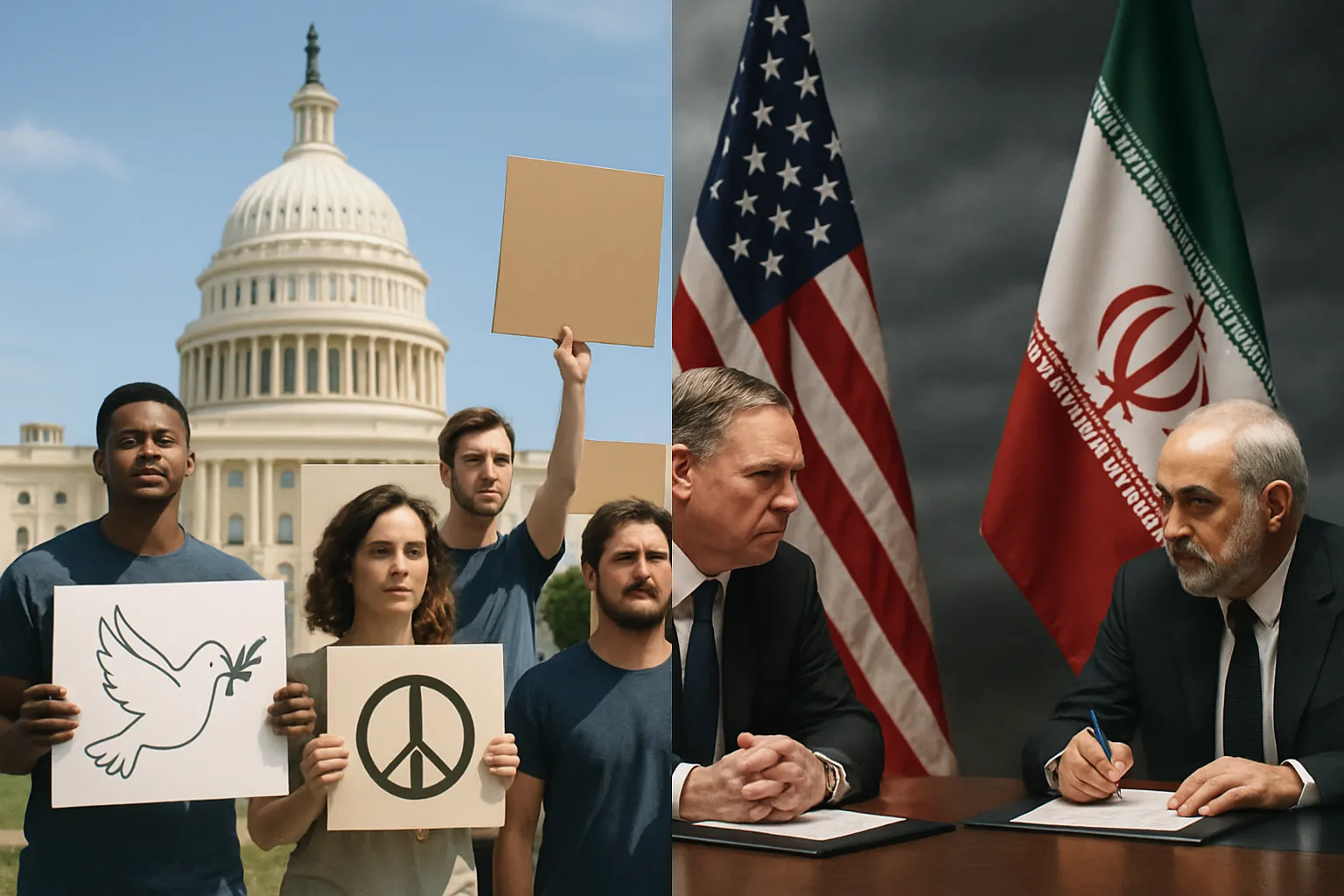
The Fault Lines: Democratic Tensions Over Middle East Policy
Nothing tests a political party’s unity like the specter of war. As President Donald Trump announces U.S. airstrikes on Iranian nuclear sites, ripples of discord are reverberating across the Democratic Party. This is not the first time Democrats have confronted internal dissent over American military intervention, but the stakes now—amid the smoldering ruins of Gaza and the ever-tense U.S.-Israel alliance—have rarely been higher.
For the past two years, progressive Democrats have been loud and insistent in their condemnation of both the Israeli government’s actions in Gaza and the Biden administration’s unwavering support for Israel. Now, Trump’s unilateral escalation prompts a new reckoning: how much power should any president have to launch strikes, especially without congressional approval? Rep. Ro Khanna of California, who has spent years crusading against unchecked executive war powers, teamed up with libertarian-leaning Republican Rep. Thomas Massie in a rare moment of bipartisanship to introduce legislation requiring explicit congressional authorization for military force against Iran. Khanna’s message echoes a tidal wave within the party’s base: intervention without oversight is no longer tenable.
This progressive surge is hardly an isolated phenomenon. Sen. Bernie Sanders, perhaps Congress’s most persistent anti-war voice, reintroduced his own bill blocking the use of federal funds for hostilities against Iran. Speaking to a crowd of Vermont supporters, Sanders declared, “Our nation cannot continue its endless cycle of violence in the Middle East. We must prioritize diplomacy, human rights, and the will of the American people.” According to Pew Research’s September 2024 polling, fully half of all Democrats say the U.S. is too supportive of Israel—up from 38% a year prior. The Democratic establishment, once reliably internationalist, now finds itself at odds with energized activists demanding a more restrained, justice-focused foreign policy.
Party Leadership on the Defensive
Calibrating a response to Trump’s Iran gambit has left Democratic leaders walking a political tightrope. On one hand, they’re wary of appearing weak or indifferent to Israeli security. On the other, they risk hemorrhaging support among young voters, progressives, and communities of color who view American interventionism with deep suspicion. DNC Chair Ken Martin crystallized the dilemma, stating that the U.S. “does not become more secure by fanning the flames of regional war.” Martin’s pointed critique underscored how Trump’s swift shift from campaign-trail non-interventionism to bellicosity has “shredded whatever credibility he had left on foreign policy.”
Sen. Tim Kaine’s condemnation of the strikes as ‘horrible judgment’ swung the spotlight to a familiar Democratic refrain: Congress—not the president—must decide when and how America goes to war. Kaine promised an urgent push for a Senate debate and vote, echoing a chorus of colleagues who recall the lessons of Iraq and Afghanistan all too vividly. Harvard law professor Laurence Tribe noted in a recent interview that “unchecked presidential war powers have repeatedly led to costly, destabilizing entanglements in the Middle East. If we haven’t learned by now, we never will.”
For Democratic presidential hopefuls looking ahead to 2028, the moment is fraught with risk. Few, if any, have spoken publicly since news of the Iran strikes broke—a silence that speaks volumes about just how treacherous the political terrain has become. Whisper networks inside the party are abuzz: break with the base and risk primary retaliation; break with Israel and risk general election fallout.
Grassroots vs. Establishment: Searching for a Moral Compass
Young activists and the party’s most engaged voters have made clear that foreign policy matters—and that America’s alliances deserve scrutiny. Their mistrust of perpetual war and the prioritization of human rights above old-guard allegiances are not passing fads, but signals of a realignment in Democratic thinking. As one senior staffer for a progressive House leader told Politico, “You can’t bulldoze the base anymore by shouting ‘national security’ every time a president wants to bomb someone.”
These debates are more than mere palace intrigue. Lives hang in the balance. With civilian casualties mounting amid the Israel-Iran conflict, many in the Democratic base view U.S. involvement as a betrayal of the party’s core values—values that prioritize justice, restraint, and the wisdom of collective action over unilateral militarism. Calls for a renewed War Powers Resolution echo through the halls of Congress, but the future remains uncertain as old guard and new guard square off in a contest for the party’s soul.
“War powers are not the playthings of presidents. Our democracy, and untold lives abroad, depend on honest debate and legislative oversight.” — Sen. Bernie Sanders
The current Democratic schism is hardly without precedent. The party was deeply divided over Vietnam half a century ago—a split that arguably helped cement Richard Nixon’s path to victory. More recently, the 2002 vote to authorize war in Iraq sparked a generational shift, culminating in Barack Obama’s anti-war-fueled rise in 2008. History seldom repeats exactly, but it often rhymes. Should Democrats fail to reconcile their differences and articulate a vision true to their progressive wing, the cost could be measured not just in lost elections, but in lost lives.
The moment demands clarity, not calculation. With America now entangled in yet another Mideast conflagration, Democrats are discovering that strategic silence and hedging are no longer viable options. The country is watching—and so is a restive, justice-minded base.
