
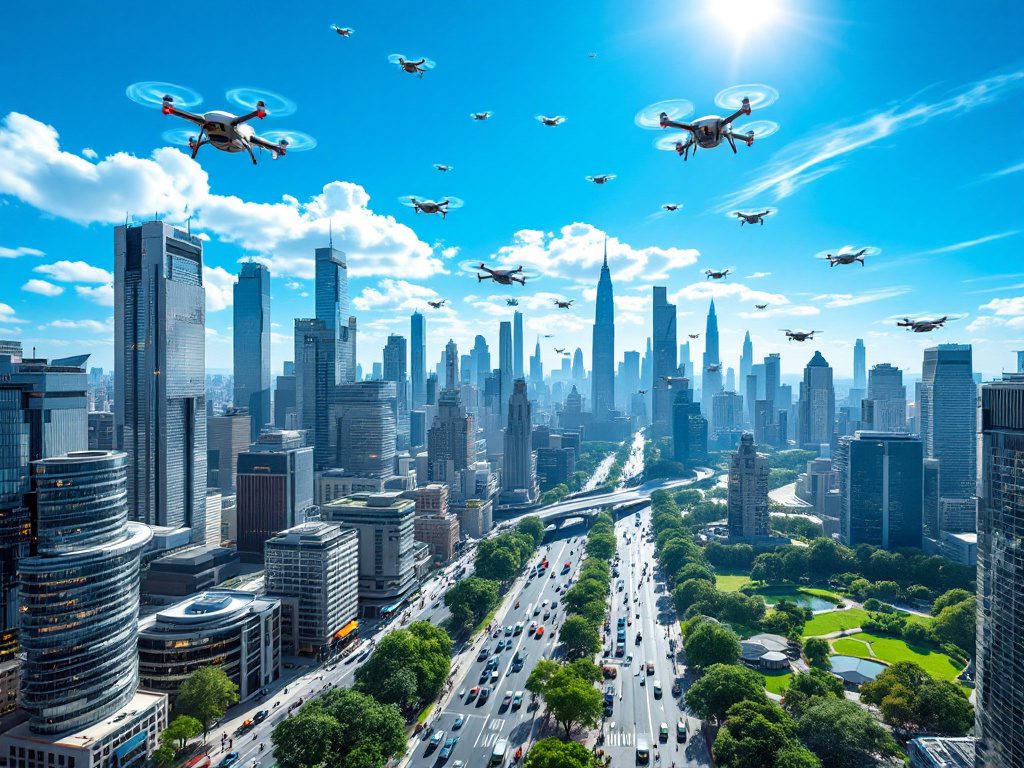
The Sky’s New Menace: Drones Overrun Airport Airspace
Moments before touchdown at San Francisco International Airport, the cockpit crew of a packed airliner glimpsed an odd silhouette just outside their window—a drone, mere seconds away and too close for comfort. This jarring encounter, reported to the Federal Aviation Administration (FAA) last November, could have ended very differently. The gnawing question: how long until a close call becomes a catastrophe?
A new reality is unfolding in American aviation. In the last decade, drones have gone from hobby-shop curiosities to omnipresent risks to our nation’s crowded skies. Last year, nearly two-thirds of reported near midair collisions at the 30 busiest U.S. airports involved drones, according to an Associated Press analysis. This surge coincides with record-setting sales and mass adoption of increasingly advanced, affordable quadcopters.
From Miami to Newark, and Los Angeles to Atlanta, commercial pilots now routinely report unnerving brushes with drones—mechanical strangers hovering just hundreds of feet from aircraft stacked with hundreds of lives. That leap in risk rivets experts and regulators alike. William Waldock, a professor of safety science at Embry-Riddle Aeronautical University, doesn’t mince words: “If you have the money, you can go on the internet and buy a pretty sophisticated drone that can reach altitudes they really have no business being at.”
Beneath the Turbulence: Why Drones Are the Perfect Storm
Drones have moved faster than our rules and regulators. No longer confined to the domain of model airplane hobbyists, today’s commercially available drones—which sometimes weigh several pounds and can soar to thousands of feet—have become both playthings and tools. Delivery companies experiment with using them to transport packages and medicine. But the broader, largely unregulated popularity means drones are now in the crowded corridors where planes are most vulnerable—during takeoff and landing.
Incidents involving drones aren’t theoretical—historical cautionary tales abound. Passenger jets have always faced peril around airports, from infamous bird strikes—like the 2009 “Miracle on the Hudson” forced landing—to more deadly episodes. In 1982, a military helicopter and a commercial jet collided near Washington, D.C., killing sixty-seven people. Drones, while smaller, can do serious damage if ingested by engines or shattering windshields at high speeds. Researchers at the University of Dayton have demonstrated just how much damage a drone can cause when it strikes a plane midair. If this seems like science fiction, aviation officials warn it’s merely a matter of time unless action catches up with technology.
“With recent drone sales skyrocketing, we’ve essentially opened up our skies to a new generation of unmanned risks—yet we’re policing them with rules written for an era when the worst hazard was a flock of geese, not 3-pound quadcopters capable of reading license plates from half a mile up.”
According to FAA logs, the first reports of near misses involving drones hit the system in 2014, and the totals climbed rapidly the following year. Now, with over a million drones registered in the United States, regulators face a challenge akin to herding invisible, unpredictable, remote-controlled swarms.
Stalled Progress and Paths Forward: Are the Skies Safe?
A closer look reveals that regulation has lagged behind drone innovation, often hamstrung by lobbying, fragmented oversight, and a mindset still wedded to traditional aviation threats. The FAA has taken some steps: banning nearly all drones from flying within five miles of airports without prior authorization; mandating registration for drones over 250 grams; and requiring certain new models to carry remote identification transponders.
Is it enough? The reality is, enforcement remains patchy at best. Many troublesome drone operators remain anonymous and often unaware of—or willfully indifferent to—existing rules. Experts like retired air traffic controller Doug Church argue for bolder solutions modeled after traffic enforcement, such as automated systems to detect, identify, and even ticket reckless drone pilots by mail. Other countries, like the UK and Australia, have advanced further, employing geofencing technology and instant pilot identification at sensitive locations.
Lives in the balance demand more than just piecemeal fixes. To hear safety officials tell it, traditional wisdom—a mix of voluntary compliance and limited policing—is no match for a digital wave of unpredictable actors. Harvard aviation law expert Laura Forlano argues that the stakes are simply too high for inaction: “If a drone took out an engine during a crowded approach, you’d better believe the political calculus would change overnight. Do we really want to wait for a preventable tragedy?”
Public pressure has led some progress: FAA detection trials have launched in several major airports, and Congress has shown renewed interest in tightening legislation. But cost, privacy concerns, and lobbying from the burgeoning drone industry continue to stall meaningful safety reforms. Progressive advocates urge a more sweeping, justice-oriented approach. It’s not about stifling innovation—but making sure the risks of new technology aren’t offloaded onto unsuspecting communities flying overhead or the working crews whose safety depends upon regulatory foresight.
Every approach—the slow grind of policy, the march of technology, the lesson of history—points to the same uncomfortable truth: when a disaster is foreseeable, inaction is a choice. For now, it falls on you, me, and our lawmakers to demand that nimbleness and responsibility in the air is matched by the urgency of action on the ground.
