
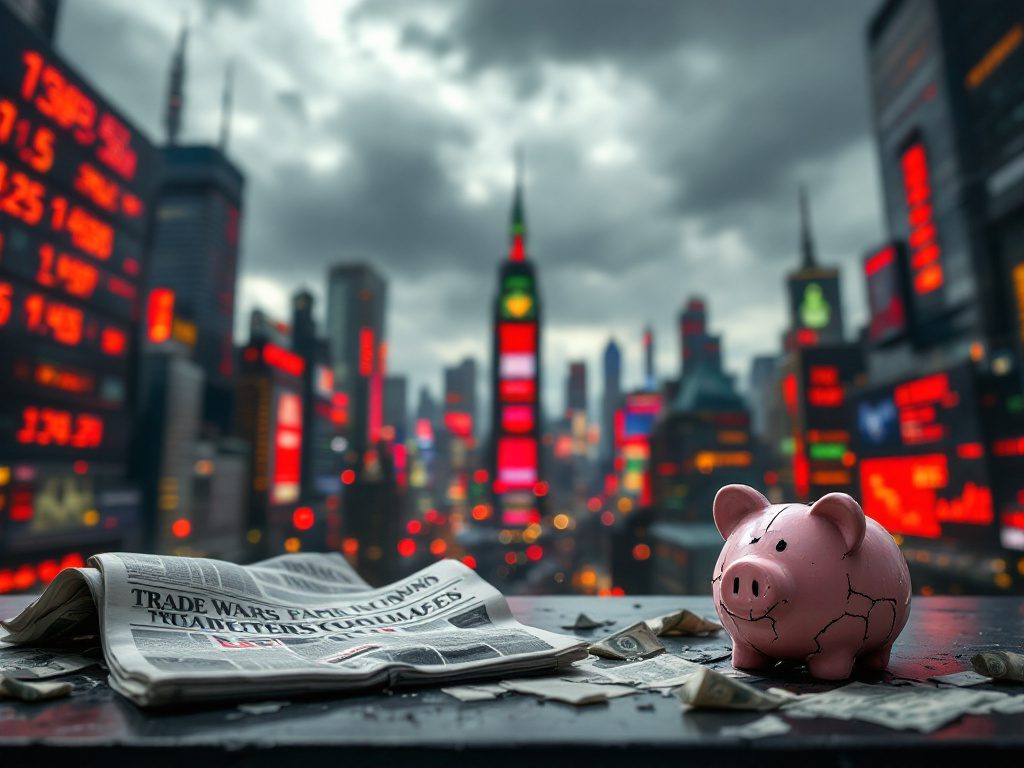
On a day many investors would rather forget, global stock markets suffered a devastating sell-off, highlighting deep-seated anxieties about the economic implications of the ongoing U.S.-China trade war. From Hong Kong to Mumbai, markets hemorrhaged value in scenes reminiscent of past financial crises, prompting questions about whether we stand on the brink of a broader global recession.
The Asian Market Meltdown
Hong Kong, a city known for its financial resilience, faced one of its worst trading days in nearly three decades. The Hang Seng Index plummeted a staggering 13.22 percent—the single deepest daily decline since the harrowing days of the 1997 Asian financial crisis. Blue-chip stocks like Hong Kong Exchanges & Clearing, Ping An Insurance, and China Life Insurance all recorded severe double-digit drops, shaking investor confidence to its core. For many investors, Monday’s crash was a rude awakening, highlighting how precarious global trading relationships are and how quickly fear can propagate amidst financial interconnectedness.
According to Alicia Garcia Herrero of Natixis, Hong Kong’s market serves as a uniquely accurate reflection of global investor sentiment toward China. “You cannot trade freely in China. You cannot short Chinese stocks. You can do all of that in Hong Kong,” Herrero stated. This freedom, she argues, makes the Hang Seng a particularly poignant barometer of global anxiety.
Across the Taiwan Strait, Taiwan’s stock exchange (TAIEX) did not fare any better, opening after a long holiday weekend to historic losses. The index suffered a record-breaking drop of 9.7 percent, with bellwether companies such as Taiwan Semiconductor Manufacturing Co. (TSMC), Foxconn, and MediaTek hitting their daily limit-downs. Taiwan, a pivotal node in global technology and semiconductor supply chains, felt acute vulnerability as investors rushed to offload stocks associated with trade-dependent revenues.
“To put this into context, previous retaliatory measures targeted less than 1 percent of China’s total imports. The magnitude of the last measures is unprecedented.” – Carlos Casanova, UBP
The Ripple Effects Extend to Mainland China and India
Markets in mainland China were hardly spared, with shares of major technology companies reeling amid escalating trade tensions. The Hang Seng Tech Index—itself an important gauge of investor appetites for China’s tech behemoths— suffered deep losses, as significant players like Lenovo and BYD Electronic fell drastically during midday trading.
Carlos Casanova, Senior Economist at UBP, highlighted the gravity of China’s retaliatory actions against U.S. tariffs, pointing out that the scope and scale far exceed anything in recent memory.This aggressive stance from Beijing includes the imposition of shrill tariffs and export controls on essential rare earth elements—a move designed to strike directly at key vulnerabilities within the U.S. technological and manufacturing sectors.
Beyond Asia, the contagion spread to India, with Mumbai’s Dalal street witnessing significant downturns. The BSE Sensex and Nifty50 both nose-dived more than 4 percent, wiping out more than 20 lakh crore rupees in market capitalization practically overnight. Major firms such as Tata Motors, Tata Steel, and Infosys felt the immediate impact, underscoring the global nature of the economic malaise sparked by trade hostilities. Automotive and technology sectors, already grappling with supply chain challenges, were hit particularly hard, bringing further uncertainty to a market that had already been showing signs of strain.
What Lies Ahead?
As global markets reel from Monday’s catastrophic trading session, the most pressing question remains—is this market crash a precursor to a larger global recession? Clearly, investor sentiment is at a tipping point, sensitive not just to the immediate effects of the trade war but also to broader uncertainties around global stability, inflationary pressures, and supply chain disruptions.
In response, governments and policymakers worldwide are expected to come under intensified pressure to mitigate further economic shocks. Taiwan, for instance, responded swiftly by unveiling an NT$88 billion (approximately US$2.66 billion) relief package aimed at supporting battered businesses, even as Taiwanese President Lai Ching-te reassured the public that no retaliatory tariffs would be enacted against the U.S.
Western economies, particularly the United States, find themselves in a precarious diplomatic balancing act. Any further escalation from either side risks deepening the economic gloom already casting shadows over major world markets. From an investor perspective, the hope for recovery lies in political and economic diplomacy that might stem the tide of tariffs and trade restrictions fueling market volatility.
History offers cautionary tales aplenty, reminding us that trade wars rarely have winners, only varying degrees of economic casualties. Whether world capitals heed these lessons and pull back from the brink may well determine if recent market turbulence proves merely a blip, or a harbinger of more profound economic challenges ahead.
