
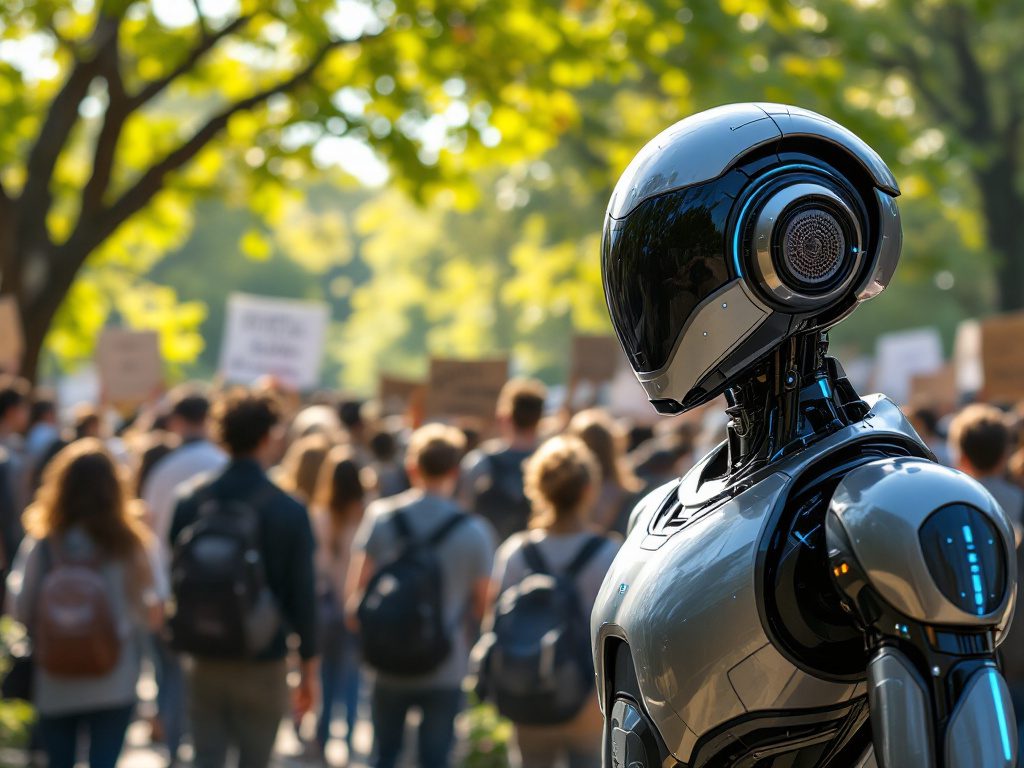
When the “College Protester” Isn’t Human: AI Enters the Front Lines
America has no shortage of storied protest movements, from campus sit-ins during the Vietnam War to last year’s demonstrations in response to the crisis in Gaza. What’s new, and deeply unsettling, is the presence of a new kind of infiltrator—not a plainclothes officer slipping into the crowd, but a lifelike, AI-generated persona deployed by police departments. According to recent reporting by 404 Media and WIRED, law enforcement agencies near the US-Mexico border, including Arizona’s Pinal County, are investing hundreds of thousands of dollars in a controversial technology called Overwatch. Developed by the New York-based company Massive Blue, Overwatch functions as an “AI-powered force multiplier,” creating virtual undercover agents that trawl social media and messaging apps to interact with—and potentially entrap—everyone from suspected traffickers to college protesters.
The scale and secrecy of this operation signal a seismic shift in policing tactics that places civil liberties at risk. At a recent Pinal County Board of Supervisors meeting, law enforcement officials sought approval for a $500,000 contract with Massive Blue. Despite the steep price tag, officials confessed the technology was still in the proof-of-concept stage, with zero arrests linked to its use so far. It’s a striking admission in a moment where, nationally, distrust in both AI and government surveillance is only deepening.
AI Undercover: From Criminal Networks to Campus Organizers
A closer look reveals just how far-reaching Overwatch’s ambitions are. The tool isn’t restricted to targeting drug traffickers or human smugglers. According to leaked internal presentations, its AI personas are meticulously crafted with elaborate backstories: there’s a so-called “radicalized protester,” a “body positive activist,” even a “honeypot” persona fluent in the Sanaani dialect of Arabic for drawing out foreign actors. Each virtual agent is programmed to navigate text threads, social channels, and private messages, all while masquerading as a genuine member of whatever group they seek to surveil.
This strategy isn’t just new technology—it resurrects old fears. As Harvard law professor Ronald Chen explains, “The use of AI-driven personas, especially to monitor constitutionally protected activities like protest, should chill every American who cares about civil liberties. There’s a difference between targeting traffickers and surveilling activists.” (WIRED, “Cops Employ AI Chat Bot To Entrap College Protesters”).
Law enforcement justifies investments like Arizona’s, arguing the border crisis and rise of trafficking demand technological solutions. What gets lost in this reasoning is the risk that AI will be used indiscriminately, blurring lines between legitimate law enforcement and the criminalization of dissent. History is replete with examples—from COINTELPRO targeting civil rights leaders to NYPD’s secret surveillance of Muslim communities after 9/11—where “innovative” security methods later became notorious for rights abuses.
“The use of AI chatbots by law enforcement to impersonate activists is a dangerous escalation—a high-tech echo of the darkest chapters of American surveillance history.”
Attorney Shirin Sinnar, an expert on national security and civil liberties at Stanford Law School, notes: “Software like Overwatch presents a potent mix of plausible deniability and anonymity for government actors, bypassing critical checks that usually apply when plainclothes officers go undercover.” With AI, there’s no need for a badge or a body—just a sophisticated codebase that can suss out organizers, bait targets, and undermine trust within already vulnerable communities.
The Slippery Slope: Entrapment, Privacy, and Political Policing
Beyond that, the lack of transparency and absence of proven results raise serious questions. Not one arrest in Pinal County has been tied to Overwatch, yet local officials pressed forward for more funding—mirroring a nationwide law enforcement fixation on purchasing cutting-edge tech before fully evaluating its ethical and constitutional consequences. The particulars matter. Overwatch isn’t merely gathering information about crimes in progress; it is designed to proactively interact, offering information or encouragement to suspects, raising the specter of entrapment.
The potential for abuse should give pause to anyone who values democratic protest as a check on government. Particularly alarming is the fact that Massive Blue openly pitches its product for “school safety” and “border security” while quietly integrating personas aimed at infiltrating college activist groups. Recent trends—like the Trump administration’s controversial revocation of student visas tied to Gaza protests—show just how quickly surveillance tools are repurposed from addressing criminal threats to suppressing dissent. (404 Media, June 2024)
Civil liberties advocates have been quick to raise alarms. The American Civil Liberties Union (ACLU) has warned for years that “AI surveillance makes it easier to target people based on race, religion, or political belief,” a concern now heightened by tools able to blend so seamlessly with digital communities. “Today it’s the border, tomorrow it’s your backyard,” says Georgetown law professor Alvaro Bedoya. “Unchecked, these systems become a tool not only for policing crimes, but for policing thought.”
The Road Ahead: Oversight, Accountability, and the Cost of Complacency
One might ask, What does meaningful oversight look like in an era when bots could be lurking in any group chat or social feed? Start by demanding that public funds spent on technologies such as Overwatch are subject to independent audits and civil rights reviews. Sunlight is the best disinfectant: transparency about how, where, and why these tools are used is essential.
History teaches us that surveillance powers given in a climate of fear rarely get rolled back without a struggle. Rather than passively accept so-called “force multipliers,” engaged citizens and lawmakers must insist on clear boundaries. The technology’s sales pitch may echo 21st-century buzzwords, but its underlying impulse—control first, question later—remains stubbornly old-fashioned.
In a moment when protests are once again reshaping American politics, it takes courage to stand up for the right to dissent, even as lines between virtual and real-world activism blur. The task ahead is not merely to critique Overwatch’s existence, but to push for a vision of public safety grounded in transparency, accountability, and respect for civil rights. Otherwise, the next time you see a sympathetic face in your protest group chat—you might wonder, is anyone in there really who they say they are?
