
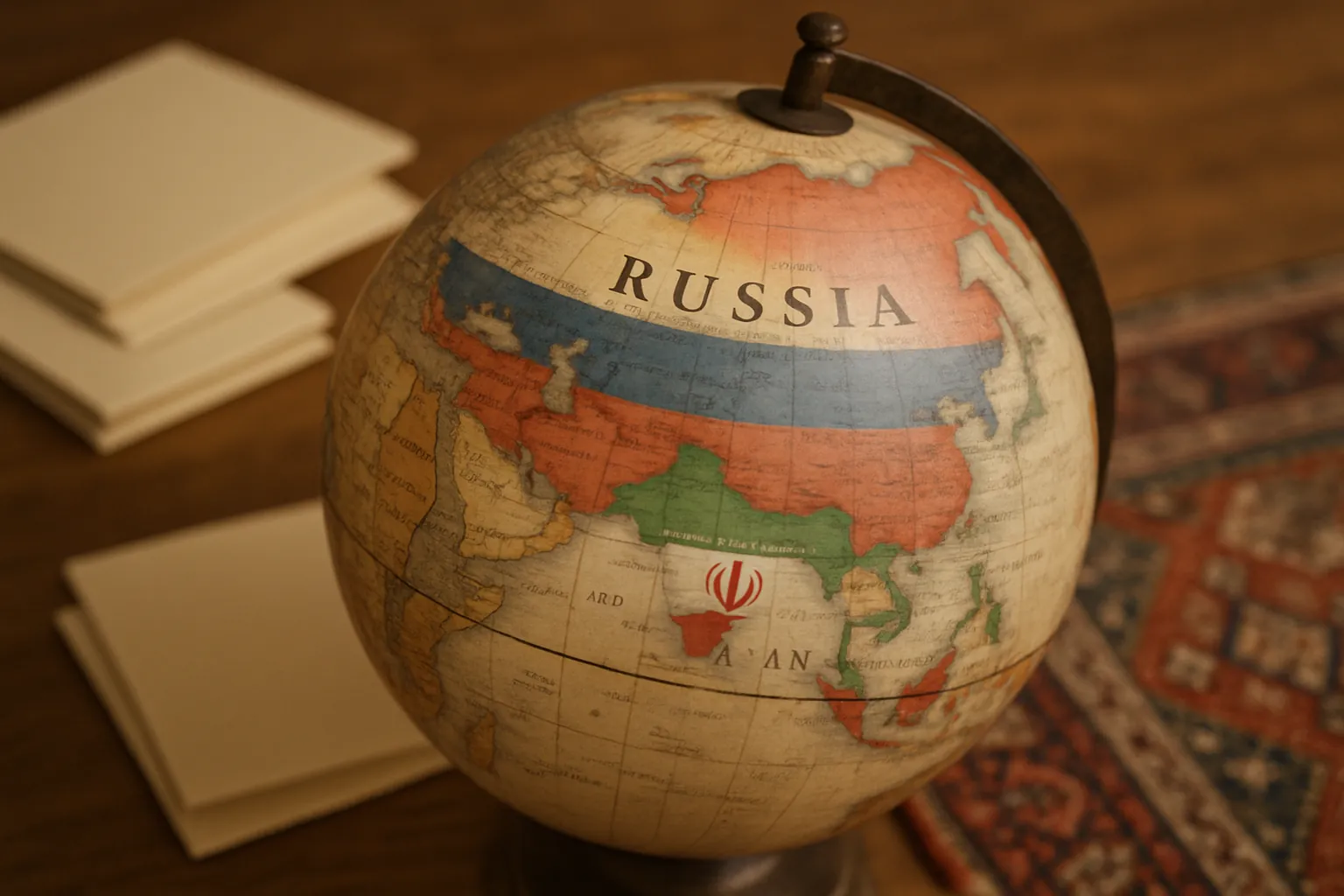
Strategic Partners in the Sanctions Age
The ascendance of Iran and Russia’s strategic partnership is rapidly remapping the contours of Eurasian geopolitics. This development comes at a time when both nations face mounting isolation and punitive sanctions from the West—a context that seems less like a coincidence and more like a calculated realignment. The announcement of Vladimir Putin’s impending visit to Tehran, his sixth official trip, is a headline, yet the deeper story lies in the complex, high-stakes collaboration between these two pariah states.
Consider the numbers: In 2024 alone, Russia became Iran’s largest foreign investor, funnelling nearly $5 billion into Iran’s gas sector as part of a sweeping $8 billion agreement. Iranian Ambassador to Moscow Kazem Jalali pointed to these investments not as mere transactional deals, but as “evidence of a new era of trust and interdependence.” Moscow’s cash is fueling more than just energy extraction—Russia is now a vital partner in constructing Iran’s Rasht-Astara railway, acquiring vast tracts of land, and spearheading wave after wave of cross-sector collaboration.
Why does this matter to you? The Iranian-Russian axis has global ramifications. A closer look reveals that Washington’s reliance on sanctions as a principal tool of foreign policy may have backfired. Instead of isolating, it has incentivized the world’s sanctioned powers to form countervailing alliances—alliances capable of undermining U.S. interests from Ukraine to the Middle East and beyond. Harvard historian Serhii Plokhy observes, “Every round of isolation pushes these regimes closer, giving them both incentive and necessity to innovate ways of resilience.”
Economic Integration: More Than a Marriage of Convenience
Surface-level analysis often frames Russia and Iran’s partnership as one of necessity, born of desperation amid global censure. Yet this narrative misses the substantial infrastructure taking root. The bilateral free trade agreement now extends to the entire Eurasian Economic Union (EAEU), setting favorable terms for both economies and smoothing the flow of goods otherwise blocked by Western restrictions.
The integration of banking systems—Russia’s Mir with Iran’s Shetab— not only helps circumvent SWIFT and the hegemony of Western financial institutions, but it also makes life tangibly easier for ordinary citizens: small businesses, students, and tourists are once again able to transfer funds, pay for services, and invest without fearing frozen accounts or punishing fees. Jalali boasts that student exchanges, trade fairs, and even medical tourism have ticked upward as a result.
For context, compare this with the Cold War era, when the Soviet Union and Iran charted separate, often adversarial courses. Those days are gone. The shared experience of isolation—both suffering under U.S.-led sanctions for, respectively, the invasion of Ukraine and nuclear policy defiance—has blurred former boundaries and created a uniquely pragmatic partnership. According to Carnegie Moscow analyst Alexander Baunov, “It’s not love that binds them, but shared enemies and mutual need—a durable, if precarious, foundation.”
“Sanctions intended to weaken have, paradoxically, made these regimes more resourceful—and more connected.”
Still, the economic symbiosis is not without long-term risks. Iran’s growing dependence on Russia may leave it vulnerable to shifts in Moscow’s priorities. If, for instance, Russia’s war effort in Ukraine reaches a tipping point, will Iran’s interests be preserved, or sacrificed? The test of this uneasy alliance will be whether cooperation can outlast the shared pressure of common adversaries.
Diplomacy, Security, and the Shadow of the West
Diplomatic coordination is extending far beyond trade and energy. During a recent Moscow visit, Iranian Foreign Minister Abbas Araghchi delivered a direct message from Supreme Leader Ayatollah Khamenei to Putin. At the heart of this correspondence: regional security, the fate of the Iran nuclear agreement, and the intractable crises of Syria and Ukraine. As Putin weighs his itinerary for Tehran, analysts speculate about the range of topics on the table—many of which run counter to Western interests.
It’s no secret the two countries have collaborated on the Astana peace process for Syria and stood shoulder-to-shoulder in multilateral venues opposed to Western interventions. With Russia now suggesting participation in new rounds of nuclear talks between Tehran and Washington—a detail revealed by former President Donald Trump—their ambition is clear: to rewrite the rules of international engagement, diminishing Washington’s ability to isolate and punish.
The consequences for regional stability and the global order cannot be overstated. The deepening Iran-Russia embrace casts a long shadow over already volatile areas, empowering both regimes to pursue objectives antithetical to democratic values. Ukrainian sovereignty, the right of the Iranian people to self-determination, and the broader principle of nuclear non-proliferation are all imperiled by Moscow and Tehran’s unshakable alignment.
Yet there is a lesson here for Western policymakers. Reflexive recourse to sanctions, without investing in robust diplomacy or offering avenues for reform, only entrenches adversarial states in ever-tightening alliances of their own making. As Columbia University’s Kaveh Afrasiabi notes, “You can fence out rogue regimes, but if the fence turns into a fortress, you’ve only made the task of reintegration harder.”
Can the United States and its partners adapt, finding ways to support democratization, address security dilemmas, and break the spiral of isolation? If not, expect the Iran-Russia compact to serve as a model for future axes of sanctioned states—all too willing to rewrite the international order on their own terms.
