
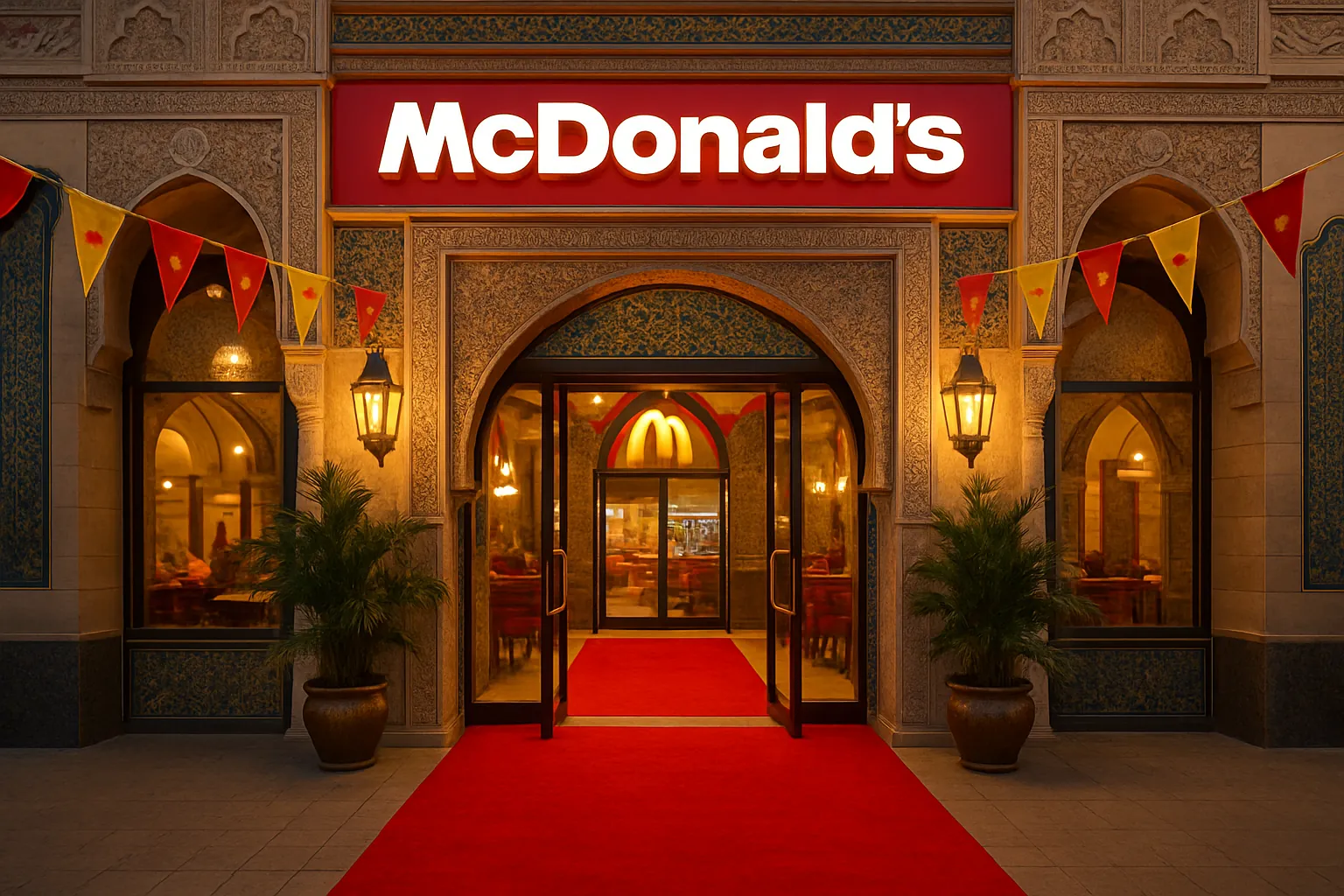
The Cheeseburger Diplomacy: Symbolism or Substance?
Among the many spectacles surrounding a US presidential visit to the Middle East, few are as oddly emblematic of modern politics as the sight of a two-story, custom-built McDonald’s truck basking in the Riyadh sun. For President Donald Trump, whose affinity for fast food has become something of a personal and political trademark, Saudi Arabia’s “mobile McDonald’s” felt less like quirky hospitality and more like a knowing wink to American pop culture.
On the eve of Trump’s arrival, Saudi officials had the double-decker food truck—branded in both Arabic and English—lined up outside the “Media Oasis” press center, where hundreds of journalists convened beneath neon screens boasting of mega-projects like the ambitious NEOM city and Saudi Arabia’s highly publicized bid for the 2034 FIFA World Cup. The truck, gleaming and air-conditioned, offered Big Macs and Quarter Pounders, but also patronized local tastes with Mini Kofta and McArabia Kofta stuffed into pita bread.
McDonald’s as diplomatic shorthand didn’t happen by accident. The Saudi reception for Trump was more than just pageantry: it was a performance staged for the cameras, the press, and ultimately, the world. The Crown Prince, Mohammed bin Salman, orchestrated every detail, from ceremonial airport greetings to American and Saudi flags furled across major Riyadh thoroughfares. According to the Washington Post, “giant video screens showed off Saudi construction projects like its futuristic NEOM city and its hosting of the 2034 FIFA World Cup.”
One might ask: Why the elaborate display of fast-food Americana amid serious discussions of defense deals and billions in investment? This was about more than burgers: it reflected both the Saudi leadership’s desire to flatter the sitting U.S. president and a diplomatic strategy dating back decades—appealing simultaneously to the leader and the iconography of American culture.
Of Big Macs, Political Theater, and Global Branding
A closer look reveals that customizing state visits for personal preferences is not as trivial as it appears. Trump’s reputation as the “Fast Food President” is rooted in both anecdote and reporting. According to biographer Michael Wolff, Trump’s penchant for McDonald’s is part culinary comfort and part calculated safety: food already made for the public is less likely to be tampered with, he once worried aloud to aides. Ferocious appetite or strategic paranoia? Either way, Trump’s brand is inexorably tied to the world of French fries and Filet-O-Fish.
This wasn’t a brand-new storyline for Trump. During his presidency, he notoriously served Big Macs and fries to championship athletes visiting the White House, even donning an apron during 2016 campaign stops. During the 2018 government shutdown, the White House briefly resembled a drive-thru window as Trump treated visitors to $3,000 worth of McDonald’s fare. Burger-based populism became a feature, not a bug—a symbol of his supposed everyman sensibility, despite his billionaire status. As Harvard historian Lizabeth Cohen has written, “Americans have long used consumer rituals to assert both equality and distinction; fast food is an accessible performance of shared taste.”
Yet, when foreign governments seize upon this motif, the layering of meaning grows more complex. For the Saudis, rolling out a mobile McDonald’s signaled both a willingness to accommodate U.S. tastes and a desire to showcase the Americanization of parts of Saudi society. As i24 News senior correspondent Mike Wagenheim observed during the visit, American franchises like Starbucks, Dunkin Donuts, and Krispy Kreme now dot the streets of Riyadh in numbers rivaling Western capitals.
But these acts come with risks. “Public displays of hospitality can easily slide into farce when courted without authenticity or sensitivity to context,” warns Carnegie Endowment analyst Yasmine Farouk. “While this McDonald’s truck was intended as a compliment, it also reinforced stereotypes about American culture and, arguably, about Trump himself.”
“If politics is often a game of symbols, then few images capture the current moment quite like a double-decker McDonald’s in Riyadh—a blend of fast food diplomacy, media choreography, and the very real power of American brands.”
Setting aside the spectacle, it’s difficult to ignore the calculated choreography involved. The “gift” was positioned outside the international press center, making it as much a prop for the global narrative as an actual meal for the president.
Culture, Power, and the Paradoxes of Soft Diplomacy
The politics of the mobile McDonald’s reveal an uneasy truth: symbols can disguise deeper imbalances and uncomfortable realities. The same visit that featured burgers and photo-ops also came with solemn pledges of multibillion-dollar arms sales and still-murky promises of economic “modernization.” According to the White House, the trip produced a Saudi commitment to invest up to $600 billion in the U.S., with further trade touted by Trump in subsequent stops across the Gulf.
Dissent and danger lingered beneath the Golden Arches. Saudi Arabia’s ongoing human rights challenges—from the continued restrictions on dissent to the unresolved murder of journalist Jamal Khashoggi—were rarely mentioned during the lavish welcoming events. “The Saudi leadership’s reliance on American imagery like McDonald’s conceals, rather than corrects, the gulf between public relations and lived realities,” argues Sarah Leah Whitson, former director at Human Rights Watch for the Middle East.
Liberal critics of Trump’s approach note the limits of transactional diplomacy centered on personal flattery and superficial spectacle. Senator Chris Murphy (D-CT) wrote, “We cannot allow weapons or investments to become a substitute for pressing real reforms abroad.” Such criticisms echo historical anxieties about U.S. foreign policy: glossing over undemocratic practices in favor of economic and security interests, especially when wrapped in the disarming language of hamburgers for all.
Yet, the mobile McDonald’s episode also reflects the odd, connective tissue that globalization provides. American franchises and images have turned up everywhere—from Moscow to Mumbai—and now, Riyadh. In some corners, this cultural convergence signals progress, a testament to shared tastes and the spread of cosmopolitanism. But for progressives who value equality and justice alongside diplomacy, the test is whether these partnerships deliver for the many, not merely the well-connected few.
Beyond that, questions remain: Will the U.S.-Saudi relationship truly evolve under the gloss of Big Macs and mega-deals? Or will photo-ops outnumber progress, with symbol substituting for substantive change? If so, America should demand not just its fries hot, but its foreign policy smart, just, and grounded in principle.
