
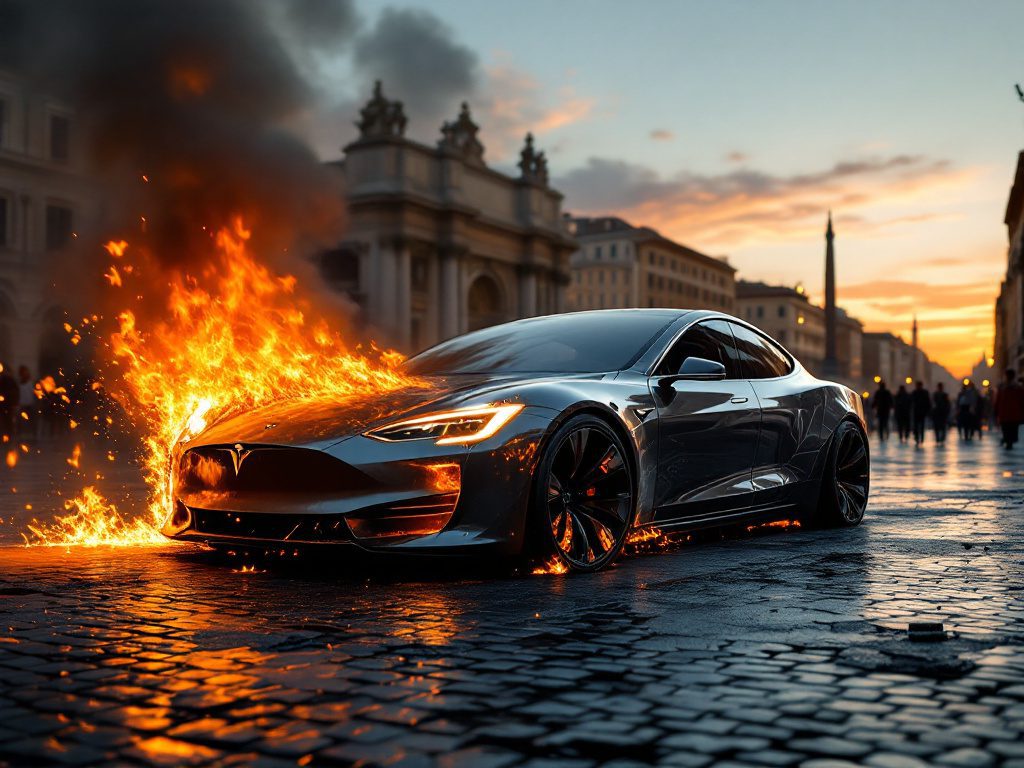
In the early hours of Monday, flames engulfed a Tesla dealership on the outskirts of Rome, leaving 17 new electric cars charred and destroyed. As the Italian authorities sift through ashes looking for clues, suspicions of arson loom large, placing this incident as the latest in a troubling series of actions targeting Tesla amid mounting global resentment.
The Fire Reflects Larger Anti-Tesla Sentiment
The destroyed Teslas were awaiting customers, amplifying the financial and symbolic blow. These devastating images come as Tesla continues to grapple with backlash spurred by CEO Elon Musk’s outspoken political opinions and business strategies. Musk’s increasingly polarizing reputation, especially regarding his associations with the former Trump administration, has sparked angry protests in multiple countries, marking Tesla and its products with controversy rather than prestige.
This broader dissatisfaction has materialized in stark actions: vandalism of Tesla vehicles in other parts of Rome with black spray paint, fierce demonstrations across the U.S. including more than 400 protesters gathered outside a Tesla location in Ann Arbor, Michigan, and perhaps most concerningly, episodes reminiscent of the Liberty City riot models against corporate overreach during the 1980s.
In response to the Rome fire, Musk himself conveyed his consternation, describing the violence against his company as “insane and deeply wrong.” Reflecting publicly, he questioned whether any modern corporate entity has faced such coordinated hostility.
But, as history has demonstrated—in past corporate backlashes against companies such as Nike or Starbucks—politics can translate into consumer actions with long-lasting brand implications.
Connecting the Dots: Political Actions Stir Controversy
The recent violence against Tesla fits into a disturbing trend tied to ideological conflicts. Reports indicate that targets are not randomly picked; rather, they reveal the depth of anger against Elon Musk’s perceived meddling in political spheres. By aligning himself overtly with global right-wing figures, Musk has unintentionally turned his innovative brand into a target. Tesla showrooms from Toulouse to Las Vegas have witnessed unsettlingly similar scenes, with burned-out cars, vandalized facilities, and defaced logos becoming alarmingly common.
Particularly in Europe, Tesla’s sales have sharply declined, plummeting by 49% in just the first two months of this year as broader electric vehicle adoption rises sharply continent-wide. Analysts suspect political protests have contributed significantly to this erosion of market confidence. Some see the physical destruction of vehicles as merely the visible peak of deep-rooted anxieties about corporate power and political complicity.
“When corporations and their leaders tiptoe into the treacherous waters of politics,” notes historian Dr. Laura Calvino, “They risk alienating broad portions of their consumer base in ways difficult to recover from quickly.”
Tesla’s global operations appear particularly vulnerable to flare-ups that blend anti-corporate demonstrations with political ideologies—a potent combination with measurable impacts, including both lost sales and damaged investor confidence. Indeed, Tesla’s stock price suffered substantially, plunging after the Rome fire was first reported. This decline symbolizes broader investor unease about associating too closely with a brand becoming synonymous with political unrest.
Lessons From the Blaze: Brands Are Not Immune from Consequences
The implication of this destructive act transcends straightforward economic damage; rather, it symbolizes the increasingly fraught relationship between corporations, their executives, and the political and ethical values of consumers. Protests demanding Musk’s separation from influential political roles underscore the urgency of calls for corporate accountability and non-partisanship in business leadership.
Consumers, particularly progressive purchasers of electric vehicles, may choose competing EV brands more congruent with values of diversity, equity, environmentalism, and social justice. Historically, consumer boycotts and brand backlash profoundly impacted companies like Uber and Chick-fil-A, forcing leadership changes or revised corporate policies in response to consumer demands rooted in social ethics.
Today, Tesla finds itself at precisely such a crossroads. If Musk continues down a path that antagonizes large segments of potential consumers, the innovative positioning and forward-looking ethos of Tesla—the very aspects that initially galvanized loyal customers—could erode irreparably.
Ultimately, every corporation, no matter how technologically advanced or visionary, operates within a community that perceives and judges its behavior. This recent blaze, regardless of its ultimate cause, starkly symbolizes the mounting costs of aligning too closely with contentious politics. Companies that prioritize progressive principles—like social responsibility, equity, inclusion, and planetary care—often experience consumer support rather than backlash.
Tesla, now more than ever, faces crucial decisions: to continue as a lightning rod for divisive politics or to dedicate itself unequivocally to creating innovative solutions that unite, inspire, and earn broad social acceptance. For Musk himself, this is an opportunity not merely for brand damage control but crucially for deeper reflection on the powerful interplay between personal politics, corporate responsibility, and global consumer citizenship.
