
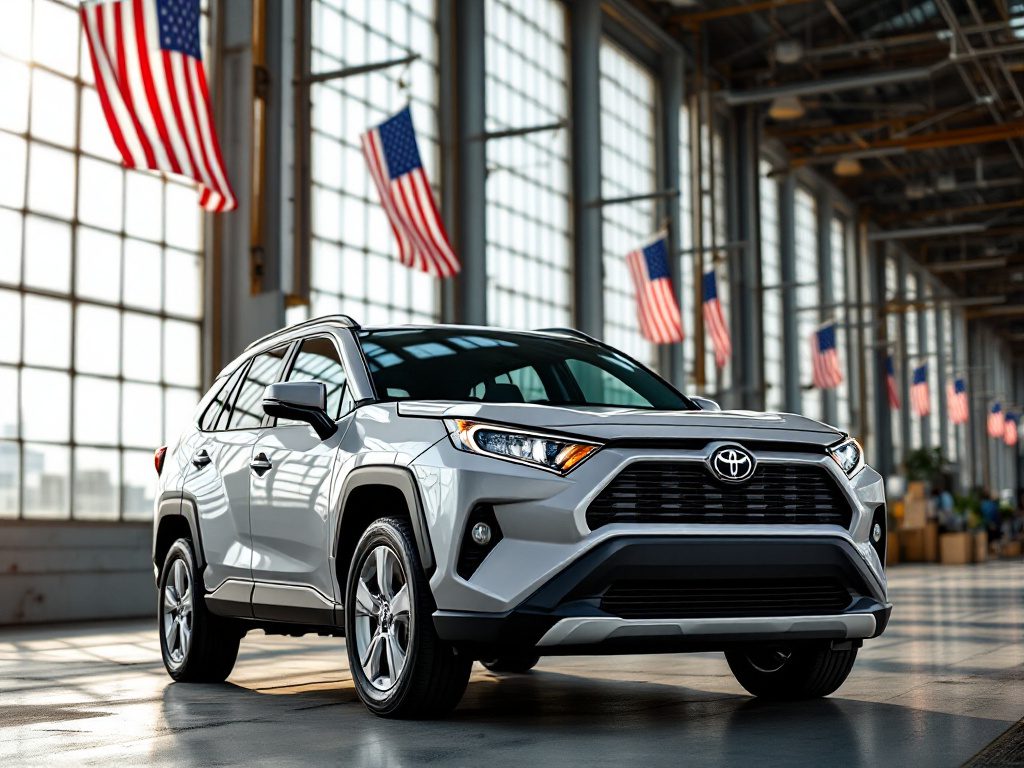
Tariffs and Uncertainty: The Pressure on Global Automakers
Imagine buying a new car, only to discover a sudden price hike driven by global politics. Trade wars, tariffs, and geopolitical chess—these may feel like far-off battles, but for American workers and consumers, they’re playing out right in the auto lot. The latest example? Toyota, the world’s largest automaker, is seriously weighing an expansion of U.S. production for its top-selling RAV4 SUV. This shift is a direct response to punishing 25% tariffs on imported vehicles, a legacy of the Trump administration’s heavy-handed trade strategy that many say continues to squeeze global supply chains.
The RAV4 isn’t just another SUV. According to data from Motor Intelligence, it was the top-selling vehicle in America last year, even outpacing the vaunted Ford F-150, with more than 475,000 units sold. This single model accounted for about one-fifth of Toyota’s American vehicle sales. For a brand that prided itself on global integration, the pressure to move production to Kentucky is a remarkable pivot. Behind the scenes, sources familiar with the matter say Toyota’s leadership is motivated not only by tariffs, but by the volatility of the Japanese yen and a rapidly changing U.S. consumer market.
Trade wars have consequences far beyond Wall Street boardrooms. Each new tariff ricochets down the supply chain, impacting jobs, prices, and choice for American consumers. As President Trump’s tariffs on imported cars persist, major manufacturers are scrambling to reconsider sourcing and assembly strategies. Toyota’s North American plants currently build about half of the 2.3 million vehicles they sell in the U.S. Now, looming changes to the RAV4’s production—potentially as soon as 2027—signal a turning point for the entire industry.
Who Wins, Who Loses: Jobs, Prices, and Global Ripples
Toyota’s official statements stress the company’s “commitment to providing stable employment” for U.S. workers. Corporate responsibility, after all, is a point of pride for a company that already staffs 11 factories across the country. Yet beyond the press releases lies a more complex truth. Americans may welcome new jobs at an expanded Kentucky plant, but other ripple effects can’t be ignored.
History shows that tariffs rarely deliver their intended benefits. The 2002 U.S. steel tariffs, for instance, were credited with saving thousands of steel jobs, but according to a Policy Analysis from the Cato Institute, they cost the broader U.S. economy approximately 200,000 jobs in related industries. The auto sector risks repeating this cycle: protecting a sliver of manufacturing at the cost of higher consumer prices, supply chain chaos, and a patchwork of uncertain, short-term gains.
Honda—another Japanese giant—has already redirected production of its Civic hybrid to Indiana rather than Mexico, a move also spurred by punitive tariffs. As Mary Lovely, senior fellow at the Peterson Institute for International Economics, recently told NPR, “Tariffs don’t keep jobs at home without consequences. They make it more expensive for everyone.” The scramble to localize doesn’t just mean more U.S. jobs; it also means costlier cars, new logistical headaches, and rising prices at the dealership.
“Tariffs rarely deliver their intended benefits. Protecting a sliver of manufacturing at the cost of higher prices, supply chain chaos, and uncertain, short-term gains is no way to ensure sustainable prosperity.”
— Policy Analysis, Cato Institute
The RAV4 story isn’t happening in a vacuum. Swiss pharmaceutical company Novartis and robotics leader ABB have also expanded stateside operations to hedge against tariff risk. Each headline tells the same tale: corporations scrambling to keep costs in check, sometimes at the expense of global partnerships and worker security abroad. For Toyota, the stakes are transformative—Kentucky workers could benefit, but Canadian autoworkers might have reason to worry about future cuts, even as Toyota publicly promises stability.
The Bigger Picture: Nationalism vs. Global Cooperation
The auto industry’s scramble to localize production is a vivid example of how economic nationalism runs counter to collective well-being. By forcing companies to reconfigure supply chains within artificial national boundaries, tariffs mirror the same isolationist logic that has haunted global progress in the past. The Smoot-Hawley Tariff Act in the 1930s, for example, is widely credited by economists (see Douglas Irwin, “Peddling Protectionism”) with deepening the Great Depression through retaliatory trade barriers.
Modern automaking depends on tightly woven, international supply networks. President Biden’s administration has sent mixed signals on trade, occasionally rolling back tariffs on some goods while leaving others in place. The fate of the RAV4—and the broader U.S. auto industry—hangs on these political calculations. According to a recent Pew Research study, a majority of Americans now support global engagement over America-first policies, recognizing that prosperity is built on cooperation, diversity, and shared technological advances.
Faced with protectionist pressures, Toyota may choose cost control rather than simply raising sticker prices, hoping to shield customers from immediate pain. But as Harvard economist Dani Rodrik notes, “No nation can produce everything efficiently on its own. Attempts to do so often result in waste and lost dynamism.” Behind every headline about reshoring lies a cautionary tale of economic inefficiency and missed opportunity. Progressive policy, in this context, demands smart partnerships, reimagined trade rules, and a renewed commitment to an economy that serves all—not just those lucky enough to live and work near a newly built car plant.
You might ask: Should American economic health be measured solely by the number of factory jobs inside our borders, or by the affordability and accessibility of high-quality goods for everyone? The debate around the RAV4’s production is larger than Kentucky—it’s a reminder that when policymakers weaponize trade, everyday families pay the true cost at the register.
Toward a More Cooperative and Fair Auto Market
A closer look reveals that shifting SUV assembly from Canada or Japan to Kentucky will not address the underlying vulnerabilities in the global auto industry. Resilient supply chains depend on a combination of local jobs and strong international ties. As Toyota and its peers adapt to today’s mercurial political winds, progressive leaders should champion policies that encourage both inclusion and innovation—rejecting simplistic answers in favor of solutions that benefit consumers, workers, and the planet.
America’s future shouldn’t be held hostage by tariffs that stifle competition and choke off opportunity. As the auto industry’s ongoing transformation unfolds, let’s prioritize collective well-being, invest in the communities most at risk, and embrace the complicated but rewarding work of real global cooperation.
