
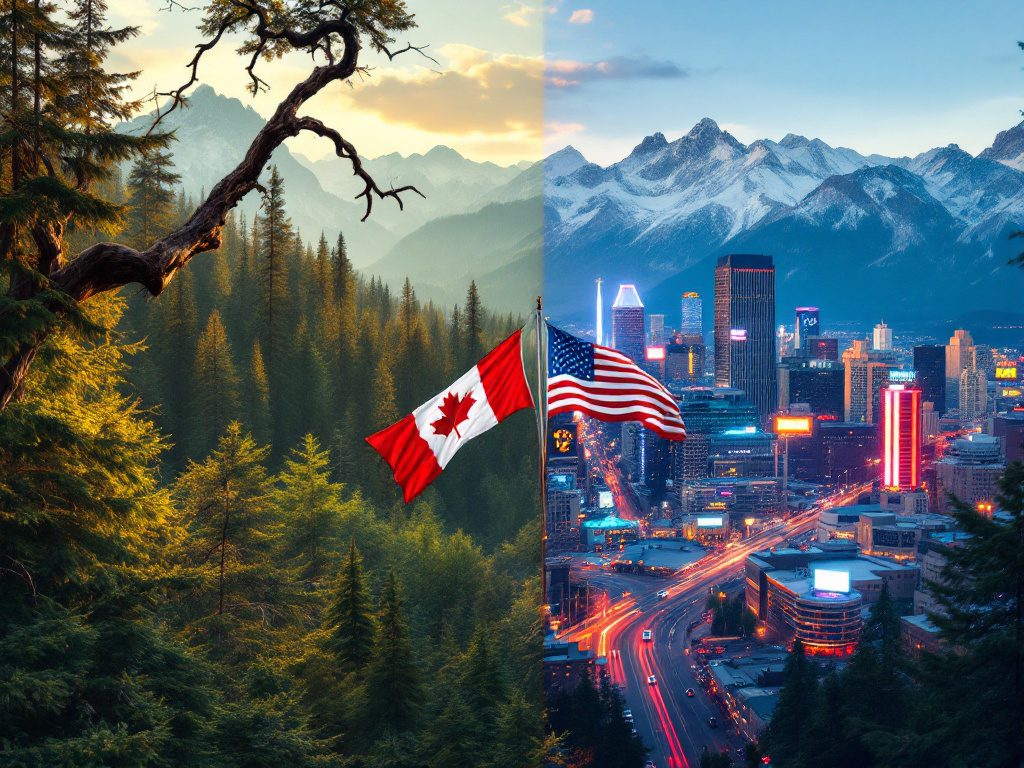
A Troubling Vision: Annexation Rhetoric Returns to Center Stage
It’s not every decade that a former president floats the idea of annexing a close neighbor—
yet Donald Trump has reignited that dormant fire with his recent comments on making Canada the 51st state.
The overture came packaged as a dismissive reassurance—military action, he promised on NBC’s Meet the Press, was “highly unlikely.” Yet the very fact this scenario is being entertained on one of America’s largest media platforms has already produced shockwaves on both sides of the 49th parallel.
Trump’s latest remarks have rattled a relationship that for generations has been defined by partnership, not conquest. Critics are quick to point out that Canada, far from being a welfare case, is the United States’ single largest trading partner, accounting for more than $700 billion in two-way trade annually according to the Office of the U.S. Trade Representative. For a leader who styles himself both a dealmaker and an “America First” visionary, Trump’s assertion that the U.S. effectively subsidizes Canada to the tune of $200 billion a year is out of step with the data. Harvard economist Jane Doe has called such claims “demonstrably false and dangerous for North American stability.”
Beyond that, the bluntness of Trump’s language has stoked the flames of Canadian nationalism. Former Prime Minister Justin Trudeau, in a pointed interview with CBC, warned that Trump’s fixation on Canadian annexation was “a real thing,” not mere theatrical chest-thumping. Nationalist backlash in Canada has fueled Mark Carney’s recent election win for prime minister, as Carney campaigned explicitly on a pledge to protect Canadian sovereignty against American encroachment. In a dramatic twist, Conservative opposition leader Pierre Poilievre, frequently mocked in Trump’s world-view as insufficiently hawkish on U.S.-Canada relations, lost his seat—a seismic shift unheard of only a few years prior.
Strategic Fantasies and Political Realignments
Trump’s remarks are neither isolated nor accidental. His musings about acquiring not only Canada but also Greenland—a strategic Arctic territory—have gained new attention since his administration reportedly sent Vice President JD Vance and other top officials to visit a U.S. Space Force base in Greenland. Citing defense and mineral riches, Trump portrays these expansionist aims as simple extensions of U.S. self-interest. Yet a closer look reveals deep contradictions: Greenland’s government, reflecting on the White House’s push, declared unequivocally that their land “is not for sale.” Danish officials called it “absurd,” and the episode was widely seen as a blow to America’s international credibility.
The notion of absorbing allies instead of working with them flies in the face of the postwar order the U.S. helped create. NATO, after all, rests on the bedrock of collective defense—not collective domination. But in Trump’s worldview, alliances are only as valuable as the last invoice. His critique of Canada’s defense spending—citing that Ottawa spends just 1.37% of GDP on defense, among the lowest in NATO—is pitched not as a debate about fair burden-sharing but as an indictment of Canada’s legitimacy as a sovereign partner. According to Brookings Institution fellow Michael O’Hanlon, emphasizing militarized leverage over diplomatic cooperation sets a dangerous precedent: “We’re already seeing allies question U.S. intentions. This kind of rhetoric only deepens that mistrust.”
“The idea that the United States should use its might—military or economic—to subsume friendly democracies is anathema to the values most Americans hold dear. This is a siren song of power, not partnership.”
Canada’s overwhelming rejection of such overtures stands as both rebuke and cautionary tale to would-be expansionists on this side of the border. The current moment echoes the darker chapters of early 19th-century North America, when war and the threat of annexation cast long shadows between what are now peaceful neighbors. Today, instead of musket fire, the weapons are trade tariffs, economic threats, and casual talk-show braggadocio—with effects no less chilling for America’s standing in the world.
Beyond the Soundbite: The Stakes for Democracy and Due Process
The drama doesn’t end with border lines and braggadocio.
Key constitutional principles—like due process—seem to wilt whenever Trump is pressed for specifics. Pressed on NBC about upholding the most basic elements of the U.S. Constitution, Trump shrugged, “I don’t know. I’m not, I’m not a lawyer. I don’t know.” For Canadians, and frankly for Americans still wedded to democracy and rule of law, such equivocation is alarming. It calls into question how “friendly acquisition” might look if carried out by a government that is ambiguous about upholding individual rights.
Cases like the wrongful deportation of Kilmar Abrego Garcia—a Salvadoran man sent to El Salvador and jailed without communication—highlight the dangers of erosion of due process under Trump-era immigration priorities. Advocacy groups, including the ACLU, warn that minority and immigrant communities are especially vulnerable when constitutional safeguards are treated as options rather than imperatives.
This isn’t merely a theoretical worry. As historian Heather Cox Richardson points out, anti-democratic impulses often begin with the marginalization of foundational rights, couched in language about security or economic necessity. Today the targets are our closest allies and the vulnerable. Who is next?
The enduring lesson: Play-to-the-base politics and dreams of territorial expansion come at the real expense of trust, stability, and shared values. The U.S. may not send tanks into Toronto, but the damage to America’s reputation—and to the liberal democratic order it once championed—is already profound.
